Dear readers,
With the publication of this issue, we reach a milestone: our 30th issue of Sight Line and our third issue devoted entirely to the arts and creativity.
At The Covenant Foundation, we have deep respect for artists and an abiding passion for projects that combine Jewish learning with creative pursuits. In this issue, you’ll read about how theater, visual art, and music can help learners consider and redefine community, deepen Jewish identity, access texts in new ways, engage meaningfully in prayer, and more.
The past month has incredibly difficult for us all and we are still reeling from the shock of the atrocities committed on October 7th in Israel. The ensuing war has brought with it harsh and frightening realities that our friends, family and colleagues in Israel must face. We feel their grief, we feel their fear, and we understand their anger as we try to process our own feelings. We also feel the sadness of the loss of innocent life in Gaza. We can hold both these things at once.
College students around the United States have found themselves on the front lines. They are frightened, angry and many are at a loss of what to do when their friends and fellow students shout at them and in fact become violent. We will help them regain their footing and their power but the shock is all encompassing. We are so deeply grateful for the unfailing devotion and commitment of all the educators teaching in Jewish institutions. They are our heroes.
I recently sat with two multi-talented day school educators who are also past Pomegranate Prize recipients, Natan Kuchar and Oren Kaunfer. As we were discussing what they might perform at this year’s Covenant Awards Dinner, they both said what is so true: Sometimes there just are no words. We decided that only the power of a niggun, (a wordless song sung as a means of elevating the soul) in which all of our voices would be raised together, could display the strength, beauty and necessity of community in all days but ever more so in this time. I hope you have the community you wish to have around you so that you may gather the strength we need in such times as these.
Finally: in this issue you’ll note the vibrant illustrations by Noa Mishkin, an Israeli artist living in Jerusalem. This is Noa’s Sight Line debut, and we hope to feature much more of her stunning work in future publications. I hope that you will enjoy her art and the articles collected here, and that some of what you see and read will lift your spirits and inspire you to create new opportunities for learning for you, your family and your students.
Joni Blinderman, Executive Director
_________________________________________________________________________
Read more from Joni Blinderman, in Sight Line:
Finding inspiration as we look ahead (Sight Line, March 2023)
Reflections for the New Year, on the value of connection (Sight Line, Sept. 2022)
A moment to reflect: Nurturing toward a better future (Sight Line, March 2022)
During good times and bad, in war and in peace, art and storytelling sustain us as individuals, communities, and nations. The Shabbat Torah readings, among the world’s longest continual ritual performances, have given form and texture to the collective Jewish experience, keeping us on “the same page.” The Passover seder, a feast of storytelling and curated food and ritual, provide an embodied, intergenerational experience that transcends history and religion. And while individual aesthetic experiences animate the Jewish experience, it’s the collective nature of Jewish creative expression that has sustained us as a people.
Enter theatre dybbuk. Inspired by the ghost myth of Yiddish culture, and the S. Ansky play that revolutionized Jewish theater, theatre dybbuk is a living, breathing community of theater-makers who have been inspiring and supporting Jewish communities since 2011. Based in Los Angeles, under the guidance of Artistic Director Aaron Henne, the company develops original material designed to investigate Jewish ideas, and support story- and performance-based community learning.
In 2023, as part of a Covenant Signature Grant, theatre dybbuk began a series of multi-community residencies called The Dybbukast Live, with stops in San Diego, the Bay Area, Baltimore, Atlanta, Portland, Oregon, Montreal and Seattle. As part of their offerings, they will present an original, radically re-imagined version of Shakespeare’s The Merchant of Venice, interweaving the original text with references to contemporary politics, and the ever-present, ever-shifting scourge of antisemitism.
In each residency, the performance is accompanied by a combination of community conversations and professional development for educators, based on community needs and input.
“Our performance work is designed to be a vessel in which Jewish history, thought, and experience helps us grapple with the complexity of our world, including issues of belonging, power, identity, and subjugation,” Henne explained. theatre dybbuk’s bold, dynamic, sometimes raucous vibe evokes Judaism’s “history of wrestling with ideas, and creates space for us to live with that complexity. And to get comfortable with discomfort.”
With several original performances in their repertoire, and having already worked closely with 100 Jewish community organizations, theatre dybbuk has found a template for rigorous and robust cultural engagement, while making space for people no matter their level of Jewish background, or their political or social ideals.
To that end, said Henne, “we are interested in using Jewish history as an entry point to invite in a diversity of audience members to match the diversity of our ensemble, which also includes people who are Jewish and not. Our most successful events are when we have that diverse audience.”
For the Bay Area and San Diego, two communities where theatre dybbuk has completed its residencies, the impact has been profound.
“Aaron and the company brought a way of exploring Judaism through arts and culture that we have never seen in San Diego before,” said Jenny Camhi, who runs The Hive at Leichtag Commons. Camhi described The Hive, now in its ninth year, as the “R & D” arm of the Leichtag Foundation, which supports Jewish programming in San Diego and Jerusalem. The Hive’s goal of “radically experimenting with how arts and culture and Jewish community can intersect” was a perfect fit for theatre dybbuk’s full-service model.
Todd Salovey, who just finished his 30th year as director of the Lipinsky Family San Diego Jewish Arts Festival, noted that “we had long wanted theatre dybbuk to be part of our festival.” With the 2019 terrorist attack on the Poway Chabad still fresh, said Salovey, the presentation of an updated The Merchant of Venice — complete with literal dog whistles — created space for people to re-experience the way antisemitism lingers and festers, “even when people aren’t calling you names on the street.”
Tova Birnbaum, Director of Jewish Content at the Oshman Family JCC in Palo Alto, was also eager to work with theatre dybbuk. With a theater background herself, Birnbaum understood that “theater is a way to surface topics, and to embody issues that words sometimes can’t.” With more avant-garde theater like Henne’s, the value of the experience moves closer to ritual. In both cases, “you’re not supposed to literally understand everything. It’s not only an intellectual experience.”
Up the road in Berkeley, theatre dybbuk collaborated with both JCC East Bay and UC Berkeley’s Magnes Collection of Jewish Art and Life, for a performance and talk-back at the Magnes. Following the performances, Sarah Wolfman-Robichaud, Director of Community Engagement, noted that the experience was everything great theater is supposed to be, “bringing us into conversation and connection. We turn to theater, in the end, to discover things about ourselves.”
Perhaps just as important as the residencies’ public performances are the professional development workshops. Birnbaum, at the Oshman Family JCC, called them “simply extraordinary,” with Henne’s storytelling and writing-based exercises “creating opportunities for collaboration among colleagues across the region that simply hadn’t happened before.”
“Arts-based experiences, be they performative, visual, or otherwise, are at the center of our engagement with the world,” Henne wrote in connection with a 2020 talk he gave at the Oshman Family JCC in 2020, entitled “Is Art the Future of Jewish Practice?” “And yet, in our Jewish communities and society in general, we often view arts as a secondary means through which we can achieve educational or ritual ends.”
Dr. Miriam Heller Stern, National Director of the School of Education at Hebrew Union College - Jewish Institute of Religion in Los Angeles and founder of Beit HaYotzer/the Creativity Braintrust (which received a Covenant Signature grant in 2019), wrote a paper on theatre dybbuk’s pedagogy and methodology along with sociologist Tobin Belzer. In that article, “The Past as Portal to the Future,” they posit that what theatre dybbuk models — in what it creates, how it creates it, and how it uses it onstage — is a different kind of Jewish learning, “whose goal is not to know but to grapple, not to master but to generate questions, not to clarify but to complexify.”
A melding of that questioning and that artistic beauty is just what Henne hopes his work might evoke.
“What would our future look like if artistic opportunities and all the beauty and complexity they offer were part and parcel of our Jewish lives?” Henne asked.
It seems theater dybbuk is on the road to find out.
By Dan Schifrin
Eliana Light’s life has always been filled with song. She grew up in a joyous Jewish home, where she and her family would sing all throughout Shabbat dinner each week. The daughter of a Conservative rabbi and a Jewish educator, Light loved going to synagogue and learned to lead services from a young age. As a child, she made up songs constantly, writing down her first Jewish song in fourth grade.
Light never stopped songwriting, but by the time she was in college, she had mostly stopped singing—until senior year, that is, when Michael Kates, of The Baal Shem Tones, reached out to Light and invited her to teach and sing at the NewCAJE conference. After performing at this gathering, many Jewish educators asked her where they could find her songs to use in their own settings. Then, months later, performing artist Jon Adam Ross, executive director of 2015 Covenant grantee The In[HEIR]itance Project, invited her to serve as Rosh Shira at Camp Ramah Wisconsin. In preparation for this newfound role, Light attended Hava Nashira, an annual songleading and music conference that brings together Jewish educators, songleaders, and community members to share the best thinking around worship and communal singing. It was through these formative experiences that she discovered that Jewish education, combined with singing and songwriting as her primary tools, could be a real career path.
Light went on to earn her master’s degree in Jewish Education from The Jewish Theological Seminary and taught at multiple synagogues across New York City. Then, in 2021, she founded The Light Lab, which received a Covenant Ignition Grant to support the T’fillah Teacher’s Fellowship program. At a time when many Jews—both children and adults—struggle to connect with prayer, The Light Lab provides professional development, an array of classes, and individualized consulting, all designed to support educators in making t’fillah (prayer) accessible and meaningful to all seekers.
Through The Light Lab, one of the main ideas Light teaches is that being a song or prayer leader is about relinquishing control.
“Just like a party planner’s job is to make it possible to have fun, but they cannot guarantee every person’s experience, there are so many choices I have as a prayer leader, and those choices can make it more or less likely that someone will have a meaningful prayer experience, but in the end, it's not a guarantee,” said Light.
Light herself always chooses to begin with the language of invitation when embarking on singing with a group. When you start with an invitation, it changes the tenor of the entire room, because people feel that they can bring their full selves to the space.
“Everybody is bringing [something on their minds] with them, so it’s an acknowledgment that we are not going to ignore those things, but we can invite people to set them down for a moment and take that deep breath,” Light explained. “It’s also about spiritual accessibility. By inviting people into a feeling, we’ve given them the key for this [particular] t’fillah—to use with or without the words.”
The language of invitation also creates space for people to feel safe enough to be vulnerable. After all, an invitation can always be declined. Many people are not comfortable singing because it has become so professionalized. However, Light insists that everyone can sing, and that making music is not just for professionals. “Music and song are meaningful tools for everyone who is called to that particular art,” she said.
While some may be hesitant to join in, Light says that, more often than not, her invitation is accepted and people sing along with her. And when people sing together, that’s when the magic happens. Singing together helps us feel connected on a deeper level—and reminds us that we aren’t alone.
Despite frequently being practiced communally, t’fillah is, of course, also a deeply personal spiritual practice. “Part of my ‘t’fillahsophy,’” Light said, “is that the words of the liturgy and the accompanying melodies are attempts to access an inner experience, which we get to have collectively. T’fillah allows us to look both inward and outward at the same time.”
Song has the power to bring us into the present moment and into ourselves, and gives us an instantaneous connection to that which is ineffable.
“Music and melody can reach to a deeper emotional place than words alone,” noted Light. “That’s what connects [song] to t’fillah—prayer is putting a divine experience into words, but failing. It’s that feeling of being beyond words.”
Music has a temporal quality as well, in which it connects us both to a specific time but also opens space for timeless moments. For instance, when we sing the Avinu Malkeinu (Our Father, Our King) prayer each year on Rosh Hashanah and Yom Kippur, it connects us to all the other times we’ve sung the prayer before, but also enables us to feel something new in the moment.
“Singing brings you into your body,” Light reflected. “Through t’fillah, we give ourselves permission to feel and music can facilitate that feeling. It can help us feel through the challenging things in our lives instead of ignoring them.”
At a time when there are so many challenges and so much darkness in the world, it’s uplifting to hear the joy in Light’s voice as she expresses her gratitude for the work she gets to do. “I can't believe this is my job,” she said, “How did this become my job? It’s the best thing ever.”
Looking back on her career thus far, there is a particular moment that stands out because of the way it brought together all the key elements—community building, spiritual nourishment, and social-emotional learning—that have inspired Light to make this her life’s work. That meaningful moment was back in February 2020, when no one knew what was coming later that year. Light was on the educator team of Songleader Boot Camp, a national Jewish songleading conference. When all the t’fillah leaders gathered in a black box theater in a round, Light led them in song. Those prayer leaders, who are usually holding a significant weight of responsibility, were able to take a step back and just be in the present moment. “Everyone had a chance to be held and let go,” Light said. “It felt like a highlight of my professional life to hold that space for the community.”
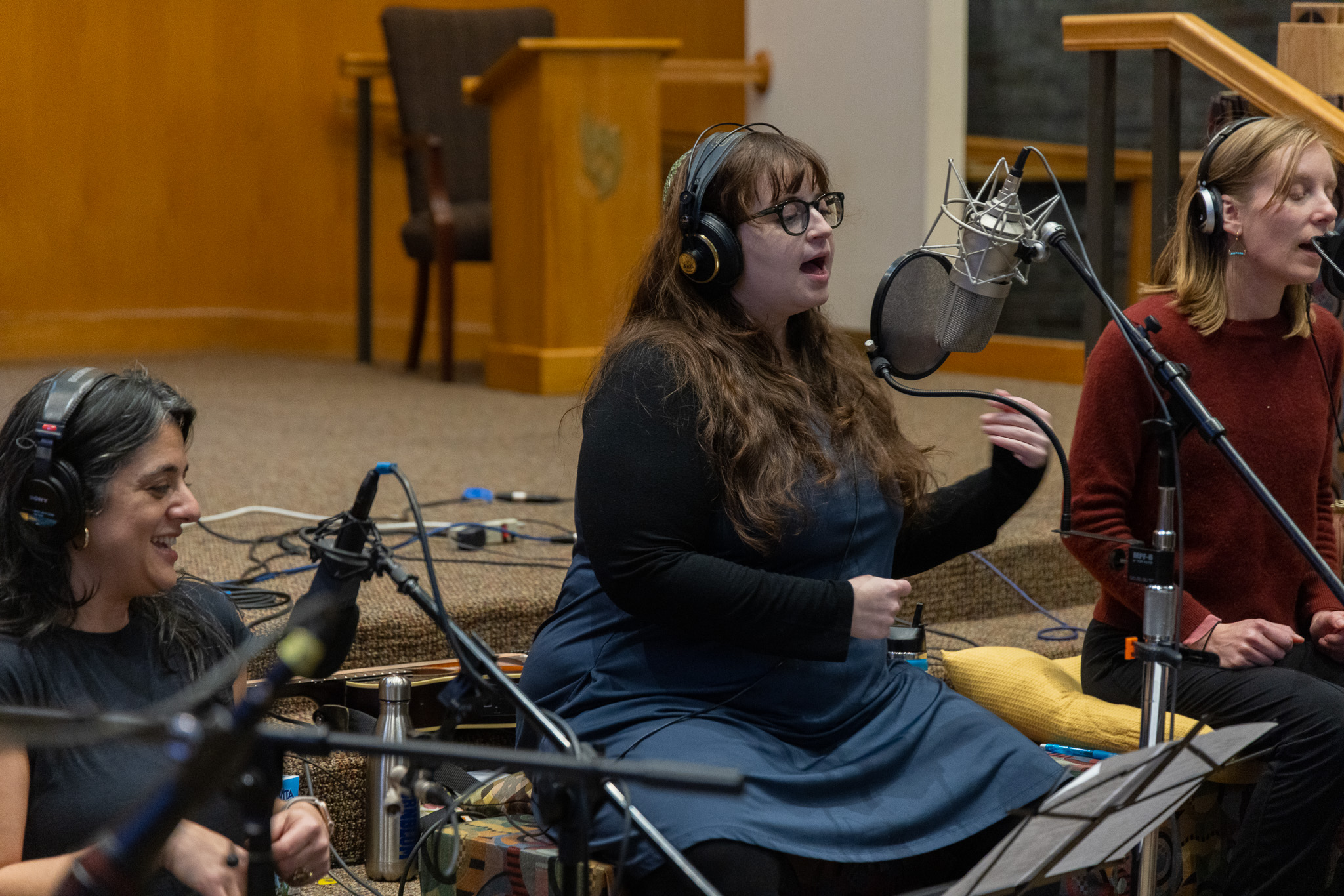
Around a month ago, Eliana released her fourth album, Orah Hi (She is Light), which she recorded with friends and colleagues in Atlanta. It was the first time she had recorded an album singing live with a group. She specifically wanted that ethereal experience of singing together.
“The process was as important to me as the product—that intangible, beautiful, connective, timeless, in the moment feeling with other people. It felt like a prayerful experience, and when I listen to it now it takes me back there. When people listen to it, I hope they’re singing with us.”
By Yonah Kirschner
The “fear of the unknown” is a well-worn phrase, and rightfully so. Throughout life, we’re faced with myriad terrifying moments when we’re forced to reckon with an essential truth: we do not have control over everything. In fact, we ultimately have control over very little. For so many of us, this is scary. What’s more, as educators and caregivers, people are depending on us for answers, and not knowing becomes ever higher in stakes.
“The idea of not knowing something—about the future, about our own lives—is often associated with dread and fear,” said Rabbi Lisa Goldstein. As a rabbi, a teacher, and a certified master practitioner of NARM, a cutting-edge modality for working with developmental trauma, Goldstein understands deeply the extent of this kind of emotional discomfort.
“But the ability to sit with the unknown is a spiritual quality,” she said, “and it can be a place of creativity, exploration, and playfulness. In the well-being world [the world of health and wellness practices], developing great capacity to sit with the feeling of not knowing is associated with resilience, and with the possibility for healing.”
The Covenant Foundation first spoke with Rabbi Goldstein back in the fall of 2022, as we all emerged cautiously into the world after the pandemic. At that time, we spoke about trauma, healing, mindfulness, and breath.
And now, here we are a year later, yet the traumas of our collective lived experiences haven’t ceased—if anything, they’ve multiplied.
How does one keep moving forward, not knowing if things in our world will improve, or how, or when? And to which modalities might one turn next, as we search for healing?
Enter: art.
“In its own way, art can be a scary unknown, especially to people who aren’t comfortable with it,” Rabbi Goldstein said. In fact, she herself hadn’t used the medium in her trauma work until she collaborated recently with Rabbi Adina Allen, co-founder and creative director of The Jewish Studio Project, and a 2018 Pomegranate Prize recipient.
The two came together to teach a series of workshops to Jewish educators in the Covenant network after the Foundation approached them in search of opportunities to offer constituents that would promote healing and wellness.
In those curated workshops, both rabbis invited participants into a space where they could explore what it is like to not know. In a short period of time, not knowing went from being scary to being playful, exciting, open, and even joyful.
“The truth of life is that we don’t know, and that’s also the terror and beauty of being alive,” said Rabbi Allen, co-founder and creative director of Jewish Studio Project, and a 2018 Pomegranate Prize recipient.
Jewish Studio Project (JSP) is an organization based in Berkeley that uses art-making as a tool for Jewish learning, self-discovery, and social change. (JSP received a Covenant Signature grant in 2022.)
“Educators are often looked at as the ones who do know. You’re the one teaching, you’re helping people, you’re standing in front of students, but you yourself don’t have all the answers,” she said.
When describing the Jewish Studio Process methodology, Allen often cites the JSP mantra—'have you made art about it yet?’— as an invitation to unpack and explore ideas (and in fact, there is a series of JSP workshops with the eponymous title).
For their collaboration with educators, Rabbi Goldstein and Rabbi Allen decided to put a greater emphasis on questions rather than on answers. They began with an introductory exercise. Rabbi Allen put a variety of art materials on the table and gave participants one instruction: make something you’ve never made before. Could be a simple shape, could be a line drawing with a material you’ve never used. Then, pass it to the person next to you.
“We were learning as we went, we were reflecting as we went, we were holding a space wherein the educators in the room could feel free to experiment, rather than feel the need to justify their choices,” Goldstein said.
Developed initially as the Open Studio Process by Rabbi Allen’s mother, art therapist Pat B. Allen over 20 years ago, and used in settings as far flung as Taiwan and India, Allen added a beit midrash element and now uses the Process on a daily basis in the workshops she and her colleagues run online, every day. Through intellectual engagement and accessing a state of flow, in which “the thinking mind recedes, and one moves into somatic experience, and follows wherever the creative energy takes you,” participants are invited to access an experience not unlike meditation, where a quality of presence emerges that can be quite powerful.
Rabbi Goldstein and Rabbi Allen also used texts from many different sources—some biblical, some kabbalistic, and some contemporary—and asked their participants to interact with ideas: what they did and did not already know about the texts.
“In a spiritual context, if you are filled up with what you know, there’s no place to receive something new,” Rabbi Goldstein said. “As educators and caregivers, at some point, we know we have to make a decision about next steps, but even then, when we do decide, we don’t necessarily know what will come out of our decisions, and we need to practice sitting with that discomfort.”
We are all feeling deep discomfort right now; reeling during a time of crisis. To help their community stay in relationship to something so overwhelming, JSP has been offering a daily community space in the form of morning sessions, which Rabbi Allen describes as something akin to a daily minyan. They are half an hour long, and they begin with a blessing for creativity that Rabbi Allen wrote with the intention of making the work sacred. Next, she shares a short line or two of text, the group sets personal intentions, and then there’s 15 minutes of art-making, where each person lets the creative source move through them. After they’ve shared their art, there is a closing ritual and singing. Hundreds have signed up for the morning sessions thus far.
The educators who worked with Goldstein and Allen will continue to meet as well, and the two rabbis will continue to hone their practice of combining elements of the Jewish Studio Process along with techniques that Goldstein uses, like mindfulness, setting intentions and examining them, and using witnessing and inquiry as different tools with which to practice not knowing.
For their part, the educators who learned with Goldstein and Allen are eager to continue.
“Throughout the course of our time together, we had a participant who left their job, and another who lost a parent,” Allen said. “These are huge life transitions that lead to a lot of ‘not knowing.’” In fact, the participant who lost a parent reached out and asked Allen to lead a virtual shiva gathering wherein the attendees all engaged in the Jewish Studio Process and made art together.
“They all relaxed into and truly came to value that vulnerable space we created,” Allen said. “It’s a place where they don’t have to perform, they don’t have to be the expert, and they don’t have to have all the answers.”
By Adina Kay-Gross
One of the most fulfilling moments of an educator’s life is when one’s students become their teachers. A decade ago I launched Dream Lab, followed by Beit HaYotzer/the Creativity Braintrust, a series of collaborations with Jewish artist-scholar-educators aimed at infusing the Jewish educational enterprise with creativity. Over the past four years, with the generous support of a Signature Grant, we created teaching laboratories at Hebrew Union College-Jewish Institute of Religion, where we are guided by the belief that Jewish learning, designed well, can be a vehicle to transform and sustain Jews and Judaism.
We envisioned a world where Jewish educators have the resources, confidence, and emotional resilience to boldly integrate creativity and the arts into Jewish educational practice. With support and preparation, Jewish educators can be the architects of a creative Jewish future with an eye toward a more empathic, wise and just community.
The essay that follows captures an example of what happens when the students become the teachers and take a leadership role in embracing the arts to create healthy, spiritually nourishing cultures.
-Dr. Miriam Heller Stern, Vice Provost for Educational Strategy, National Director of the School of Education, and Associate Professor at HUC-JIR.
Read more about Beit HaYotzer in Sight Line Volume 23, Sept. 2020.
Yotzer Or: Educators Creating Light at HUC-JIR
Researched and authored by Allison Lester, PhD1
July 2023
In the sacred halls of traditional seminary education, the study of Jewish texts and the sharpening of intellectual acumen have proudly stood as twin pillars of enlightenment. This enduring model, while venerable, has recently been nudged gently towards an expansion, an invitation to deepen the essential dimensions of personal and spiritual growth. It is in this realm that Yotzer Or - “Creator of Light” - emerges, a beacon of creative experimentation nestled within the historic structures of HUC-JIR in Los Angeles, California. A student-led brainchild inspired by the creative powerhouse of Beit HaYotzer/The Creativity Braintrust in HUC-JIR’s School of Education, Yotzer Or is weaving creativity, self-care, and artistic expression into the student experience at HUC.
Founded and led by Dr. Miriam Heller Stern and with the support of a signature grant from the Covenant Foundation, Beit HaYotzer emerged as a response to an educational system that often treats artists as ancillary, temporary guests in professional development or special student programs. In contrast, Beit HaYotzer aimed to invigorate the rigorous academic environment with ingenuity and self-expression, intertwining creativity with pedagogy in graduate education.
At the heart of the Beit HaYotzer model is the formation of a “Creativity Braintrust,” a collective of creative professionals invested in one another and integrated into the culture of graduate education, including artists such as Rabbi Dr. Ariel Burger, Jon Adam Ross, Alicia Jo Rabins, and Aaron Henne. Through their contributions, these artists are encouraged to identify as educators and, through collaborative planning and reflection with Miriam, begin to utilize an educational vocabulary that embraces an intentional and multifaceted approach to pedagogy. Miriam asserts that, “the mission was really to spark and amplify creativity and creative practice in Jewish education through the work of teaching artists.”
The initiative uses a holistic approach, merging intellectual study and emotional engagement to foster creative thinking and enhance spiritual leadership. This method reshapes the learning environment, encouraging students to step out of their comfort zones and inviting them to explore new dimensions of themselves and their capabilities as leaders and teachers. “The impact on the program has been creating a learning culture where we're constantly reinforcing group norms of taking risks, growing one's capacity to think outside of the usual efficient model of trying to do graduate school,” Miriam shares. “Helping our students express themselves in new ways, helping them expand their courage and their ability to be bold. Because artistic work in particular often demands that we try things we're not sure we're good at.”
A vivid illustration of this concept can be found in one of the unique, creative practices that Miriam introduced to the students - Kintsugi. Originating from Japan, Kintsugi involves the repairing of broken pottery using lacquer mixed with powdered gold. This art form, acting as a metaphor for resilience and adaptability in leadership, enhances students' appreciation for the beauty in imperfection and inspires their development as educators and leaders.
Consequently, the learning approach encourages students to be insightful and self-revealing rather than merely providing answers. Miriam notes, “Creative practice offers a more expansive environment for our students, one that appreciates and encourages their exploration as adult learners. The interplay between personal and professional creativity offers a unique approach to academic work.”
The experience of studying in an artists’ teaching laboratory has been transformative for students in HUC’s graduate programs in education, and ripple effects of creativity can be found in the settings where alumni serve as educators around the country. For the Master of Educational Leadership students who were continuing their rabbinic studies, it opened their eyes to the possibility of shaping the culture of their HUC campus in LA. On their return to rabbinical studies, the students brought with them a refreshed perspective on education and an appreciation for the power of creativity in their teaching, leadership, and sacred service to the community.
In response to the students' shared passion for the arts and their wish to maintain their creative pursuits, Miriam proposed establishing a campus initiative. The Yotzer Or initiative functions as a nurturing ground for joy, authenticity, inspiration, and renewed inventiveness. It represents the potential of creative Jewish education and Beit HaYotzer's broader objectives: enabling students to become agents of creative culture in their leadership and teaching. Miriam reflects, “They are relying on their inner artist to be the teacher, to create experience, and to merge text with the artistic medium.”
“One word that truly encapsulates our intentions for Yotzer Or is ‘cathartic,’” Julia shares. “Our aim is to provide students with cathartic experiences as they train for roles as rabbis, educators, or Jewish professionals. We pondered how creativity could become integral to our educational practice and discovered that engaging in creative endeavors has a calming and healing effect.” With sessions scheduled to coincide with the semester's end, Yotzer Or encourages students to unwind through playful and hands-on activities that encourage participants to reflect on and share their unique wisdom and gifts.
Miriam explains, “The desire to enhance and amplify creativity in the culture of your institution is culture-building work. My aspiration is that people are not just doing creative arts in their setting to check off a box, but are actively nurturing dispositions of creativity. Creativity is generative; it is a process of designing our reality and inventing the future.”
Looking towards the future, Julia passionately shares, “I hope that even after I complete the program, students will continue to engage in similar programming. It is essential for our campus culture to encompass activities that contribute to a sense of play, creativity, and learning for its own sake.” Yotzer Or's commitment to a vibrant learning environment envisions a future where creative exploration is integral to education.
1 Dr. Allison Lester is lead instructor and program designer for the DeLeT Master of Arts in Teaching program at HUC Los Angeles and Director of Creative Design and Impact at ish: Driving Cincinnati Jewish & Israeli Arts & Culture. She earned her PhD in Education and Community-based Action Research at the University of Cincinnati. Dr. Lester was engaged as part of the Covenant signature grant to observe the activities of Beit HaYotzer and Yotzer Or and conduct interviews with the leadership of the initiative between February and May 2023, in service of documenting the creative process, goals and learning that occurred.
Following the tragic shootings at the Tree of Life – Or L’Simcha Congregation in Pittsburgh, PA in 2018 that took the lives of 11 people, and the hostage crisis at Congregation Beth Israel in Colleyville, Texas in 2022, M.J. Kang felt she had to do something.
“I looked at my daughter, and I knew I wanted to be part of somehow bringing an understanding of who the Jewish people are, to the rest of the world, and in this way, maybe help alleviate antisemitism,” said the playwright, actor, and storyteller.
“I wanted to tell the stories of the Jewish people from a diverse perspective,” she said.
Kang was born in South Korea and immigrated with her family to Toronto as a young child. She grew up Catholic and converted to Judaism when she was pregnant with her first child. She is married to playwright Oren Safdie, and they agreed to raise their children with one religion, Judaism.
What was prompted as an act of solidarity with all Jewish people eventually became Kang’s play that is now in development through the “Expanding the Canon,” program, a new initiative of Theater J, the largest and most prominent professional Jewish theater in the U.S., based at the Edlavitch Jewish Community Center of Washington, DC. “Expanding the Canon,” is made possible in large part with a Signature grant from The Covenant Foundation.
In Kang’s play, she is exploring grief, following the recent death of her beloved father. Drawn to Jewish mysticism, she is also writing about being Korean and Jewish and the joys of being both; “the family we are born into and the family we create – how we can hold onto who we’ve become and where we can land spiritually,” she explains. In the play, she honors her late father, who was born Protestant and converted to Catholicism.
“For me, it’s really wonderful to feel included in this community,” she says. “It’s also important that we are different ages and can learn from different generations. To feel like we are one and to recognize our differences.”
“I want people to know that being Jewish is not one stereotypical thing,” she added.
The goal of the program, as Hayley Finn, artistic director of Theatre J explains, is to encourage playwrights of diverse Jewish backgrounds to develop Jewish plays that highlight non-white Jewish narratives, and share them with audiences. Finn and her colleagues recognize that there has been a dearth of quality theatrical works that tell the stories of Jews of Color. As such, the program is designed for writers who are Jewish but do not identify as white or Ashkenazi.
Finn, who serves as Project Director for the Covenant grant, joined Theater J earlier this year when the program was already underway. In fact, she says that “Expanding the Canon” was one of the things that attracted her to the position.
“It’s right in line with my work in supporting playwrights and expanding who gets seen on the stage,” she says. ‘It’s important to show the multiplicity of Jewish identity, how it continues to evolve, and to support Jewish stories and characters that are unrepresented.”
Finn, who has worked with Jewish and non-Jewish playwrights over her distinguished 25-year career, has developed more than 1,000 plays, many of them of Jewish interest.
Previously, she was the associate artistic director at Playwrights’ Center in Minneapolis.
Seven award-winning playwrights were selected in 2022 for the first cohort of “Expanding the Canon.” They hail from cities across the United States, and several are also actors, directors, and theater artists of all kinds. One is also a rabbi. And, another has not yet written a play, but is a novelist and librettist who teaches classics at Howard University. More than 80 people applied to be part of the inaugural program.
“The program creates a Jewish space that’s not predominantly a white space,” Finn said. “It’s not something these writers have experienced before. We give them access to ways of thinking about Judaism they may not have been exposed to.”
Playwright Zachary Ezer chose to research the black and Jewish communities of Louisville, Kentucky, after discovering a little known strike in 1908, by an organized labor union of non-Jewish workers, informally referred to as the “Shabbos goys.” Based on his research, Ezer is now creating an original play, The Negotiating Committee, around that strike. He is employing a technique known as critical fabulation -- imagining gaps in the historical record after relying on facts as much as possible.
Ezer, who describes himself as both black and Jewish, says that when he heard of “Expanding the Canon,” “it seemed as if the Jewish theater was specifically searching for Jewish playwrights that looked like me,” and thus he decided to apply.
Each playwright is granted a $10,000 commission to develop a new play, and becomes part of a cohort that meets with Jewish teachers for a variety of professional development opportunities.
Over the course of the three-year program, each playwright will have access to a $5,000 developmental budget for additional research, classes, or work with a dramaturg. Once the participants submit drafts of their plays, they will receive feedback which will help them to further develop their works and, when they are ready, readings of the plays as well. Finn says that Theater J will consider staging some of the plays and will use its extensive theater contacts, nationally and internationally, to stage others.
Finn hopes to workshop three of the plays from the cohort during this spring and, depending on the writers’ interests, they may be open to the public. She looks forward to mounting some full productions in the following seasons as well.
In August of 2022, the playwrights participated in an immersive meeting in Washington, DC in August 2022 with a beit midrash (learning space) facilitated by Sabrina Sojourner. A practicing theater artist, Jewish educator, spiritual leader and Jew of Color, Sojourner arranged for teachers to meet with the group as a whole and for some individual meetings geared to particular interests. The teachers, storytellers, and practitioners include National Jewish Book Award-winning novelist Lori Banov Kaufmann, Franz Afraim Katzir, founder and director of SHIN DC-Sephardic Heritage International, and Rabbi Dr. Richard Ruth, a rabbi, psychologist and professor (who has since passed away.)
Since the retreat, the cohort has been meeting online to share ideas about their learning and respective projects.
“The narrowness that has been perceived of as Jewish in this country is problematic,” Sojourner reflected, as she spoke about her involvement in the program.
“Jews are primarily perceived as white, and there is a history as to why,” she added. Unfortunately, that road has cleaved many divisions. As a result, we don’t have all of the stories. Now, we are all looking forward to the stories these playwrights will bring to the larger Jewish community and to the world.”
By Sandee Brawarsky
As we complete the first quarter of 2023, I feel a deep sense of accomplishment radiating out amongst my colleagues near and far, but I can also feel our collective exhaustion. Important and meaningful work is being done throughout the field of Jewish education, and yet the work becomes increasing challenging with every passing day.
I don’t have a remedy for those very real struggles, but I do have thought leaders to whom I turn for inspiration, like Susan Magsamen, author of the forthcoming book Your Brain on Art: How the Arts Transform Us.
Founder and executive director of the International Arts + Mind Lab (IAM Lab), Center for Applied Neuroaesthetics at the Pedersen Brain Science Institute at Johns Hopkins University School of Medicine, Susan teaches that engaging with arts—in any form—can rejuvenate us and give us the energy and fortitude to face challenges. Creativity provides a respite for our minds and bodies, and allows us to connect with one another and our communities in a more meaningful and present way.
In this issue of Sight Line, you’ll get an inside look at the 2022 class of Covenant Foundation grantees. As you consider your own work and that of the inspirational group of educators featured here, consider some of these lessons we’ve learned, as we nurture and support our past and present grantees, award recipients and Pomegranate prize recipients:
Think creatively and expansively. Sometimes just allowing yourself to consider, on paper, one of your dreams, can manifest its reality far more than just thinking about it in abstract.
Consider how you might enrich Jewish classrooms and learning spaces (a la Magsamen’s idea of an “enriched leaning space”). Add texture, add color, bring the outdoors inside, and free yourself from the conventions of traditional learning spaces.
Pay attention to the needs of your community. Listen closely to people when they tell you what they’re searching for. We are all looking for connection. It might come over a meal together, listening to music together, baking something together, or simply watching the sun rise, together.
Inspiration is everywhere, and it’s a salve. Look for it and grab it when you find it. Let us know what you discover.
-Joni Blinderman, Executive Director, The Covenant Foundation
Susan Magsamen has spent her career thinking about the intersection of arts and brain science. She is the founder and executive director of the International Arts + Mind Lab (IAM Lab), Center for Applied Neuroaesthetics, a pioneering initiative from the Pedersen Brain Science Institute at Johns Hopkins University School of Medicine. She is also the author of the Impact Thinking model, an evidence-based research approach to accelerate how we use the arts to address problems in health, well-being, and learning.
Susan’s newest book, Your Brain On Art: How the Arts Transform Us, written with Ivy Ross, Vice President of Design for Hardware at Google, is a journey through the science of neuroaesthetics, and offers proof of how our brains and bodies are transformed when we participate in the arts and aesthetic experiences.
In this conversation, Susan shares with Sight Line readers how art can improve our physical and mental health, help us learn and flourish, and build stronger communities.
Can we begin by talking about what an aesthetic mindset is, and why it should matter to educators?
The aesthetic mindset means you move about in the world in a way that’s curious, and in a way that encourages playful exploration, sensorial awareness, and an interest or passion in making, or beholding the arts.
Children do all of those things naturally. Young children are incredibly curious; they smell, taste, and touch--they’re always exploring and experimenting and observing.
But if you think about a traditional classroom, you realize that most are not set up for exploring or nurturing those basic mindsets. An enriched environment is necessary for the aesthetic mindset to take root. We are hired-wired for art because of our physiology. We experience the world through our senses and that’s how we create neural pathways and build sophisticated circuitries.
The younger a child is when they’re exposed to enriched and safe environments, the more neural connections they will create. This neuroplasticity, as we know, is so important for creating functions of resiliency, greater memory, executive functioning, problem solving, collaboration skills; all the traits that are crucial for young people to grow and thrive.
So what does this look like, in practice? How do educators, parents, and individuals create these enriched environments?
These experiences that we call aesthetic, can be quite simple. Think about peeling an orange, for example. As you touch an orange to open it, smell it and taste it, your brain is having an incredibly enriched experience right there.
One might consider bringing fresh flowers into a classroom or office, swapping out toys so that children experience different colors and textures, or, on a larger scale, considering a biophilic design for a home or classroom or office space (a biophilic design is one that connects people and nature within built environments and communities).
Given what we know about the benefits of engaging with art, why aren’t we using the arts more in educational spaces and for healing purposes, in this country?
I think our society has rarified the arts and rarified the people who make art, and experiencing the arts has thus become a luxury. But that’s not the whole of art by any stretch. Art can be doodling in your notebook, singing, humming, designing your home, or cooking.
The truth of the matter is, to have great benefit from any art form, you don’t have to be good at it. Collaging, writing poetry, painting, singing--I do all of those things badly, but I get tremendous benefit from doing them. As a society, we have wasted a good deal of human capacity for growth and healing because we deemed someone untalented and therefore told them ‘that [art form] is not for you.’ Kids stop making art in elementary school (unless they choose it as an elective) because there’s “no future” in it.
What’s more, as a culture, when we think of the arts in service of health, we devalue fields like art therapy and arts in health in general. There’s a whole community of creative art therapists, for example, whose fees are often not covered by traditional health insurance providers, rather, they are either private pay or absorbed as overhead. That’s actually something I am working on with the Aspen Institute, it’s called the NeuroArts Blueprint. The goal is to build a sustainable field where there is funding and policy for the arts in medicine and public health.
Speaking of therapy and mental health, in your book you talk about how art can help support a person with trauma and PTSD.
Yes. Trauma and crisis are unavoidable, and often, we never think it will happen to us, but it happens to everyone. The thing is, when trauma isn’t addressed, it gets stuck in our bodies, and it’s very hard to extract or alleviate.
With young children, art can help build capacity and resiliency so that they are better able to handle the kinds of stresses that will inevitably come their way.
For adults who have already experienced trauma or might be suffering from PTSD, art can help them find metaphor and symbols with which they can express feelings that they cannot find words for. For example, I know the daughter of Holocaust survivors who uses visual art, in her case, painting on a canvas, to process her feelings of intergenerational trauma. She did continuous paintings on the same canvas, over and over, white on top of each image, to extricate her feelings. In all, she painted 80 images on one canvas.
For another person, it might be another medium. Interestingly, clay is one of those miracle materials to work with, where your hands have equal dexterity, and the manipulation of it allows for oxytocin and serotonin to be released. When playing with clay you immediately feel more relaxed, it’s an extraordinarily soothing experience!
Of course there are even more obvious ways that art can be therapeutic—like engaging in expressive writing. We learn from Dr. James Pennebaker at UT Austin, a scholar who has spent his career studying expressive writing, that just the act of writing down a secret, something you’ve held on to so tightly, will free up your cognitive load and that physical health and work performance can improve if one undertakes simple writing and/or speaking exercises. Even if you burn the page after you’ve written something down, the simple act of writing it has already lowered your cortisol levels and stress. Journaling is a form of art as much as it’s a form of mental healthcare.
Can you talk a bit about how art can create communities?
As we all have deeply felt, the pandemic stripped us of the social fabric we had woven together. For better or worse, there had been some consistency in the way we came together as communities before then, and once we were isolated at home, we may have tried to come back together in various forms, but we weren’t always successful. Those of us that used the arts seemed to do better during the pandemic, because engaging in art—drawing, singing, dancing, writing, for example, helped us to manage stress and anxiety, communicate and collaborate, to release our fears and even to grieve.
In my lab, we created a Covid Neuroarts Field Guide with simple tools and activities that people could do at home, during lockdown. We also discovered that dancing together, either on zoom or in person, helped people connect. There are lots of studies that show how doing something in synchronicity with others, helps us feel more connected to those people [for more on this, read the Sight Line interview with science writer and researcher Annie Murphy Paul].
What would you say to someone who wants a quick takeaway on the importance of an aesthetic mindset?
I would say that we have forgotten to stop and smell the roses and that we need to really allow for more sensory awareness in our lives. This may seem obvious, but start small. Feel the sheets and soft blankets you sleep under. When you get up in the morning, appreciate the smell of your toast. Look at the daffodils that are starting to come up in your yard or park or the buds on trees, pay attention to how you cook your food, sing in your car, doodle. Watch the sun rise and set.
Like sleep or exercise or nutrition, engaging with the arts is essential to our health.
Written and edited by Adina Kay-Gross for The Covenant Foundation.