To accompany this volume of Sight Line, we’re highlighting a 2021 Covenant Signature grantee, Sacred Spaces, and learning more about the outcome of their 2021 grant: the development and distribution of a study guide on how Jewish ethics informs abuse prevention in Jewish institutions.
In the article below, Rabbi Lev Meirowitz Nelson, director of scholarship, introduces the research Sacred Spaces conducted to compile their guide. He provides the methodology for approaching such a difficult topic with resources by the Jewish educators and community leaders who were a part of the project. Through their scholarship, Sacred Spaces has created a foundation on which Jewish communal organizations may build safety, respect, and establish abuse prevention in Jewish institutions.
-Adina Kay-Gross, Director of Thought Leadership, The Covenant Foundation
By Lev Meirowitz Nelson
When we ground Jewish action deeply in text or theology, we give it roots. We enable it to absorb hard-earned wisdom from past generations and give it more staying power.
That’s what Sacred Spaces sought to do when, beginning in 2017, we partnered with The Center for Jewish Ethics to produce a study guide that would bring the work of abuse prevention and response into the context of the beit midrash. In 2022, the Covenant Foundation supported three cohorts of educators in studying these texts to bring conversations about safety into their communities. We trained 32 educators, spread geographically across the country and religiously across Jewish movements, to address abuse prevention. The project’s core goal is simple and actionable: culture change starts with shared values, shared language, and supportive structures that make hard conversations possible and sustainable.
With the three cohorts complete, Respect and Responsibility enters a new life stage. The teaching materials created by those 32 educators are available online, as is the guide itself. This introduction aims to guide users by offering a framework for approaching this rich content. Three organizing themes emerge from Respect and Responsibility: preparing oneself to enter an ethical quandary, what makes Jewish ethics Jewish, and how we implement Jewish ethics in our institutions.
How we enter
Respect and Responsibility begins with articles and poems that help a reader enter into this topic in a healthy, productive, spiritually aware manner. Rabbi Jessica Rosenberg provides an essential starting point, reminding us to be trauma-informed and stay cognizant of the impact the topic has on us as learners. Dr. Hadar Schwartz introduces us to the concept of spiritual injury and how it tends to show up for Jewish survivors of abuse. Dr. Shira Epstein broadens the lens from self to institution and invites us to deepen our awareness of how power is distributed in a community.
Following in the path laid out by Rabbi Rosenberg and Dr. Schwartz, several poems/prayers remind us to tend to our spiritual sides as we work. In addition to two contemporary pieces, we include a brief “Prayer for Weighty Discussion” from the Talmud, which the 1st-2nd century Rabbi Nehunya ben Hakana recited every time he entered his house of study. This is a reminder that poetic phrasings and creative appeals to God have deep roots in our tradition that can continue to birth new, modern expressions. These lenses of trauma-informed self-care, spirituality, and organizational behavior attune us to the lasting impact of abuse and prepare us to move into the next section of this guide.
What makes it Jewish
What constitutes a Jewish value is a matter of some debate. The faculty at M2: The Institute for Experiential Jewish Education offer the following schema: There are universal values whose name (e.g., justice) constitutes a “thin” expression of the value, which means different things to different communities. That universal value becomes Jewish by a process they call “thickening”: articulating the value using a series of Jewish reference points to show its profound connection to Jewish content. These could include key Jewish texts that teach the value, practices that bring it to life, or contexts in which the value appears. Sometimes placing a Jewish law or concept into an unfamiliar context can offer new insights–not just language but specific ideas for action steps. Even for Jews who do not follow Jewish law, these particular teachings can offer a helpful conceptual framework for action. While the study guide does not use M2’s terminology, six articles are examples of just such a thickening process: Rabbi Yosef Blau on teshuvah (repentance), Rabbi Rachael Bregman on justice, Rabbi Steven Exler and Sacred Spaces’ own Dr. Shira Berkovits on transparency, Rabbi Dr. Matthew Goldstone and Rabbi Dr. Mira Wasserman on rebuke, Asher Lovy on harm, and Dr. Sharon Weiss-Greenberg and Rabbi Susan Fendrick on yichud (seclusion). Together, these articles examine how thick expressions of Jewish values can guide our ethics processes.
But articulating values and frameworks is not the final step. Our most difficult ethical challenges do not usually exist in the clear definitions but in the gray areas, in the places where two firmly held values conflict and where challenges don’t have simple or obvious answers. For such instances, Jewish texts offer case studies, enabling us to explore multiple perspectives. Professor Marjorie Lehman guides us through a rabbinic story about violence in the Temple where the priests prioritized the institution over the welfare of the people within it. Read her article in dialogue with Rabbi Bregman’s (above) for a multifaceted engagement with this tension. Judy Klitsner, Sacred Spaces’ founding board chair, and Dr. Elana Stein Hain lead readers through biblical and Talmudic interpretations of the story of David and Batsheva, exploring a multifaceted story of sexual assault, abuse of power, and teshuvah. The stories carry a clear warning but also offer nuance to unpack beneath the surface.
What makes it work
As so much of the Respect and Responsibility guide emphasizes, most forms of abuse are about power at their core. Therefore, we protect our communities by offering clarity and structure around power imbalances. Shira Hecht-Koller and Dr. Aaron Koller draw on the archaeology of ancient Israel to demonstrate how architecture and physical layout shape our relationships to power: who is empowered, disempowered, protected, and at risk. Rabbi Mary Zamore and Sharon Levin, LCSW both draw on the concept of covenant to help people create guardrails. Rabbi Jeffrey Fox’s article on consent and power draws in part on the famous Talmudic text from Shabbat 88a about God holding Mt. Sinai over the heads of the Jewish people and requiring them to accept the Torah. This demonstrates that consent should permeate all aspects of our lives, not just sex.
Safeguarding matters across the lifespan, and should begin from the earliest ages, with our most vulnerable population–children. Rabbi Yitzchak Blau warns about the dangers of charisma in school systems and emphasizes that even “superstar” teachers must be screened and supervised. Asher Lovy, in his second contribution to the guide, teaches how pikuach nefesh (saving a life) should guide our approach to safeguarding children. Finally, Rabbi David Ingber returns to the opening chapters of Genesis to remind us of our fundamental moral responsibility for children.
Conclusion
When we study, teach, and discuss safeguarding through Jewish texts and lenses, we build a culture where safeguarding is an essential part of who we are as a community and as a people. Jewish texts can connect with our intellect, with our communal narrative and purpose, with our feelings, and with our spirituality. They can help us enter into ethical quagmires mindfully, find the uniquely Jewish way through the difficulty, and come out the other side effectively. Our hope is that Respect and Responsibility helps communities on that journey to increasing safety for every individual.
Rabbi Lev Meirowitz Nelson is director of scholarship at Sacred Spaces, which builds healthy Jewish communities by partnering with Jewish institutions to prevent and respond to sexual abuse and other abuses of power. He was a recipient of the Covenant Foundation’s Pomegranate Prize in 2017.
By Sandee Brawarsky
Filmmaker Sam Ball and the nonprofit documentary storytelling company Citizen Film are spreading hope, empathy and a renewed commitment to America’s foundational democratic ideals in these challenging times.
Their latest PBS collection of documentary films, American Creed: Citizen Power, presents the visions of young Americans from all over the country – of different cultural, class and ideological backgrounds – working to address challenges that affect their communities; through that process, they learn how to navigate America’s flawed democratic institutions to solve problems in meaningful ways.
Citizen Film’s initial program launched in 2018 with a PBS program that has been viewed by more than one million people over the air, online and in continuous use in schools thanks to distribution by PBS LearningMedia. American Creed: Citizen Power is this year’s multiformat continuation of the ongoing project.
The 2018 American Creed program wrestled with the question of American identity. The new program focuses on what we can learn from young adults about the way forward for American democracy. In addition to new shorts currently rolling out in batches across PBS online channels, PBS will release a limited series of half-hours across all PBS platforms in September. In the meantime, students around the country are watching and discussing American Creed “Citizen Power” PBS LearningMedia shorts. High school students learn from these stories and reflect together on shared ideals and institutions before writing common core aligned essays about how people in their own communities express and reflect shared ideals.
“This project starts from the thought tradition that says, America has a unifying creed based on a set of values, like life, liberty and the pursuit of happiness that are derived from our founding documents,” Ball says. He cites Reverend Martin Luther King, Jr.’s famous statement that the ideals expressed in these documents are a “promissory note.” One reading of our national purpose is that each successive generation is called upon to reach toward the realization of those ideals. The young adult leaders featured in the American Creed: Citizen Power project share this vision of possibility -- and responsibility. A recipient of Covenant grants for his work in 2011 and 2014, Ball is a masterful storyteller. But he doesn’t view the process of documentary filmmaking as directing people who are his “subjects.” Rather, he sees the people he profiles as full collaborators. The films are beautifully shot, with much attention to details that illuminate each young adult’s vision of what their communities’ struggles and successes mean for us as a nation.
Ball’s approach to casting, storytelling and audience-engagement integrates these activities seamlessly into Citizen Film’s partnerships with powerful civic organizations. Recent support from the Covenant Foundation encourages Jewish participation in a coalition that ensures the PBS series reaches a large and diverse audience.
Olivia Gross, one of the young adults Citizen Film cast in partnership with civic organizations fostering audience engagement, is the granddaughter and great-granddaughter of Holocaust survivors. She founded the first-ever comprehensive constitutional law program for high school students “to foster a debate environment, in a respectful learning environment.” In one of the American Creed films, she says that her passion for free speech comes from her family’s history. She connects her upbringing in the Talmudic tradition of argument to her passion for civic dialogue and American constitutional law.
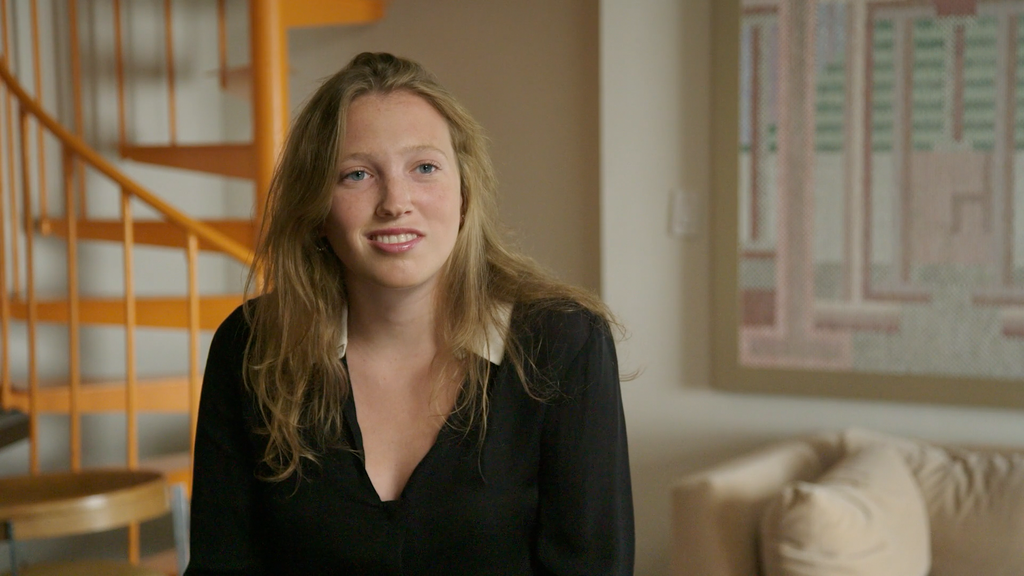
Olivia Gross in the PBS series American Creed directed by Sam Ball ©️Citizen Film
For Gross, truth is arrived at through respectful argument. She says, “You can’t really embrace an idea without understanding how that idea can be challenged.”
Each personal narrative is rooted in a young leader’s community and cultural background. Jonathan Blair, who comes from a long line of coal miners in Appalachia, engages with both cultural preservation and industrial change. Trinity Colón organizes against industrial pollution in her Southeast Chicago neighborhood in collaboration with her immigrant community that includes workers who depend on heavy industry for their livelihoods.
Colón says, “As an organizer, you’re always fighting against something you don’t want. And I think people don’t recognize enough the power of a conversation that helps us imagine together what we do want. Healing requires more than me exercising my imagination, dreaming and visioning by myself. It requires me going out and sharing those visions with other people, listening to other people share their visions, asking them what they dream about.”
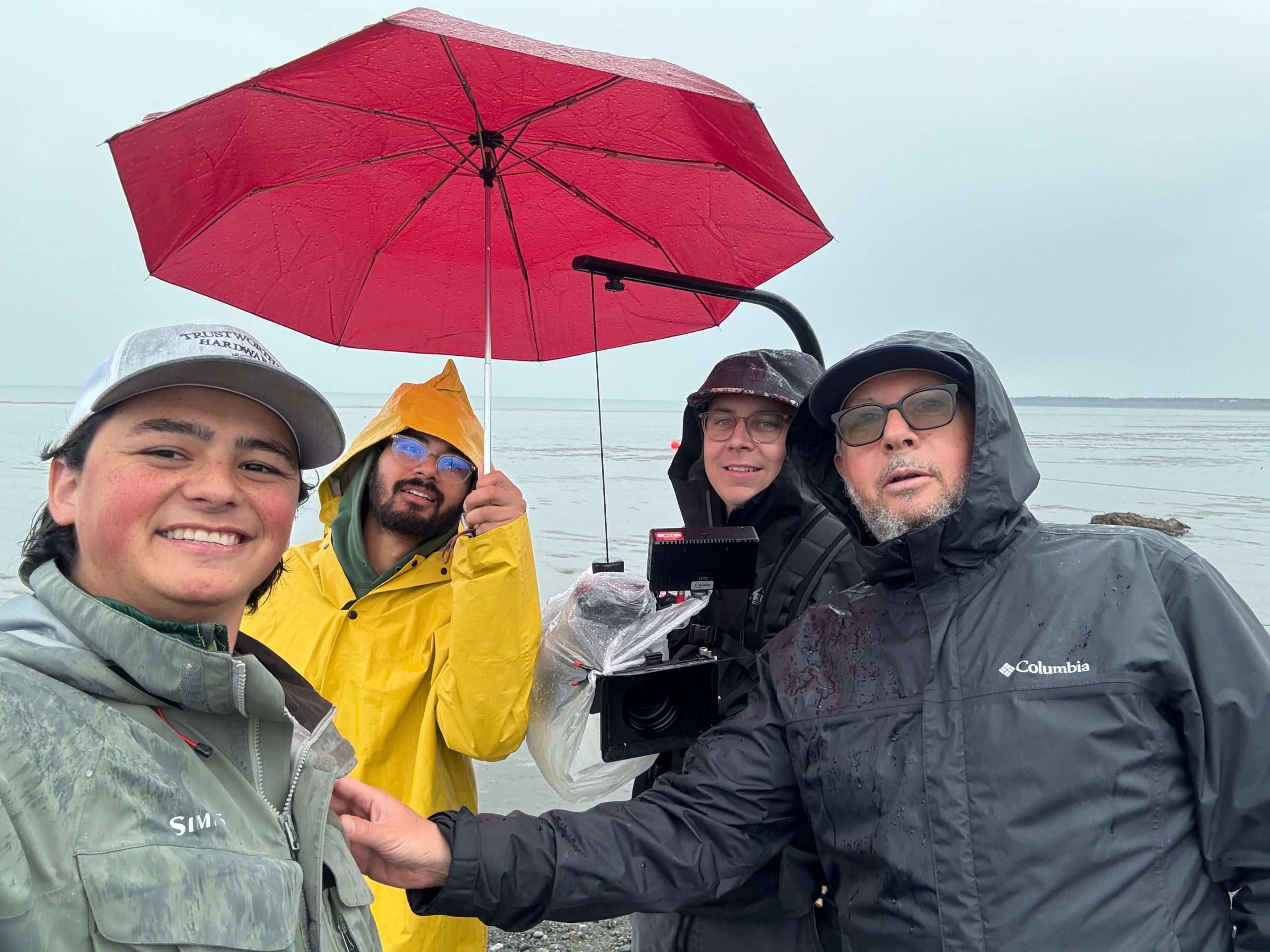
Sam Ball with (left to right) Sam Schimmel and Citizen Film crew members Manish Khanal and Quentin Smith
Sam Schimmel, another compelling protagonist, recently graduated from Georgetown Law. He is the son of a Kenaitze Indigenous Alaskan mother and a Jewish father. After the State of Alaska opened the Kenaitze’s traditional fishing grounds to commercial fishing but denied the Tribe a fishing permit, Schimmel became the first Kenaitze citizen to advocate for his Tribe as an attorney.
The young adults featured in the films – all persuasive, hard-working, pragmatic, but also earnest about ideals they believe are worth fighting for -- demonstrate the power of individuals to mobilize communities and institutions.
“We want to model what it looks like to build a more resilient democracy through community engagement and dialogue,” Ball says.
One of Citizen Film’s goals is to help high school students find and research issues they are passionate about, and discover the tools and techniques available to them to get involved in civic life. The National Writing Project – a teacher-led civic organization and longtime PBS partner – trains public high school teachers in all 50 states to use American Creed: Citizen Power resources to teach writing as a means of civic reflection, participation and action. Students publish op-eds that can have local influence.
Citizen Film’s approach is intentionally nonpartisan; all the project partners share a commitment to American democracy. Timed to PBS’ America@250 programming this summer, new shorts will be released on PBS YouTube Channel – to maximize reach among young adults. After that, the September 2026 PBS limited series interweaves the young people’s stories with on-camera dialogues co-facilitated by two scholars of American democracy: former United States Secretary of State and political scientist, Condoleezza Rice, and her Stanford University colleague David M. Kennedy, a Pulitzer Prize winning American historian known for his books on the New Deal. The series will be released across all PBS platforms. From their notably different perspectives, Professors Kennedy and Rice advise Citizen Film to ensure broad take-up that transcends partisan lines.
Ball sees Citizen Film, founded in 2002, as both a film production company and a civic organization. When asked about the through line in the organization’s work, he says, “We're interested in how people live together and solve problems. Our films show real people facing real challenges. Viewers may not share the exact circumstances, but they recognize the challenges and see solutions that make sense to them. That recognition builds empathy and reminds people that community can extend beyond their immediate circle – locally, and eventually, nationally.”
“We can be pragmatic,” he says, “and still work toward the realization of ideals. For me, the American Creed project is a way to counter some of the nihilism and hopelessness that can set in when democracy is fragile and we worry that our politicians don't share our values, or aren't capable of resolving the challenges we face. We hope to illuminate pathways toward citizenship in the fullest sense of the word: owning your part in American society and taking responsibility for its future.”
As America approaches its 250th anniversary, the young leaders profiled in American Creed demonstrate that this responsibility isn't abstract – it's found in organizing neighbors, advocating for communities, and engaging with democratic institutions despite their flaws. Their stories remind us that the American experiment doesn't depend on perfection, but on each generation's willingness to do the work.
By Yali Szulanski
In Nina Cohen’s U.S. History classroom at Frisch High School, a chart hangs on the wall. Students have filled it with the norms they decided were necessary for real conversations: how to speak with care, how to show they are listening, how to disagree without turning against one another. Nina, who has benefited from training through Civic Spirit, refers to the chart often, especially when the discussion moves into topics that feel complicated or personal.
Scenes like this are not incidental to Rabbi Charles E. Savenor. As Executive Director of Civic Spirit, and a grantee of the Covenant Foundation, he sees these moments as small but essential steps toward a healthier civic culture. He works with schools that want their students to learn the habits of democracy in real time, not someday in the distant future. His work focuses on the belief that students learn democracy by practicing it, not memorizing it. Dialogue and responsibility deserve proper time and structure to grow.
I came to this conversation as both an interviewer and a practitioner. As an educator who partners with schools and community organizations to train teen leaders and facilitate dialogue, and as a recipient of the Covenant Foundation’s Pomegranate Prize, my work focuses on helping teens and teachers navigate disagreement with clarity and care. In classrooms, youth programs, and school-wide settings, I support students in learning how to speak honestly, listen generously, and remain in relationship when conversations become charged. I also work closely with educators, many of whom feel the weight of guiding difficult discussions without enough tools or support.
It was from this shared ground that I sat down to interview Savenor. Again and again, I heard echoes between Civic Spirit’s approach and my own work in schools: a belief that young people are capable of more than we often give them credit for, and that avoiding hard conversations does them a deep disservice. “We are helping students find their voice, build connections, and make thoughtful decisions about the kind of society they want to live in,” Savenor told me.
Young people rarely witness productive disagreement, and they are seldom guided through it. Students want to speak honestly with their peers. They want to understand what fairness looks like in real time. They want to know they belong in the conversations shaping their communities. Teachers feel this pressure too. They want to guide students through moments that matter, yet often feel unprepared to do so alone.
What Students and Teachers Are Facing
Civic Spirit emerged from a concern that civic dialogue in the United States had grown thin. Polarization seeped into family dinners, classrooms, and daily communal interactions. Early research from Civic Spirit revealed declining civic knowledge, rising feelings of helplessness, and teachers who wanted to open meaningful conversations but did not feel equipped to guide them.
Savenor spends considerable time thinking about these realities. He notes that telling America’s story has grown more complicated: different groups argue about which version should be taught. Students often encounter simplified narratives that portray the country as entirely admirable or deeply broken.
“The American story contains moments of courage and moments of pain,” he says. He believes students can hold the fuller story when given tools to explore.
Teachers also need practical tools. Through my own work with schools, I see how even small language frames can reshape a conversation. Even a sentence stem like, “I see it differently,” can give a child enough space to disagree without fear, and make difficult conversations feel more manageable.
Head, Heart, and Hand
Civic Spirit organizes its work around three strands: democratic fluency, civic skills, and civic attitudes.
Democratic fluency begins with primary sources. Students work directly with documents that shaped American life, such as the Declaration of Independence, the Constitution, or Martin Luther King Jr’s Letter from Birmingham. They annotate, question, and imagine themselves inside the dilemmas these documents address. Hands-on interaction strengthens their grasp of history, and improves their ability to identify the ideas they want to protect.
Civic skills focus on the practice of dialogue. Teachers in Civic Spirit cohorts learn protocols that make room for careful, structured conversation. Students take turns, ask clarifying questions, and reflect back what they heard before responding. Students learn how to be curious, rather than defensive.
Civic attitudes address students’ sense of belonging in this country. One of Savenor’s favorite exercises invites students to trace their families’ arrival in the United States. Rediscovering these stories often helps students appreciate the possibilities their families sought and the responsibilities they now carry.
Savenor often reminds students that a strong democracy protects minority communities. For the Jewish community, this truth carries weight. It encourages students to learn their rights, recognize their voice, and engage with neighbors whose backgrounds differ from their own.
From “Days Off” to “Days On”
Several of the clearest examples of Civic Spirit’s impact come from stories inside partner schools.
At Bornblum Jewish Community School in Memphis, TN, educators recognized that civic holidays on their calendar functioned mainly as time off. Once they joined Civic Spirit’s cohort, they chose three holidays each year to reimagine as “days on.” Students and teachers use these days to explore civic themes, reflect on shared responsibility, and engage with the wider community. The shift changed the culture of the school. These days are now widely welcomed, rather than thought of as interruptions.
At Golda Och Academy in New Jersey, Rabbi Shira Johnston teaches American law in conversation with halakha. Her class engaged in a nuanced study of abortion through both legal traditions. She used dialogue protocols from Civic Spirit to help students talk through what they learned. The structure allowed students to hear one another without fear and discover that respectful disagreement strengthens understanding.
Civic Spirit’s student clubs, supported by a Covenant Foundation Ignition Grant, offer another window into this work. Clubs choose a local issue and design a project that reflects their school’s needs. Students at Yavneh Academy in New Jersey began the year with frustration: their school library had been converted into a classroom due to growth. The Civic Spirit club created a space for students to share concerns and propose solutions. The process taught students how to speak up, listen to constraints, and collaborate with peers and administrators.
Preparing the Next Generation to Swim
The Talmud instructs that parents must teach their children to swim; preparing children with this life skill is essential. Savenor often returns to this idea. When he talks about preparing students for civic life, he speaks with the same sense of care. Students step into choppy waters full of disagreements and questions without simple answers, and they need strokes they can rely on.
“Hope carries me forward,” he says. “The last few years have brought painful moments of antisemitism into my world. Even with those experiences, I hold tightly to the idea that understanding can grow, and dialogue can soften what feels rigid.” He often refers back to the idea that education is the steady work that keeps the next generation from sinking into fear or disconnection.
Savenor often speaks about our responsibility to those who come after us. “Moses spends his life preparing the Israelites for a future he will not enter,” he says, returning to the image not as tragedy but as calling. For him, this is the heart of education: work rooted in trust rather than control, patience rather than certainty. “We teach toward horizons we may never see,” he continues, “with the faith that our students will carry the work forward—building communities, institutions, and civic life in ways we cannot yet imagine.”
Democracy grows through these small acts of learning and courage. Civic Spirit creates spaces where these moments can unfold. Students learn how to listen, how to steady themselves, how to remain curious, and how to recognize one another as partners rather than opponents. These are skills they will carry long after they leave the classroom and will keep them moving toward a future they will one day shape.
An interview with Dr. Susie Tanchel and Rabbi Daniel Klein
Condensed and edited by Adina Kay-Gross
In recent years, faculty on campuses across the country—from small liberal arts colleges to major research universities—have supported student populations in crisis. Many students began college during the pandemic; others, including rabbinical students, delivered their first sermons in the shadow of the October 7 attacks.
Educators have been called to teach, mentor, and counsel students through overlapping domestic and global crises, drawing again and again on deep reserves of personal resilience. This work has required cultivating their own inner lives, reexamining beliefs and pedagogies, and modeling openness and growth. Perhaps most essential has been teaching students how to engage one another with respect—how to listen, disagree, and even argue with care.
Recent years have tested even the steadiest campus leaders. For the Jewish community, however, few moments have been as fraught as the time since October 7. At Hebrew College, a pluralistic, transdenominational institution that prepares rabbis and Jewish leaders to serve diverse communities, Vice President Dr. Susie Tanchel and Dean Rabbi Daniel Klein have been leading intentional efforts to foster thoughtful, peaceful dialogue among students.
In a recent conversation about cultivating productive dialogue on campus, Tanchel and Klein reflected on the period following the October 7 attacks on Israel and the ensuing war. In the midst of shock and grief, they knew the only way forward was to continue the work they were charged with: teaching Jewish students how to be Jewish leaders in community.
“We were processing our own feelings and managing our own responses to the attack, and at the same time we had to lead a pluralistic institution,” Tanchel said. “We needed to quickly figure out how to hold ourselves accountable—to ourselves, and to our community.”
“We decided to engage students in dialogue around leadership,” she continued. “Our students are going to be leading institutions very soon. We needed to think with them about what it would mean to lead a community through a crisis like this, and what it would mean to hold ourselves responsible, too.”
Establishing the guardrails needed for dialogue to remain constructive and healthy—and a dedicated focus on the wellbeing of their students—was already central to both leaders’ work. With support from a Covenant Foundation Signature Grant, Klein and Tanchel launched a series of professional development workshops focused on spiritual formation among future rabbis, alongside an introductory course designed to help rabbis serve their communities with compassion and humility. The project aimed to nurture the inner lives of rabbinic students to cultivate resilience, through the teachings, practices, and resources available through our Jewish tradition.
For Tanchel, a 2018 Covenant Award recipient who directs the Master’s in Jewish Education program at Hebrew College, and previously spent nine years as head of Boston’s Jewish Community Day School, leading through difficult moments was not new—though this moment was unprecedented. Through their work,both Tanchel and Klein understood deeply the importance of giving their students the tools to process difficult events, withstand the pressure of being in community in times of crisis, and then learn to lead from the heart. They knew they needed to start by providing a safe space in which people could talk and share.
“In addition to our work with Rabbinical students, we held open forums for our MJED students,” Tanchel said, “because they were on the front lines in their own communities, working in different educational contexts and being asked to lead in real time.” Some students, she explained, were early in their careers and struggling to navigate their own emotions while supporting others. “It was a very painful time.”
For both Tanchel and Klein, grounding themselves and their students in middot—core virtues—was paramount.
“We kept reminding the community of the basic middot that enable productive conversation,” Klein said. “I personally return to four: humility, curiosity, courage, and graciousness.”
“Humility and curiosity are the most important,” he added. “Humility means, ‘I don’t have all the answers, and I will take up the right amount of space—not too much, but enough.’ Curiosity means, ‘I am not here to persuade or teach, but to be open.’”
Tanchel emphasized listening as an active and disciplined practice. “What does it mean to truly listen to someone else?” she asked. “The first step is that when someone speaks, no one jumps in for thirty seconds. The practice is to genuinely hold space for what was just said.”
She also highlighted the importance of reflecting back what someone has shared before responding, and offering affirmation rather than challenge. “In the early days after the attacks, when tensions were so high and blame came easily, we were very clear that dialogue was not about persuasion,” she said. “We were trying to listen with empathy and compassion—to build a container where people could speak from the heart without feeling they had to defend themselves.”
Klein noted the additional challenge of contending with the loudest voices on campus, as in broader public life. “Those voices often carry disproportionate weight in shaping culture,” he said. “That affects people’s sense of what can and can’t be said, and what feels worth saying at all.”
Both leaders emphasized the importance of holding nuance and complexity at the center of communal life. While shared middot provide a foundation, productive dialogue also requires bringing students into relationship with people who are not exactly like them—encouraging them to articulate convictions while remaining open to possibility.
“At Hebrew College, we are deeply committed to being a place with no political or religious litmus tests,” Klein said. “We have expectations around middot, but when we consider whom to admit, we also ask: are you someone who can encounter difference with respect and curiosity?”
Tanchel and Klein also spoke about the unique position rabbinical students occupy—training to lead communities while simultaneously being active members of a compassionate and kind communal ecosystem themselves, at home and on campus.
“Toggling between those two perspectives—leader and community member—and modeling steadiness was incredibly important,” Tanchel said. “Where students were in their journey affected their capacity to hold their own feelings and appreciate what their leaders were carrying. The closer they were to leadership themselves, the more able they were to hold that complexity.”
The path ahead for students entering Jewish communal leadership is not an easy one. Still, both leaders find hope in the continued willingness of people to step forward.
“The statistics on clergy trauma and burnout are staggering,” Klein said. “Rates of PTSD rival those in the military, and the loneliness and divisiveness of the pulpit world are intense. And yet, people are still choosing this work. That commitment to serving community is truly inspiring.”
For Tanchel, hope comes from the students she teaches.
“Watching them take what they’re learning into the world—to work for justice and equity—is a profound privilege and joy,” she said.