Nachama Moskowitz, Director of Curriculum Resources and Early Childhood at the Jewish Education Center of Cleveland, keeps a note with these words taped to her computer screen:
“Jewish education as the process of becoming, in dialogue with Jewish tradition.” The focus of this process should be “students’ growth and development as human beings,” Moskowitz explained.
When the COVID-19 pandemic hit, Moskowitz knew she needed to offer a Jewish educational response to the stress, isolation, and uncertainty burdening students and families.
“I wondered how Jewish learning could map onto people’s actual needs,” she said. “How could we take care of the kids, parents, directors, and educators?”
The answer was La-Bri’ut: To Our Health and Wellness, a new, one-year curriculum for kindergarten through sixth grade designed by Moskowitz and a team of creative and thoughtful educators. Developed last summer and freely available online, the curriculum launched in time for many educators to implement it in the fall of 2020. It includes a plethora of materials for learners and educators, and offers professional development support. More than 220 educational programs have indicated that they are using La-bri’ut, which means that the learning approach has reached more than 10,000 students.
The curriculum combines a strong independent learning component with a weekly online mifgash (gathering) of a cohort of up to 10 students for a 30-minute session. In many cases, educators have chosen to organize the cohorts by family rather than by age or grade—with three or four families learning together, building community, and engaging with the content of each module.
“If a family has a kindergartener and a fifth-grader learning about the same thing, it changes the conversation at the dinner table,” Moskowitz said.
Anchored in Jewish teachings and enriched by a study by Dr. Stevan Hobfoll and colleagues at Rush University Medical Center about the five essential elements of trauma intervention, La-Bri’ut is organized into five modules: sukkat shalom (a shelter of peace), ometz lev (inner strength), g’vurah (using one’s power and strength for good), k’hillah (community), and hesed (loving kindness, tying into hope).
The curriculum draws on different stories from Jewish tradition—from the Bible, Talmud, and other sources—to suggest and illustrate its primary themes. It also pulls from more recent history to reveal examples of people responding to the needs of their time, such as the story of a community in Billings, Montana banding together after an act of hatred in 1993.
“We created a learning approach that focused on what kids need right now,” said Moskowitz. “Yes, I care that students know Moses and Miriam. But what I really want children to remember are the Jewish values like ometz lev—that these Torah heroes used their inner strength when faced with big emotional challenges. Moses hid his face, and he used his ometz lev when he encountered God at the burning bush. Miriam grabbed her tambourine and danced to release energy after escaping the Egyptians and crossing the Sea of Reeds. It’s about giving children the language to talk about inner strength, in dialogue with Jewish tradition, and empowering them to act on it in their own lives.”
In concert with the weekly online gatherings, children expand their at-home learning with age-appropriate activities. For upper elementary school students, this means completing weekly challenges that demonstrate concepts such as: If you take the time to help others, and make it possible for others to help you, there is hope in the world. In the g’vurah module, students are invited to learn and tell the stories of heroes in Jewish history—people who used their strength and power for good—including through comic books and other media. They are welcomed to enter into the stories as protagonists themselves.
Younger elementary school students receive a box of curated, hands-on activities. They work with cloth to make their own shelter of peace; they shake jars of glitter, and then watch the glitter settle, as they use their ometz lev to overcome stress and achieve calm. And, according to their parents and teachers, they develop a new vocabulary—citing the ometz lev of a beloved children’s book character or offering advice to family members (as in, “Mom, you need to use your ometz lev”).
Moskowitz works closely with Cleveland congregations using La-Bri’ut and keeps in touch with others—including via an active Facebook group of Jewish educators—who are adopting the curriculum as well. A major piece of this story, she said, is “the goodness of Jewish educators. People always share, but now it just seems to be different, and more. A lot of people are in this together.”
“Educators embraced La-Bri’ut as a way of thinking about what Jewish learning can look like, not only now, but also in the future,” Moskowitz added. “There are tantalizing hints of what can be, if we can grasp it.”
By Miriam Haier, for The Covenant Foundation
More to Consider
- Where do we start? (ejewish philanthropy, January 2021)
- “La-bri’ut Parents – this is for you!” (overview video)
- Full La’Bruit curriculum guide
- The La-bri’ut theme song
- Five Essential Elements of Elements of Immediate and Mid-Term Mass Trauma Intervention: Empirical Evidence.” Hobfoll, Stevan et. al. [Note from Nachama: See especially the charts beginning on page 302]
Rabbi David Eliach, a 1992 Covenant Award recipient and the former principal of the Yeshivah of Flatbush, is 98 years young. Retired for almost 25 years, Eliach still visits Flatbush several days a week, to mentor teachers.
Sally Grazi-Shatzkes, a 2019 Covenant Award recipient, the Director of the Arts Department at Yeshivah of Flatbush, and an alumna of the school, is one of the myriad teachers Rabbi Eliach has mentored. And though he retired a year after Grazi-Shatzkes started high school, Eliach’s reputation has always loomed large in her mind. “He’s a true mensch,” she said.
Photographed by Zion Ozeri at the Yeshivah of Flatbush on December 9, 2019
“Zion was taking pictures of us while we were talking,” Grazi-Shatzkes explained. “We were learning a piece of Torah together, and we were also talking about my son, who has special needs. Rabbi Eliach was talking about the importance of treating each child according to their way. It had been a really hard day for me, personally, and he probably didn’t realize what an impact our conversation had.”
“To me, the most important approach in education is to be a human being, a nice person,” Rabbi Eliach shared. “You cannot only teach text to your students; you have to also teach them how to become a better person. That is the main goal of education.”
“In the Witness Theater program, participants often ask me if they are doing a good job,” Grazi-Shatzkes said. “They say, ‘We don’t remember all the details! What if we miss something?’ They know the stories they’re privileged to hear from survivors are precious. But I tell them to just relax and be present. If you are present and listening, the experience will change you. My parents, my first mentors, are both really good listeners. They took the time to listen to me.”
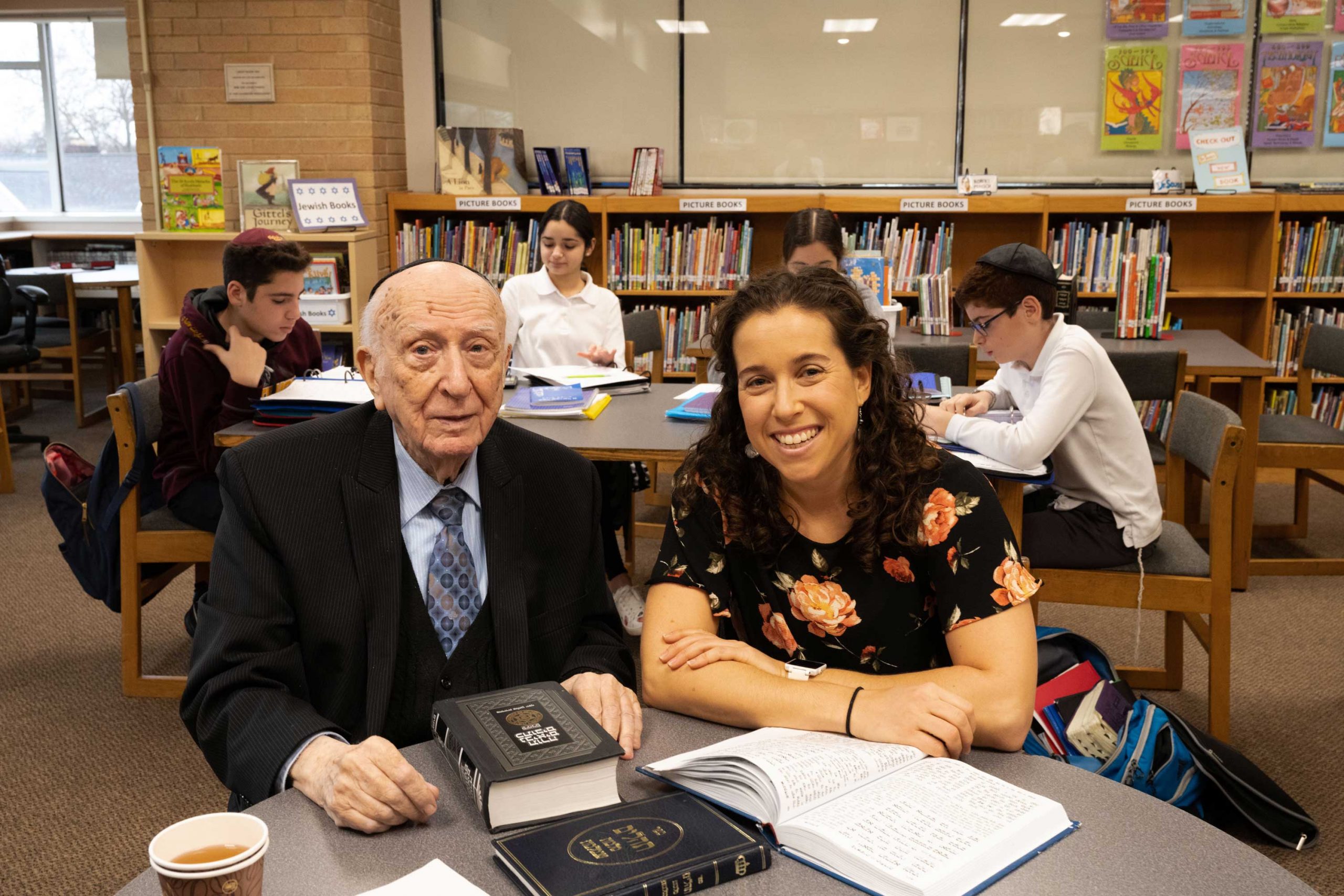
“The first thing you have to do as an educator is love your students,” Eliach said. “They are young, they are looking for guidance, and you can provide that. But you have to like them. If you don’t like them, you’re not going to be a very good teacher. It’s essential to have a positive relationship with the children you’re teaching. Sally is a wonderful mechanechet (educator) because she understands kids, and she understands what it means to relate to people—old and young. She is a natural.”

“When I was young, I studied at a yeshiva in Hebron, in Israel,” Eliach recounted. “Every day we sat and learned mussar for a half hour. You sit down, and you think about who you are, what you did that day—the good things and the bad things—and how you can improve. We did that every day, for four years. I still do that now.”
By Adina Kay-Gross, for The Covenant Foundation
More to Consider
- For Covenant Award-winning Teacher, It’s All About Empathy (The Jewish Week, January 2020)
- School-based Mentoring: Principles to Live By (HaYidion, the Prizmah Journal)
- Mentorship: Lessons Learned from Jewish Education – eJewish Philanthropy (January 2013)
- The Lessons Of Rabbi Eliach (The Jewish Week, January 2012)
In this moment of political unrest in the United States, it is easy to fall into the trap of distrust and disengagement. How do we confront differences in perspective and worldview in a way that doesn’t further polarize us from our neighbors and fellow citizens? How does one communicate respectfully and effectively with those with whom we disagree? And how do we teach these skills to our students?
Civilly Speaking: A Curriculum on Civil Discourse
Kindness and empathy start in the classroom, which is why The Covenant Foundation commissioned a curriculum on the topic of civil discourse from renowned Jewish educators Joel Lurie Grishaver and Ira J. Wise. Across six units, the curriculum explores important themes, such as how and why we argue, why anger is such a powerful motivator, perspective-taking, and the indisputable value of facts in the face chaos and confusion.
Whether through Talmud, Ted Talks, or Tevye, Grishaver and Wise provide space for learners ranging from Grade 6 to adults to unpack their own reactions in the face of conflict, beginning with establishing a working definition of civil discourse and ending with a deeper understanding of truth and decency.
Conflict Resolution: A New Jewish Food for Thought Animation and Original Study Guide
Hanan Harchol, an animator, New York City public school teacher, and the creator of Jewish Food For Thought: The Animated Series has just released Conflict Resolution. In this animated short, the characters of Hanan and his father discuss what it means to argue and disagree, and how we all tend to focus on “winning” rather than trusting one another enough to be vulnerable. Without vulnerability, the characters realize, empathy and connection remain unattainable.
Covenant Award recipient and Director of Project Kavod/Dignity at Jewish Family Service of Seattle, Beth Huppin has created a study guide based on the film, turning to Jewish tradition to posit how can we live peacefully when confronted with “seemingly impenetrable conflicts.” Through text study and introspection, the guide provides space for learners to grapple with what it means to be vulnerable and how such risk taking can ultimately create an environment where there is mutual respect between those who disagree.
By Lindsay Malin, for The Covenant Foundation
More to Consider
- Using Jewish Ethics To Empower Teachers and Students: An Interview with Hanan Harchol (Sight Line, December 2016)
- Making Movies During Quarantine: From the High School of Art and Design - (Sight Line, June 2020)
- iMovie, Papercuts and Visioning the Future of Jewish Education - (Sight Line, October 2017)
- Embedding Jewish Education into Agency Wiring: JFS and Project Kavod - The Covenant Foundation
- Inspired Educators - The Covenant Foundation
- On Cultivating Empathy: A Text Study
When the COVID-19 pandemic first began to shut down schools in March last year, Jewish educator Heather Wolfson found herself scrambling to set up online learning for her students—12th graders in the supplementary Community Jewish High program based in San Diego. Typically, Wolfson’s classroom includes lots of discussion, interactive activities, and leadership development, but the pandemic derailed all of those plans, forcing her to quickly adapt and find alternative ways to engage her students in the virtual space.
“I was trying to find any way in which to build an engaging, dynamic experience for them over a screen,” Wolfson explained. That’s when she received an email from M²: The Institute for Experiential Jewish Education about a brand new resource called Value Sparks.
Founded four and a half years ago by Shuki Taylor to professionalize the field of experiential Jewish education, M² disseminates research, shares expertise through consulting, trains educators in the multi-disciplinary work that comprises experiential education, and develops curriculum and other educational resources for the field.
Similar to Wolfson, during the first week of the pandemic shutdown, M²’s Senior Program Director Mollie Andron found herself trying to figure out how to make an organization virtual that had never been virtual before. She was also thinking about what kinds of resources and experiences M2 could provide for its network of educators and their learners. Like so many others, she was also already experiencing “Zoom fatigue” and grappling with how to live out Jewish values in a dramatically changed world. Andron starting asking herself questions like, “how can we be hospitable when we can’t invite people into our homes?” And, “how can we be in community when we can’t physically be with other people?”
From Andron’s reflection on the tensions of trying to live out these values in the COVID era, Value Sparks was born.
“It's exhausting to only learn through one medium,” Andron said. “I wanted to see how we could create educational experiences that were multi-disciplinary, that combined art, music, and Jewish texts, and offered a variety of ways of interacting with a value.”
After coming across the versatile software Adobe Spark, Andron and her colleagues Kiva Rabinsky and Hayley Sklar created the first Value Spark—“The Great Indoors”—in which Andron guides listeners through a 15-minute interactive tour of their homes. As Andron says in the recording, you go on “an adventure of discovery to connect and reconnect with the story of your home…to discover the forgotten nooks, local hotspots, and quirky crannies of your living space.” The Great Indoors includes three distinct exercises and a number of prompts to act on, including making a mezuzah and reflecting on what comprises “chametz” since the Spark was released in the days leading up to Passover.
M² emailed out this first Value Spark as a gift to alumni, and in just one week, The Great Indoors was accessed over 3,000 times. The M² team knew it was onto something. Educators were struggling to keep their heads afloat as the pandemic and its impact deepened, and they didn’t necessarily have the time to create entirely new teaching materials as they switched to online learning.
So, Andron and colleagues proceeded to design and release an additional 13 Value Sparks—all available for free download on the M² website. Each Spark is grounded in Jewish text and also contains a story that introduces the main idea about the value under consideration. Each link throughout the Spark takes the learner deeper into the complexity around the value. There are guiding questions and at least three ways to engage with the value. The Spark delves into the tension inherent in the value in the present moment and what’s getting in the way of that value being put into practice.
Of course, many of the Sparks were inspired by life during the pandemic (Humor—Is it okay to laugh given the circumstances?; Community—We’re participating in the 7:00pm clap every night, but what are the boundaries of community?), but as 2020 progressed, the Sparks responded to other current events, such as the Black Lives Matter protests, which is linked to both the Integrity and Courage Sparks. Additional Sparks were connected to Jewish holidays. What all the Value Sparks have in common, though, is that they are simultaneously timely and timeless, Rabinsky explained.
For Wolfson, who also previously served as M2’s Chief Operating Officer, the Value Sparks have given her a foundation that has enabled her to continue to provide a robust learning experience for her Community Jewish High students over Zoom.
Before the November election, Wolfson used the Independence Spark as a tool to help her students open up conversation about what we are dependent on, what we can be independent of, the right to vote, where responsibility comes into play, and what is Jewish about independence. After her 11th and 12th graders studied the Talmudic text in the Spark that centers around obligation, Wolfson invited them to do a fill-in-the-blank activity about their obligations to friends, family, and teachers.
“The power that came from it was unreal,” Wolfson shared. “With virtual learning, the students have experienced a shift in what they’re now responsible for in their education. Teachers can only do so much,” she added. “And students have had to bring more agency to their learning.”
Most recently, Wolfson needed a resource to provide a foundation for her students to have a conversation with guest speaker Abby Stein, the first openly transgender woman who was raised in a Hasidic community. After reading Stein’s memoir, Wolfson turned to the Value Spark on Preservation. The Spark begins with a Rabbinic teaching suggesting that the Jews were redeemed from slavery because of three things—giving their children Hebrew names, wearing traditional clothes, and speaking their native language. The text set the stage for the class to explore the tension within the value of preservation, and consider questions like, what do we preserve? What do we leave behind? What do we adjust and keep?
“We talked about what this means, then we looked introspectively at ourselves—our name, our appearance, our speech,” Wolfson said. “Some students didn’t know where they got their name from, so I gave them three options: write the history of your name, ask someone about the history of your name, or research your name online. Some were able to engage their parents in a quick conversation.”
When Wolfson’s students recently met Stein, they had a deeper context for the conversation and what they learned.
In addition to engaging students with thought provoking material and prompts, Wolfson also noted the aesthetic quality of the sparks and how visually they “speak to the senses.” With the pandemic limiting everyone to existing in rigid virtual boxes, and primarily only using the senses of sight and hearing all day on Zoom, M2 intentionally prioritized visual elements in the design.
“Aesthetics are a really important part of teaching and learning,” Sklar said. “The different methodologies that one explores through Value Sparks—art, music, text, poetry, video—engages not just one’s mind, but also one’s heart.”
By Yonah Kirschner, for The Covenant Foundation
More to Consider
- A guide to the socially distant Shavuot, with pilgrimage and cheese (The Times of Israel, May 2020)
- Amid pandemic, Jewish groups get creative for Shavuot festivities (JTA, May 2020)
- Experiential Education during the COVID-19 Pandemic: A Reflective Process (Journal of Constructivist Psychology, 2020)
- M2: The Institute for Experiential Jewish Education YouTube Channel
- Post-Pandemic Gifts for our Children (eJewish Philanthropy, Jan 2021)
- Schools Navigate How to Provide Experiential Learning in a Socially Distanced World (EdSurge, July 2020)
Ten years ago, Lisa Levy was sitting on the bus in Israel with her eighth-grade class, wondering why so many of her students weren’t connecting to the vibrant, complex Jewish homeland they had been studying for years.
“When I looked around, I saw that most of them were staring down at their laps, instead of out the window,” said Levy, who has taught art and Jewish Studies at Brandeis Marin day school, just north of San Francisco, for 15 years. The following year, digging deeper into her art and culture toolkit, Levy introduced her students to the flourishing street art scene in Israel. And on the next trip to Israel they saw the art for themselves.
“I almost cried when I saw their level of excitement,” she said, describing the change as “phenomenal.” Apart from recognizing and responding to the art itself in visceral and positive ways, the students began to connect with the energy and complexity of Israeli life, asking questions and making observations far beyond the content of murals in the Tel Aviv bus station, or the graffiti in Jerusalem’s hip Nachlaot neighborhood.
This moment of educational insight was followed soon after by the arrival of Dr. Peg Sandel as Head of School, and Merav Steinberger as Dean of Hebrew and Jewish Studies. This trio, along with their colleagues, saw the potential for braiding art more completely into the study of Israel at the school. Graffiti on the walls of Israeli cities became a doorway into the soul of a country.
In 2018, The Covenant Foundation awarded Brandeis Marin a Signature Grant to solidify and expand this work, called the Tiferet Project (“tiferet” means beauty or adornment in Hebrew).
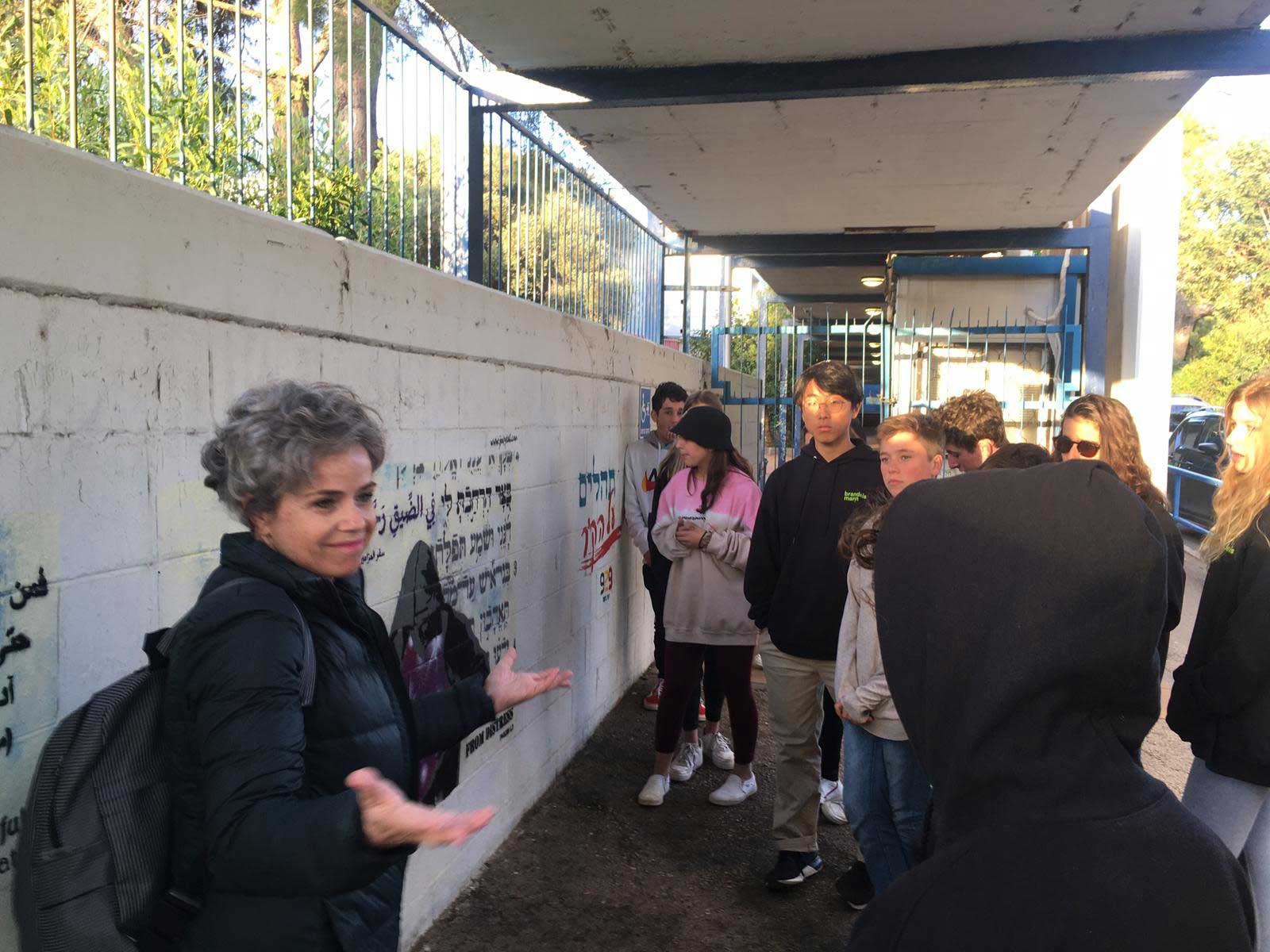
The heart of this program is a year-long class for eighth graders, called Israel Art and Culture. The first semester focuses on learning the language of analyzing art, followed by an exploration of Israeli culture and society, with an eye to finding points of connection with students’ lives. In the second semester, and prior to their annual journey to Israel, the students do a deep dive into the country’s street art. This work—colorful, energetic, and unafraid to tackle current events head on—gives students a chance to more deeply grapple with the complexities of Israeli society. Most importantly, perhaps, they come to their own conclusions about the country, with a baseline of excitement and knowledge about contemporary Israeli life.
“Israel is a young country, and the artists we studied saw Israel as a canvas to make political statements and effect change. They must feel very confident to express themselves so freely,” observed Elia Janes, a recent graduate of Brandeis Marin. “At Brandeis, we are encouraged in our Jewish Studies classes to ask questions, but also we are given the responsibility to find our answers.”
Olivia Felson, also a recent graduate, noted that the Israel Art and Culture class deepened her faith in Judaism while at the same time opening a window to an Israel she never knew. The study of art allowed her to see more clearly that “Israel is a second home to many different groups of people… and although there is a history of conflict in the region, there is also a strong community that transcends individual differences and instead focuses on innovation and the future.”
For Sandel, this shift in teaching about Israel couldn’t come a moment too soon. Like many educators, she worried that Jewish schools were failing to adequately engage students with a love of Israel, or create a teaching environment that included the political, religious, and other complexities of the country. Without these two pillars of engagement and nuance, she feared Jewish educators were setting students up for apathy and disappointment later on.
“With the Tiferet Project, we wanted to re-think Israel education,” Sandel said. “We wanted to meet kids in subjects areas [like art and culture] where they had a natural curiosity, and enter into Israel studies from that space.”
Discussing recent academic findings about the views of Jewish youth toward Israel, Sandel, who has a Ph.D. in Jewish Studies, noted that “some of the loudest anti-Zionist voices come from day school kids, kids who, davka, were supposed to be inoculated from these ideas. They had the feeling they had been lied to about the complexity of Israel.”
The response, pedagogically, is boldness and innovation. “To what extent can we dare to let our students know that there is complexity, and give them the tools to deal with it? We are good at that as Americans. We can love this country, and recognize it has a lot of problems, and live with that tension. But with Israel, we haven’t yet developed that same robust toolkit. The arts make that possible.”
For Merav Steinberger, the yoking together of art and Israel has had benefits throughout the Jewish Studies curriculum.
“Our approach to teaching art parallels the way we teach texts, by asking questions and interpreting, and being able to agree or disagree with what is said,” said Steinberger. When students see how “streets artists use graffiti in Israel—by crossing out what one person did, and adding their own ‘text’—they understand from a different angle the process of Talmudic commentary.”
As with every school program over the last 12 months, Tiferet underwent major adjustments because of COVID. Most importantly, the 2021 spring trip to Israel had to be cancelled, as was the arrival last year of an Israeli artist the school had studied, and who was set to work intensely with the Brandeis Marin community over a week-long educational residency.
Lisa Levy acknowledged this disappointment while looking forward to a future that will require her students to ask even better questions about Israel and Jewish life. More than anything, “we want students to push back against what they see. To look, and then look again.”
By Dan Schifrin, for The Covenant Foundation
A former columnist for both New York Jewish Week and the j: Jewish Newsweekly of Northern California, Dan Schifrin has taught creative writing at UC Berkeley, San Francisco State, and Stanford University Continuing Studies, and served as writer-in-residence at the Contemporary Jewish Museum. He recently founded StoryForward, which offers creative writing courses to Jewish teens, intergenerational Jewish book club support, and public conversations connecting art, literature, and community. He is the author, among other things, of the play “Sweet and Sour;” the one-man show “String Theory”; and a forthcoming memoir about fatherhood and science fiction. As part of a LABA Fellowship at the JCC of the East Bay, Dan is writing a play about medieval Jewish Spain and its influence on twenty-first-century America.
More to Consider
- Integrating arts into Jewish day schools (HaYidion, the Prizmah Journal)
- Teaching teachers to teach art (Art 21)
- Israeli street art as global phenomenon (Israel 21c, March 2017)
The batei midrash (houses of learning) that closed their doors to slow the spread of COVID-19 have been closed for almost a year now. Jewish educators’ urgent switches to online programming have given way to longer-term adaptation. What can their experiences tell us about community, connection, and the essentiality of chavruta learning (or learning in pairs or small groups) itself?
“The chavruta methodology is fundamentally empowering,” said Rabba Yaffa Epstein, Director of the Wexner Heritage Program. “You can—you should—read the text for yourself and form your own understanding. Every text is multivocal. When you read it in partnership, with multiple voices, you are discovering the richness of the text, and it comes alive as a result.”
Chavruta methodology is used across the Wexner Foundation’s leadership initiatives—not only to empower pairs to learn Jewish texts, but also as the basis of brainstorming and cohort-building activities.
“We don’t have many spaces in our world where we’re supposed to disagree,” Rabba Epstein added. “But chavruta is about celebrating difference; it’s about saying, ‘I am different from you; I read this text differently than you. In this very holy, very precious space, I am supposed to have my own opinion.’ The Torah we create together in that moment is brand new, rich, and complex.”
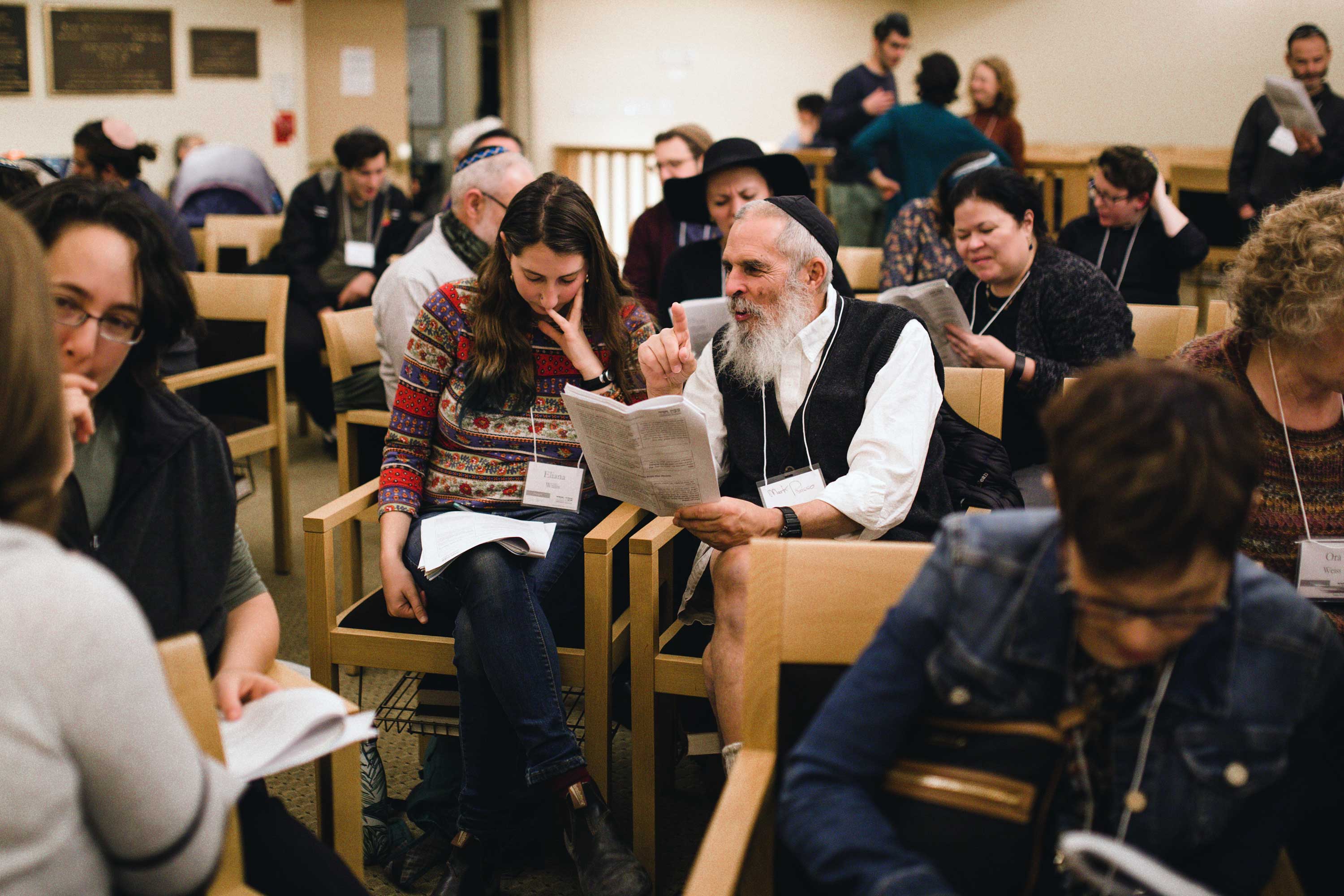
Once the pandemic began in earnest last winter, SVARA—a traditionally radical yeshiva dedicated to the serious study of Talmud through the lens of queer experiences--launched new online offerings, including a 30-minute learning program that meets six mornings a week.
“It was obvious to us that [during this time] people needed even more of a sense of connection, of being seen and cared for,” said Rabbi Benay Lappe, SVARA’s Founder and Rosh Yeshiva and a 2016 Covenant Award recipient. “We have always said, this is a community, not a class.”
The day we spoke, Rabbi Lappe noted that there had been 233 back-and-forth comments in the Zoom chat among 50-some learners—far more than could have happened in an in-person space.
And in fact, SVARA has seen rapid growth in its community since the start of the pandemic; enrollment went from 3,000 students in 2019 to 7,000 in 2020.
“Our goal is to create independent learners,” said Rabbi Lappe. “In a Jewish context, that means people being able to learn in chavruta, without a teacher, as a regular part of their lives. [The experience of the pandemic] has inadvertently shifted us toward what we’re after even faster—more people learning one-on-one as a spiritual practice.”
“The texts we study existed before coronavirus,” said Laynie Soloman, Associate Rosh Yeshiva and Director of Transformative Leadership at SVARA and a 2020 Pomegranate Prize recipient. “But they were born out of the same experiences of pandemic, pain, and isolation that we are witnessing now. The spiritual technology of chavruta was most robustly developed by rabbis in exile. And the language of exile is really resonant in this moment."
Hadar Institute—an educational institution that empowers Jews to create and sustain vibrant, practicing, egalitarian communities of Torah learning, prayer, and service—has seen an “explosion in demand for Jewish learning” according to Rabbi Elie Kaunfer, its President and CEO. For example, in 2019, more than 1,000 people were learning with Project Zug (Hadar’s program dedicated to chavruta learning). In 2020, during the pandemic, the number more than doubled.
“People want something to get them out of their isolation,” explained Rabbi Kaunfer. “Chavruta meets that need during the pandemic. But the staying power of chavruta is strong. Once people taste the power, they’re not going to want it to go away.”
With Hadar’s classes and programs taking place online, students from around the world can participate in real time. Since July, Rabbi Kaunfer has been teaching an early-morning class that runs for 15 minutes, five days a week. A class of this duration and timing would be impossible in-person. Online, 230 people enrolled, and 60-70 attend on any given day.
“When people are willing to get online, the sky is the limit,” Rabbi Kaunfer said.
Yeshivat Maharat—the first institution to ordain Orthodox women as clergy—has long used a hybrid model that serves students from around the world. But when faced with the prospect of online-only learning, Co-Founder and President Rabba Sara Hurwitz and Maharat faculty led efforts to re-envision the experience.
“We were concerned about what is lost when you can’t be in-person, including the things that happen outside of a classroom to build community,” Rabba Hurwitz said. Maharat scheduled optional time for students to hang out online; it expanded breaks between classes to mitigate Zoom fatigue; and it instituted new ways for students and faculty members to get to know one another and learn together.
“In-person, you have faculty members checking in with you [during chavruta]. Now someone pops into your Zoom room—giving you the sense of the teacher walking around the beit midrash,” said Rabba Hurwitz.
Maharat is also striving to perpetuate its traditions. At graduation, each student walks under a banner when they are ordained. This year, graduates received banners in the mail to carry forward the ritual on Zoom.
When it is able to return to a hybrid model, Maharat will continue to build on the strategies it has developed. “We are a global yeshiva,” said Rabba Hurwitz. “We have to make the online experience the best it can be.”
Rabbanit Aliza Sperling—Founder and Director of HerTorah, a SVIVAH program dedicated to diverse women’s voices and perspectives in Jewish scholarship that received a 2020 Covenant Foundation Ignition Grant—welcomes even unexpected opportunities to foster community online. If a student’s child momentarily comes into view, for example, “it is good for the rest of us on Zoom to see the student in her home, with her family—we get another perspective on who she is,” Rabbanit Sperling said.
“Community is part of learning,” Rabbanit Sperling explained. “Learning is not just the text and the teacher—it’s you in conversation with someone else. Even though we are on Zoom, we are co-creators.”
There are still barriers to access: One needs a computer and internet access to participate. However, for many people, online platforms present “a level playing field,” Rabbanit Sperling said.
In February of 2021, HerTorah will launch a program series inviting community-wide reflection and conversation about the trauma and challenges of the COVID-19 crisis, the opportunities it is creating, and the lessons learned. Among the topics for discussion will be how to achieve greater inclusion in the future.
“It is very, very difficult not to be together in-person,” Rabbanit Sperling said. “But, of course, there were already people who couldn’t go everywhere—who couldn’t leave their homes, or who felt a barrier to entering a Jewish space,” Rabbanit Sperling said. “For many, this has been a precious step forward. [After COVID], we can’t leave any of our community members behind.”
By Miriam Haier, for The Covenant Foundation
More to Consider
- “Fellowship to Elevate Jewish Women Scholars Begins this Week” (eJewish Philanthropy, January 2021)
- “Long-distance Jewish Learning Is Giving Me the Conversations I Crave” (Times of Israel, January 2021)
- “In Chicago, an LGBTQ Talmud study center gets a pandemic boost” (Forward, November 2020)
- “Women’s Talmud Study Picks Up During the Pandemic” (Tablet Magazine, January 2021)
At the Jewish Studio Project, an educational and spiritual initiative in Berkeley, California, the idea of creativity is unlocked and democratized.
“We are all creative, we are created to create, and our creating creates the world,” says Rabbi Adina Allen, who co-founded JSP with her husband, Jeff Kasowitz, in 2014. Allen emphasizes that creativity helps open people up to “empathy, resilience, learning to be with the unknown and to be with complexity,” all worthy qualities any time, but especially now.
Allen and Kasowitz uphold the idea that the impulse—and capacity—to express oneself creatively and imaginatively is inborn and accessible to all.
“Even those who remember being told by a third-grade teacher that they would do better in math than art can discover their innate creativity,” Kasowitz says.
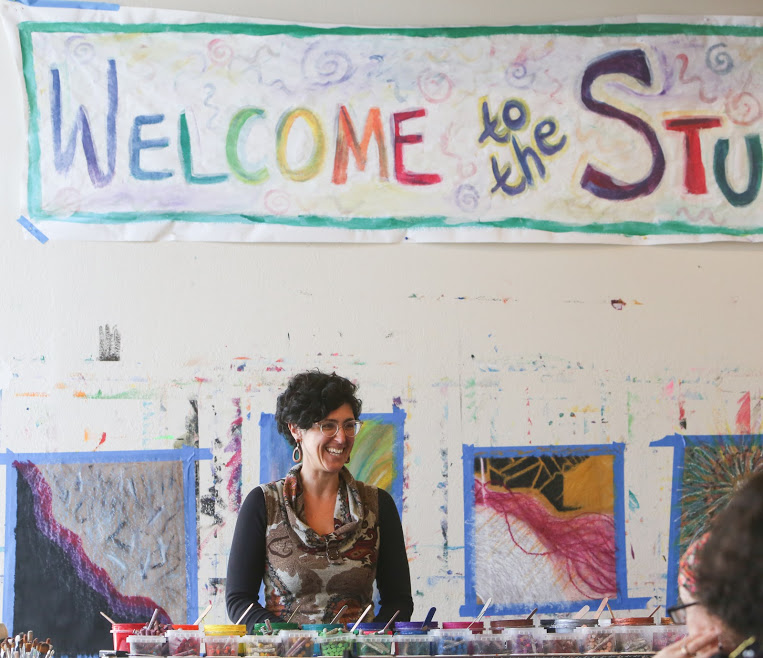
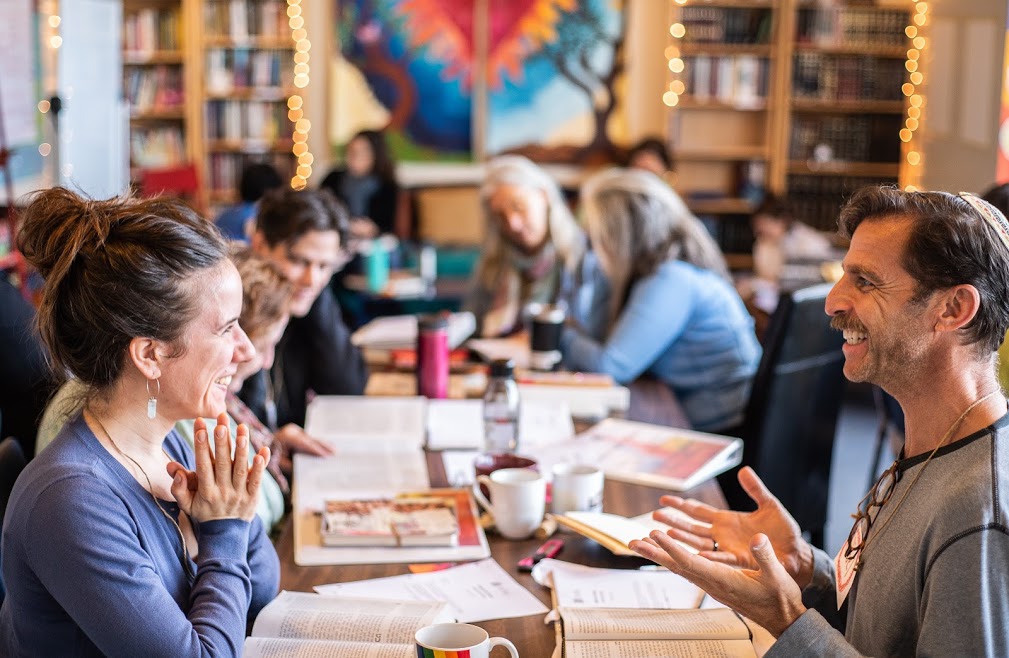
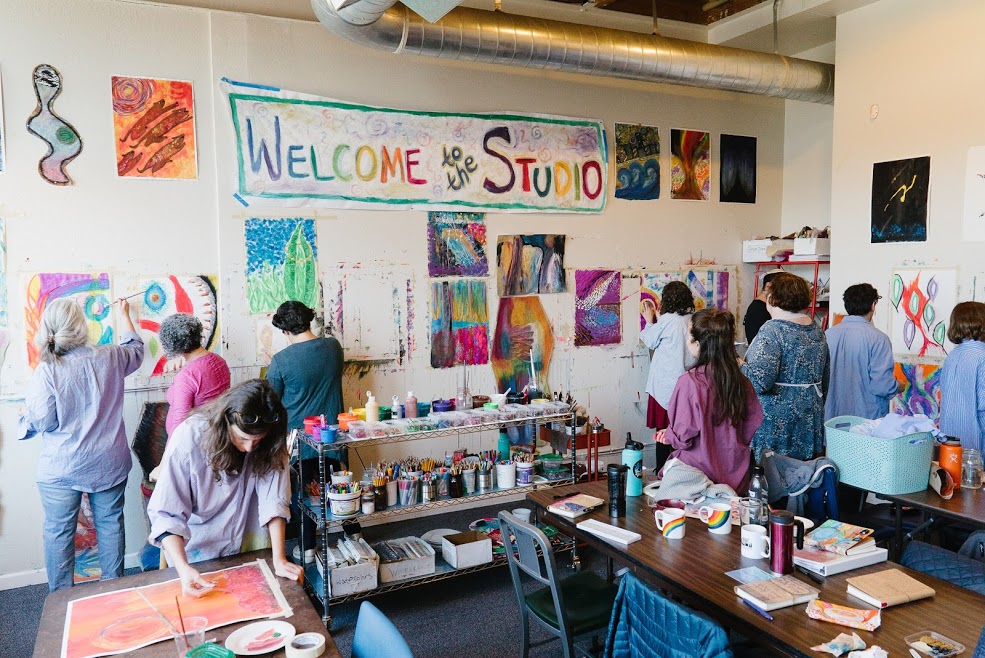
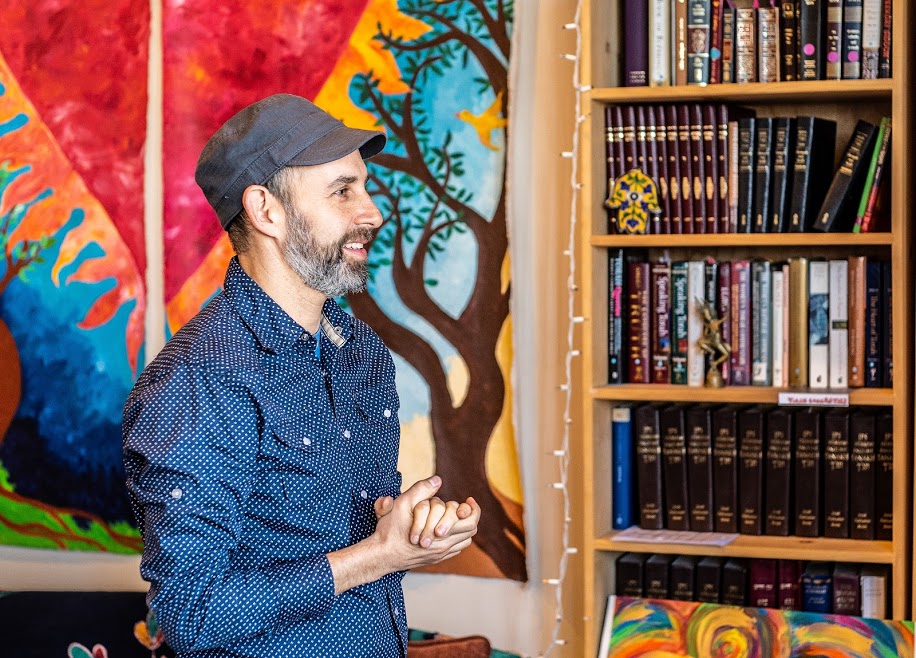
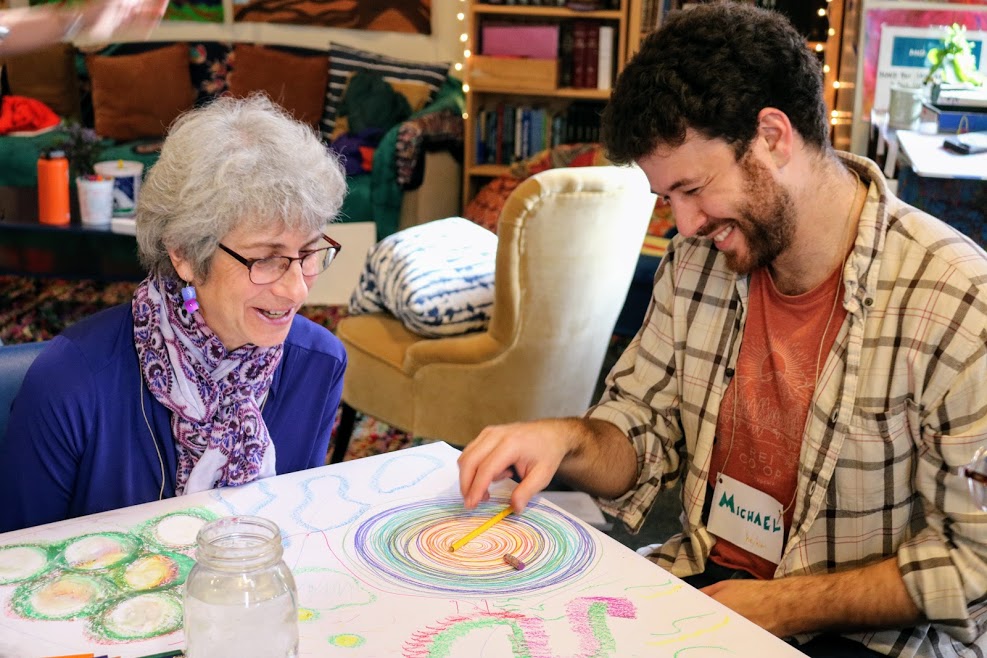
JSP’s pioneering and innovative program moves from the beit midrash, the house of study, to the studio, from a black-and-white page packed with words to a blank sheet, to be filled with lines, shape, and color. The work of the JSP is fueled by a combination of engagement with Jewish texts and artmaking as a way toward an authentic understanding of the self, others, and God. The process involves hands, heart, and mind, deepening a sense of curiosity, compassion, connection to Judaism and to community and, ultimately, to positive social change.
It’s an ambitious agenda, and Allen and Kasowitz have systematically built a highly-praised national organization. While their studio headquarters in Berkeley has a lovely, colorful messiness about it—with abundant art supplies, traces of glitter and paint that didn’t make it onto paper, and curtains that, as Allen says, look like they were repurposed from Burning Man—there’s a clarity of thought driving the project, from their foundational principles grounded in art therapy and Jewish study in hevruta, or partnership, to their vision of social justice.
Rabbi Allen serves as creative director, Kasowitz as executive director. A Wexner Fellow and the recipient of the Covenant Foundation’s 2018 Pomegranate Prize for emerging Jewish educators, she is a spiritual leader with ordination from Hebrew College, a writer, and an educator. Kasowitz is a social innovator, a musician, and an executive whose background includes nonprofit management and strategic planning, with an MBA and an MPH. Both are visionary community builders and leaders; each sees the others’ skills as complementary.
JSP offers programs of various length and intensity. The structured JSP process involves learning in pairs, and the co-founders emphasize the importance of listening, of learning to truly hear another’s point of view, and, together, teasing out new meanings. Participants then “set an intention” and begin using art materials to create something expressive, whether reactive, interpretative, or meditative in some way. No comments on the work—whether complimentary or not—are allowed in the studio. Participants are urged to find pleasure in the work, to “notice everything,” and to keep going. While the process is prescriptive, there’s endless room for inventiveness.
After making something, participants are guided to “witness the work” and write something about it. The art, or finished project, isn’t the point—although participants are encouraged to take their projects home with them and keep engaging with them—but Rabbi Allen and Kasowitz emphasize the process.
Allen grew up in a world of art and action, as her mother, Dr. Pat Allen is an internationally-recognized art therapist, writer, and teacher. She recalls that if she mentioned a concern or quandary to her mother, Dr. Allen would ask, “Have you made art about it yet?”
“Her question was a way for me to discover the answers that I had in me,” Rabbi Allen says. It is a refrain often quoted at JSP, where Dr. Allen serves as senior advisor.
Rabbi Allen says that she entered Hebrew College as a way “to carve a new pathway into the Jewish world.” During her rabbinical studies, she became enamored with the idea of hevruta study—she loved the creative and spiritual interchange and the opportunities to study classical commentaries and insert new interpretations and personal insights. Inspired to bring together the art process ideology she had learned at home with interactive study, she formed a living laboratory, enlisting faculty and students to participate alongside her.
“I wanted to create a Jewish space where people could be authentically who they are, to drop down into that and explore that in an authentic way, to be real with themselves and real with each other.”
After ordination, she and Kasowitz moved to Berkeley and launched JSP. In the early days, Kasowitz says, they would travel from event to event with a bucket of art supplies in their car. Now, they have a $750,000 budget, five full-time staff members and a distinguished board of directors. To date, about 10,000 people—from a variety of age groups and professional backgrounds, including clergy who have been wrestling with texts for most of their lives and others who hadn’t heard the term beit midrash before—have participated in their programs. Some have described the experience as “life changing.” For the High Holidays, JSP runs prayer services, and this past year, more than 1,000 people participated on Zoom.
“A good part of my work with JSP is in the realm of professional development, mostly for other Jewish educators,” said JSP Senior Educator Rachel Brodie. “I've been doing this kind of work for thirty years, but it wasn't until I began to invite people into the Jewish Studio Process that I got to see people transform the cerebral aspects of study into personal insights that they could use both for their own growth but also to bring directly into their work.”
Rabbi Allen is currently working on a book, Created to Create: A Jewish Approach to Creativity as a Force for Personal Transformation and Social Change, and Kasowitz leads their efforts in development and fundraising, figuring out ways to get more people to experience the process, train others, and build a network.
With the pandemic, JSP has shifted its flagship Studio Immersive, a five-day in-person experience in text learning and spiritual practice, to a one-day online program. Recently, they completed their inaugural 18-month “Creative Facilitator Training” with a cohort of 11 participants, which also moved online, including an online siyyum (a closing celebration). Their “Facilitator Training Manual” along with “The Home Practice Guide” were funded in part by a 2018 Covenant Foundation Ignition Grant.
“The Home Practice Guide: A How-To Guide for Making the Jewish Studio Process an Ongoing Personal Spiritual Practice” is particularly well-designed and is distributed to new alumni of JPS. The publication leads participants through the step-by-step process so that they can continue the work beyond the walls of JSP, whether on their own or with a partner.
These days, they also hold bi-weekly and monthly virtual programs and pre-holiday events, open to all (some are free and others are offered on a sliding scale; no one is turned away for lack of funds). While at home, Rabbi Allen says, participants can gather art supplies at hand, including markers and magazines. Some programs emphasize journaling.
On a recent morning, I joined in the robust conversations in a “Creative Commentary” program on Zoom, with participants from the Bay Area and around the country. After some soulful singing and learning based on the weekly Torah portion led by a local scholar, we embarked on hevruta study (in breakout rooms) that felt both intimate and serious. My partner was Sarah Stone, an accomplished novelist from San Francisco, who later said, “JSP was the first place that helped me to make a personal connection between Jewish texts, traditions, and song with my own writing, artmaking, and work for social change.”
Toward the end of the session, we were asked to journal in response to prompts. Participants turned their screens toward their notebooks, opening their hearts to the page. Later some shared poetry and lines linking the learning to their lives and hopes.
By Sandee Brawarsky, for The Covenant Foundation
More to Consider
- Celebrating Creativity (Jewish Boston, February 2021)
- The Jewish Studio Project: Art Making as Another Way to Interpret Our Texts, Evolve, Reconstructing Judaism
- What's Up With G?d - Rabbi Adina Allen and Gamal Palmer in Conversation with Sarah Hurwitz (scroll down to episode 8)
- Creativity as Spiritual Practice, My Jewish Learning
- In the Beginning: A Case for Creativity, eJewishPhilanthropy
- Inclusivity, Creativity and Shavuot, the Jewish Federation of North America
While some retirees move to Florida and look forward to relaxing after a long, productive professional career, others find new and innovative ways to apply decades of professional experience in a new setting, like Rabbi Dr. Marty Schloss.
“I came here and found [school] principals galore, psychologists, reading specialists,” he said recently. “I started talking to them and realized there is a treasure trove of people in our retirement village who could be making a difference!”
A 1995 Covenant Award recipient and a pioneer in the field of Jewish special education, Schloss started to look around at some of the members of the Young Israel of Deerfield Beach, where he serves as president, and shared his ideas with friends.
Schloss’s brainstorm eventually became The Intergenerational Enrichment Center. In 2019, he received a Covenant Foundation Ignition Grant to “create meaningful intergenerational relationships and enhance the Hebrew reading skills of Boca Raton Jewish day school students in Grades K-2 by pairing them with retired educators for tutoring.”
The initial plan was for 20 senior citizens—referred to as “coaches”—to meet with 20 students in their schools. Then the COVID-19 pandemic hit. “We saw that everyone was using distance learning and thought, ‘Why not us?’” asks Schloss. So the program transitioned to iPads and Zoom, where an initial cohort of 10 participants and coaches meet for two half-hour sessions each week. Students work to earn medallions by completing each book in the color-coded “Alef Champ” reading program.
Marla Turk, who has been instrumental in helping Schloss set up the program and recruit tutors and who is a tutor herself, shares Schloss’s observation about the skills of many fellow retired Jewish educators in South Florida.
“We have so much talent here,” she said. “Teachers who combined have hundreds of years of experience.”
Turk, a former New York City Board of Education principal in Canarsie, (Brooklyn) New York, continued her career as headmaster of The Brandeis School in Lawrence, which is in New York.
“We put ads in the local shul bulletins and at first got no response,” she said. “But when I personally approached retired teachers, we got one person, and she told a friend and so on, until we had 10 coaches.”
Turk enjoys her Monday meetings with her first grade tutee, Tehila. Turk explained that they use both a textbook and flash cards to learn letters, vowels, and blends. “You become an Alef Bet champ and receive a medallion at the end of each book,” she said. And perhaps most importantly, “The smile on Tehila’s face is ear to ear!”
What’s more, the two are forming a special bond. In addition to learning Hebrew, “We talk a little bit, and we are forming a relationship.” Turk said, “I love seeing how happy she is. I sense that she is a little more confident.”
Turk started coaching over Zoom from her summer home in New York, and just recently got to meet Tehila in person. She’s having such a good time tutoring that she is already looking ahead to tutoring another student once Tehila completes the program.
Sora Shain, who works with Schloss at their synagogue, jumped at the chance to have her daughter Leora, who is six and a half, participate in the program.
“When I heard what Marty was doing, I immediately wanted our daughters to be a part of it,” she said. Leora, who attends both a local charter school and Hebrew school, “is reading Hebrew more confidently with each class,” Shain added. Plus, having a coach provides additional benefits to Shain and her husband.
“My husband and I are so busy and have no time to review with Leora. But with Turk’s help, Leora has passed two levels so far and has received both white and red medallions,” she said.
Schloss’s program has been so successful that there is interest from residents at the nearby Century Village as well as other area retirement communities. Turk is confident that she will again work her magic and manage to recruit more tutors for the program, and Schloss agrees.
“I know how much all of these people accomplished during their careers,” Schloss said. “Why not do it all again?”
By Howard Blas, for The Covenant Foundation
More to Consider
- Volunteering as a Pathway to Productive and Social Engagement Among Older Adults
- Perceived Benefits of Intergenerational Tutoring
- 10 Literacy Organizations Seeking Volunteers Over 50
- AARP Foundation Experience Corps
- Turning Crisis Into Opportunity (respect ability, January 2021)
- Disability Entrepreneurs: Support Disability in Business (Abilities.com)
Caring. Standing up for others. Engaging with community. Being honest. Creating art. Acknowledging the bad along with the good. Being present. Being equitable. Listening.
Inspired by the film The Adaptable Mind, Tiffany Shlain’s 11-minute exploration of the skills humans need to flourish in today’s world, Sight Line asked five thought leaders—Elliot Cosgrove, Rabbi; Noa Kushner, Rabbi, Liz Lerman, artist; Eric Liu, civics activist; and Martin Shichtman, college professor—to share their thoughts on how one might greet the Jewish New Year with strength and conviction, in a time of such uncertainty and fear.
What follows below are the insights and reflections gleaned from those interviews.
Jump to: Elliot Cosgrove, Noa Kushner, Liz Lerman, Eric Liu, Martin Shichtman
Elliot Cosgrove
“This is what I call a bullhorn moment—it’s a moment redefining institutions, redefining the American Jewish community, and redefining rabbinic careers. But the good news is that the Jewish people, time and again, have reinvented themselves in response to circumstances not of their own choosing.”
Rabbi Elliot J. Cosgrove, PhD, is rabbi at Park Avenue Synagogue in Manhattan. He received his Masters of Hebrew Letters from American Jewish University, studied at the Schechter Institute of Judaic Studies in Jerusalem, and was ordained at The Jewish Theological Seminary. He received his doctorate in the history of Judaism from the University of Chicago Divinity School.
How has synagogue life been transformed over these last months?
Since March, we have turned everything online. If you think about a synagogue as a house of worship (beit tefilla), a house of learning (beit midrash), and a house of community (beit knesset), we have had to figure out how to do all those things virtually. They don’t teach you this in rabbinical school. And the landscape is ever-changing. We’re a New York congregation so we see the numbers that are on the rise nationally, and we remember the months of March and April. No one has a crystal ball. It’s all about scenario planning—you can hope for the best, but you need to expect the worst.
Is faith helpful to your congregants?
I think so. With so much uncertainty and so many unknowns, people are seeking ritual and connection to tradition and community. That could be having the refuge of Shabbat, having family dinners on Friday nights. That could be people signing up for opportunities to learn, or people connecting virtually to Friday night or Shabbat morning services.
And people are asking questions of faith. I think God has a lot of explaining right now. I’ve seen a severity and a quantity of loss over these few months that I’ve never seen before in my rabbinic career. There are a tremendous number of people in pain and seeking comfort through prayer, the words of tradition, and the presence of community. Even when answers elude us, the fact that we are not alone, nor the first to ask these questions, is a form of comfort.
Do you have a sense of what your message for the High Holy Days might be?
The task of my talks, the same as any congregational rabbi, is to speak with passion and relevance to the issues of the day, all the while bringing my congregation closer to tradition and closer to community. The themes of the holiday—whether one is looking globally, hayom harat olam, this is the day world was created, to the precariousness of life—are really brought into full relief by Covid. The theme of many prayers is about the fragility of life, a reminder of what’s actually important in our existence. These are the themes of the holidays every year but felt even more acutely this year. I’m well aware that the sermons I deliver will be delivered virtually. In my lifetime and in the lifetimes of my members, that is unprecedented, so I imagine I’ll be thinking about that. I am also aware that rabbis will be preaching on the cusp of an election cycle, and I am deeply concerned about the health of our democratic ideals and institutions.
Have you seen examples of resilience, an important theme of these days, in your congregation?
Everyone is coping with loss and with dreams deferred and denied. And everyone is seeking to accommodate themselves to a reality we didn’t count on. We’re all being called upon to draw from spiritual reserves in ways we never imagined. What is so unnerving about our moment, unlike other forms of loss, is that we are not yet in a time of healing; we are still in the midst of it. We don’t have the luxury of reflecting back on this experience; we don’t yet have a light at the end of the tunnel. I see signs of resilience, endurance, fortitude of spirit, patience, being able to constantly adjust and recalibrate our lens of vision. These are all the callings of the day.
Is there a prayer that particularly speaks to you in this moment?
I would have to say Unetane Tokef, a central prayer of the holidays in the musaf service. For me, it teaches that despite the fact that no one knows what the next days will bring, we are not immobilized, and teshuvah (repentance), t’fillah (prayer), and tzedakah (deeds of righteousness and giving) are all still well within our grasp. Even in this time of Covid, these three activities are things that every searching Jew can do.
How has your own sense of leadership evolved?
This is what I call a bullhorn moment—it’s a moment redefining institutions, redefining the American Jewish community, and redefining rabbinic careers. The muscle groups that rabbis are being called on to use—about community formation, pastoral care, and future models of synagogue membership—are all transforming, in real time. But the good news is that the Jewish people, time and again, have reinvented themselves in response to circumstances not of their own choosing. Please God, we’ll all look back on this chapter, and say that once again the Jewish people emerged changed and strengthened to meet the future.
Interviewed by Sandee Brawarsky for The Covenant Foundation
Noa Kushner
“The work of the holidays is to bring us together... even though we will be online and in different spaces, maybe reading things at different times. The holidays are going to be especially important for us to feel together and to feel like we can sanctify time, even when we are really all in between.”
Rabbi Noa Kushner founded The Kitchen in 2011 in response to friends who were looking for an informal, transformative Shabbat experience that they couldn’t find. Kushner was ordained by Hebrew Union College-Jewish Institute of Religion in 1998 and served as a Hillel Rabbi for both Sarah Lawrence College and Stanford University. Her written work appears in many publications including The Torah: A Women’s Commentary, and the Prayers of Awe series.
How is your work at The Kitchen evolving these days?
This is indeed a really different moment. And so even if I try to be a rabbi the way I was nine months ago, I won’t succeed. I’m trying to learn very fast what is needed now. How can we be of service?
The mission of the Kitchen remains the same. Our job is to try to connect heaven to earth and people to each other. There are some businesses that are out of business. Ours is more alive than ever. But the way in which we do it may change and is changing.
Have you moved most of your events online?
I like to say technology is like money. It can do a lot of good, and it can be very destructive.
We never used to do anything online. In San Francisco, this was an anomaly: You had to come, you had to show up.
Now, that is all shifting, and we are doing a lot online. One of the things we’re thinking about creating is an audio tour, like in a museum. Maybe you could use it during Elul or Yom Kippur afternoon: You would have a series of tracks and the idea would be, say, to go find a tree, and then press track one to hear a prayer, a prompt. It’s using technology, but the idea is that the participant could navigate it and hopefully find some spiritual depth in a way they might not be able to do otherwise.
How do you create the intimacy that the Kitchen is known for, online?
It is a new modality for us, but it’s the same premise we always had, which is if we are actually praying and if something is going on for us, we hope people will be able to tap into that. The biggest pitfall for us would be playing to the camera, and creating something artificial.
Back when we were praying together live, you could barely see us. We were in the middle of the room, encircled by people praying. I’m not used to people seeing my face, and to be honest I am not so comfortable with that. But at the same time, again, if this is what we have now, for me to not do that would not be living up to what is required in this time when we’re all distanced. I think intimacy is best created indirectly, especially with religion.
Are there new traditions you are envisioning for the Jewish holidays?
We are going to try an experiment. In Italy, there’s a beautiful tradition of “La Passeggiata.” One evening a week, people go out and stroll on the street. We’re having a Shabbat Passeggiata, with masks. We will have streets designated where people can walk and see one another face-to-face. No official program other than seeing one another. A riff on kabbalat panim. We may wear white or have some way to identify ourselves, and different hosts will sit out on their porches.
What will you be speaking about on Rosh Hashanah and Yom Kippur?
I’m going to quote my dad [Rabbi Lawrence Kushner] who says there are two kinds of rabbis: the ones who know what they’re doing before the holidays, and the ones who don’t. I could never be able to tell you this early!
However, the theme of midbar, or wilderness, that sense of being in the middle, of being in between and of being frightened and not knowing where it’s all going to end, I know that’s going to be a big piece of the larger backdrop to whatever it is that we are talking about. This country is in flux in a way that it hasn’t ever been in my lifetime. Certainly, race is a high priority, we’re all thinking a lot about it, racism is on our minds. I heard a Christian minister say that racism is a sin against God. That’s such a succinct way of teaching the religious objection to racism, and our principle of b’tzelem elohim, the understanding that we are each made in the image of God.
Because of our partnership with GLIDE [GLIDE is an inclusive, loving community, including Glide Memorial Church, which serves people among the most vulnerable in San Francisco], we have built a series of relationships and have been involved in on-the-ground volunteering. It has to do with being connected to their space and also being connected to the people and having our missions connected. When the latest racial questions arose, we had a natural place to have conversations. Our partnership is helping us to frame where it is we are going from here.
What part of the holiday service speaks most to you, in this moment?
Unetaneh Tokef. Who will live and who will die? This has never been more right in front of us than it is right now. No one is outside these stark realities. Some of us know it more than others.
Yom Kippur is a holiday where, in a safe way, we think about the fact that we will die, and perhaps we change accordingly. We are living through that moment right now; it’s not an exercise of the imagination.
Is being positive something that is important to you?
I want to be honest over being positive.
The work of the holidays is to bring us together, and in a way that is what is most primary and fundamental, just to come together, to feel that we are together. And I really will feel we will be, even though we will be online and in different spaces, maybe reading things at different times. The holidays are going to be especially important for us to feel together and to feel like we can sanctify time, even when we are really all in between.
Interviewed by Sandee Brawarsky for The Covenant Foundation
Liz Lerman
“Engaging our full selves includes our bodies. Just moving and being part of a group in song, or just bringing our arms up together is beautiful. People feel so much more connected. I’ve put my whole life into this, and it surprises me that it’s still unusual.”
Liz Lerman is an American choreographer and currently an institute professor at Arizona State University. Her style of dance-making is characterized by personal story, multi-generational casting, current events, scientific research, humor, public participation, and interdisciplinary collaboration. In 2005, she choreographed “Small Dances About Big Ideas,”which was commissioned by Harvard Law School. The piece uses motion, sound, and characters to portray humanity’s response—or non-response—to genocide. She received a Covenant Foundation grant to tour the piece across the country.
What is on your mind these days?
I’m thinking deeply about equity and justice and what my role is in bending the world in that direction. In all of my conversations, I bring forward my Jewish spiritual life. I try to speak from experience, not authority; then beautiful things can happen.
I believe that in Judaism we form new relationships with the past, if we are lucky. So much of what we are fighting over in the streets is our histories and how they impact the present; the retelling of our Jewish stories along with fresh commentary is a way of dealing with the implications of the past.
Can dance be a healing process?
Absolutely. Engaging our full selves includes our bodies. Just moving and being part of a group in song, or just bringing our arms up together is beautiful. People feel so much more connected. I’ve put my whole life into this, and it surprises me that it’s still unusual.
People are more fully themselves when engaging in healing or in being in relationship with others. The questions are not just their own. Those acts help heal the inner soul too.
I understand that Shehecheyanu is your favorite prayer.
I first started to bring Shehecheyanu into multi-cultural and multi-religious settings—which are most of the settings I’m in—in the 1990s, talking about how identity and different cultural forms play out on stage. I would introduce myself with the Shehecheyanu and first translated it as we learned it, thanking God for granting us life, sustaining us, and giving us structure, and helping us reach this day. Then I would retranslate it for artists: Isn’t it amazing that given our histories, that we should be here at this moment, right now, together?
What kind of work are you doing with synagogues?
This year, I will work with Temple Micah in the afternoon of Yom Kippur. The place is usually packed then and everyone knows that’s the time when we’ll use our bodies. This year, we’ll try it virtually, with everyone in their homes. Preparation begins in Elul, when Rabbi Daniel Zemel puts forth a question and people send their personal stories back. The rabbi also selects a few congregants to help me make the dance. It is really an eclectic group of all ages. We look through the stories and turn them into a dance that will be taught and then set to a prayer that the cantor selects. Again, the dance and the moving holds multiple purposes, bringing us together, hearing the stories in a new way, and helping us get through the long day that is Yom Kippur.
How does this moment in America relate to your preparation for the High Holidays?
I want to talk about Ibram Kendi’s book, How to Be an Antiracist. I heard him say that you’re either in denial or confession, as white people. I found this useful. When I am in conversation with friends and these issues come up, rather than going into denial, it’s better—according to my understanding of Kendi—to jump to the other side. Do I need to confess? What I have found powerful is that this forces a deeper reflection on what we mean by apology. A lifetime of observing Yom Kippur has given us rehearsal; we spend weeks preparing and thinking about our year and our actions, about ourselves and our community. As Jews, we have this very compelling practice of atonement. You don’t get off easy. Confession, as I have come to understand it as a Jewish concept, is bigger and deeper and more demanding than mere apology.
Where is God in all of this?
I think God is an example of our extreme creativity. Trying to make space for people to recall their innate creative selves is Godlike for me. I am amazed and startled by people’s capacity to do this. My rabbi once said that God is most Godlike when creating. We are created in God’s image and we are most Godlike when we are creating. That is a sustaining thought.
Interviewed by Sandee Brawarsky for The Covenant Foundation
Eric Liu
“As citizens we are charged to repair and heal the community at whatever scale—neighborhood, city, or world. Citizenship is about remembering the weave of relationship and obligation that we are woven into. It’s about remembering that life in community isn’t just about rights for you; it’s equally about responsibilities to others.”
Eric Liu is the co-founder of Citizen University, a Seattle-based organization designed to reframe American citizenship as a moral and communal responsibility. The author of several books, including Become America: Civic Sermons on Love, Responsibility, and Democracy, Mr. Liu served as White House speechwriter for President Bill Clinton and later as the President’s deputy domestic policy adviser. Sight Line spoke with Mr. Liu at his home in Seattle.
At a moment of transformation in American life, you are recasting the idea of citizenship. What does citizenship mean to you beyond the legal construct?
Citizenship is a moral and spiritual question. At Citizen University, we have this broad conception of citizenship beyond papers and passports. It’s an ethical notion. As citizens we are charged to repair and heal the community at whatever scale—neighborhood, city, or world. I’m the son of Chinese immigrants. That has certainly shaped my sense that citizenship is about remembering the weave of relationship and obligation that we are woven into. It’s about remembering that life in community isn’t just about rights for you; it’s equally about responsibilities to others.
You’ve talked about citizenship as a “civic religion.” Can you say more about this concept?
The United States is a society bound together by a set of ideas and ideals, meant to be perpetually contested and argued. This is the foundation of our civic spirit, or civic religion. This concept is made visible in one of our signature programs: Civic Saturdays. These events are a civic analogue to faith gatherings, with all the elements of such a gathering. In addition to song and poetry, we turn to a stranger next to us, get to know them, then look at a piece of civic scripture, which provides the anchor for the civic sermon that will follow.
What kinds of texts would qualify as “civic scripture?”
The texts vary depending on the community, but might include the Constitution, or Section 1 of the 14th amendment (ensuring citizenship rights for the formerly enslaved—and anyone else born or naturalized here—and equal protection of the laws for all). It might include speeches or remarks by John Lewis, or Jack Skirball, who dedicated himself to the fusion of American ideals and Jewish life.
For Jewish communities, classic texts like the Talmud help guide decisions by evoking ancient moral concepts and codes, according to which we might live.
The Talmudic approach to interpreting and debating the meaning of core texts has influenced our work at Citizen University. We use texts that capture part of America’s original compact: equal protection under the law; everyone being equal in dignity, voice, and capacity to participate in self-government. In the U.S. we are blessed and burdened by having such a set of promises. We want to live up to, and not betray, this promise. That means taking the words seriously. Struggling to make the dream a reality was what animated several founding moments of our country, from the original founding to Reconstruction and the Civil Rights Era. Now, perhaps, we are at another founding moment. And we can find our way forward by returning to texts that express our highest aspirations of civic spirit.
You also talk about the value of “power,” and how individuals should understand and activate it more effectively.
At Citizen University we boil this issue down to a simple, but not simplistic, equation: power + character = citizenship. To be a contributor as a citizen means to be both literate and fluent in power; to understand what it is and what it isn’t; who wields it and why. But if all one has is fluency in power, wielding force and having people do what you’ll have them do, untethered to any moral core…then all you become is a finely skilled sociopath. So you must couple that literacy in civic power with a grounding in civic character—how to live constructively in community.
Civic character is expressed through our connection with words, something central to Jewish education—to live among others bound together by the word; to contest the meaning of the word; and to understand that the process of contesting and reckoning with those words is the field within which we cultivate our character.
Your work also celebrates the value of listening, whether it’s for that “still, small voice” of God, or for the wisdom and humanity of the stranger we meet on the street.
Listening is one of most underdeveloped capacities in American civic life today. Everything in our culture, from media to social media to celebrity, incentivizes speaking and transmission, and offers few rewards in the receiving. And yet in every setting related to learning, as well as in lawmaking and self-government, it can’t only be one-way transmission. Truly listening in a humanizing way to someone else’s experiences shows that the stranger next to you is not really a stranger.
What programs are you running that look to inspire today’s youth, and offer ways of making a difference?
We are rolling out a new program this year, a “civic confirmation” for young people guided by elders, and culminating in a rite of passage around civic faith. We are working closely with a diverse group of elders to learn how teachers can create the spaces within which we can change hearts and minds, and the rituals that will help us create an arc of civic, spiritual, and moral formation. Since classes are closed right now, our task as educators is to help develop those spaces. One of the lessons is that each of us, properly understood, is an educator, and everything we do, intentionally or not, is an act of teaching.
In what ways can educators actively model what it means to teach and, by teaching, repair the world?
We can’t be teaching every waking second, but we can be aware of the choices we make in every moment, and those small choices contribute to the repair of the world. For instance, when you take your kid for a walk, do you spend the time scrolling on your phone? Or do you ask them what they notice? If they notice an empty lot, ask them why it’s been empty for so long. If the bus takes a long time to come, ask them why buses take so long in certain parts of town, and who gets to decide that. These small moments can awaken us, and awaken those around us into a kind of civic mindfulness. It’s a corrective to the hyper-individual narrative in our culture that says everything is always about us, now, here. We need a counter-culture that helps us be aware that we are not alone, that we are connected to a past and a future, and that we have obligations greater than our own desires.
Interviewed by Dan Schifrin for The Covenant Foundation
Martin Shichtman
“In times of great trauma, great hatred often grows. It's hard to be kind when you’re anxious and worried about yourself and your family. It’s easy to be manipulated by malevolent forces. I will urge my students to be kind and to practice every-day acts of kindness, which for some might be a simple as putting on a mask to protect others.”
Martin B. Shichtman is Director of the Center for Jewish Studies and Professor of English Language and Literature at Eastern Michigan University. He has been a fellow at the United States Holocaust Memorial Museum and at Brandeis University's Schusterman Institute for Israel Studies and is co-author of Cinematic Illuminations: The Middle Ages on Film (Johns Hopkins University Press, 2009) and King Arthur and the Myth of History (University of Florida Press, 2004). Dr. Shichtman received a Covenant Ignition Grant in 2012.
As you begin to prepare for a new semester in a changed world, what are you thinking about?
I want my students to understand that it is OK for them to think that this situation is really difficult. Isolation is painful. They’re at an age when socialization is so important. In many ways, higher education is not only about learning classroom materials, it’s about socializing, living, loving, and friendships. There are memes on the internet suggesting that young people should toughen up, because this isn’t as hard as what other generations have faced, but I want them to know this is hard, and it’s okay to feel that way.
What are some lessons that you might impart to your students, given the challenges of the Covid-19 pandemic?
In the fall semester, I will be teaching a Culture and Holocaust class, in which we study the idea that in times of great trauma, great hatred often grows. I want my students to be hypervigilant about the kind of fear-mongering discourse that we’re bound to encounter, and how these discourses can move them toward hatred. It’s going to be hard to be kind when you’re alone and anxious and worried about yourself and worried about your children and your parents, as you watch the number of deaths escalate. It’s easy to be manipulated by malevolent forces. But I will urge my students to be kind and to practice every-day acts of kindness, which for some might be a simple as putting on a mask to protect others.
But I also want to impart that we’re not helpless. We need to think about our roles in caring for ourselves, in caring for others, and we need to stand up for each other, in ways that maybe we hadn’t before. We need to stand up for the weakest and most vulnerable members of our society. Even as it becomes beneficial for some politicians to speak hate, we need to stand up against that. The willingness of Americans to stand up for each other is enormously heartening, as we witnessed with the myriad Black Lives Matter demonstrations. We are responsible for each other, for repairing the world, even when we are alone and afraid.
We’re going to beat this a lot faster than we beat other “plagues,” and it will be less dangerous than those experiences were. Our science and determination is better now and if there’s any hope, there’s that.
What are you looking forward to?
I am hoping to take a contingent of university students from Michigan to Israel in May 2021. Sure, if necessary, we could do the trip on Zoom, but it will never compare to the visceral experience of being in Jerusalem and walking those streets. So even if the trip can’t happen next May, we will do it the following year. I am looking forward to having back the ability to travel and to learn and teach face-to-face. And that's going to come back. It may not be in the next 6 months, but I genuinely believe that we will get that back.
Interviewed by Adina Kay-Gross for The Covenant Foundation
Covenant Award recipient and acclaimed photographer Zion Ozeri—creator of The Jewish Lens, In the Image, and The DiverCity Lens—and Sara Wolkenfeld, Chief Learning Officer at Sefaria , have just launched a new educational program centered on Pirkei Avot, a Mishnaic tractate focused on moral teachings passed down over generations.
Supported by The Covenant Foundation, this new project pairs each teaching with a photograph and though-provoking questions to encourage learners to dive deeper into the wisdom of Pirkei Avot and its relevance to our own complicated times. The program presents a new and exciting opportunity for educators and parents to engage students in learning about Jewish values.
Students will also have the opportunity to participate in a contest by submitting photographs that interpret Pirkei Avot's teachings. Those who submit will be eligible to win an Instax camera, and the winners will be featured in an in-person exhibition at the Museum of the Jewish People at Beit Hatfutsot in Tel Aviv.
The contest will be determined by a panel of judges, with consideration given to the amount of 'likes' a submission receives. All contest entries must include: (1) an original photograph, (2) the participant's name, (3) the photograph's title, location, and year, and (4) a caption or short reflection (1-2 sentences) connecting the image to the themes of Pirkei Avot. Submissions should be posted to The Jewish Lens Facebook page by January 14th, 2021.
Texts will be available in English, Spanish, Portuguese, and at a later date in French and Hebrew, on Sefaria.
Any questions can be directed to bhprograms@bh.org.il.