It’s probably safe to assume that lots of Jewish high school kids have acted in a production of Joseph and the Technicolor Dreamcoat—or at the very least, that they’ve seen some theatrical interpretation of the bible story on the stage of their school or summer camp. But it’s also probably safe to assume that most of them haven’t experienced the story of Joseph, the transgendered young man being bullied in high school. “It was an exploration of the gender binary, of the guy who doesn’t fit in, interspersed with deep themes of bullying and identity,” explains Charlie Schwartz, a Senior Jewish Educator and Director of BIMA and Genesis, two Brandeis University high school summer programs that offer intensive courses in the arts, sciences and technology, all within a Jewishly integrated communal campus experience.
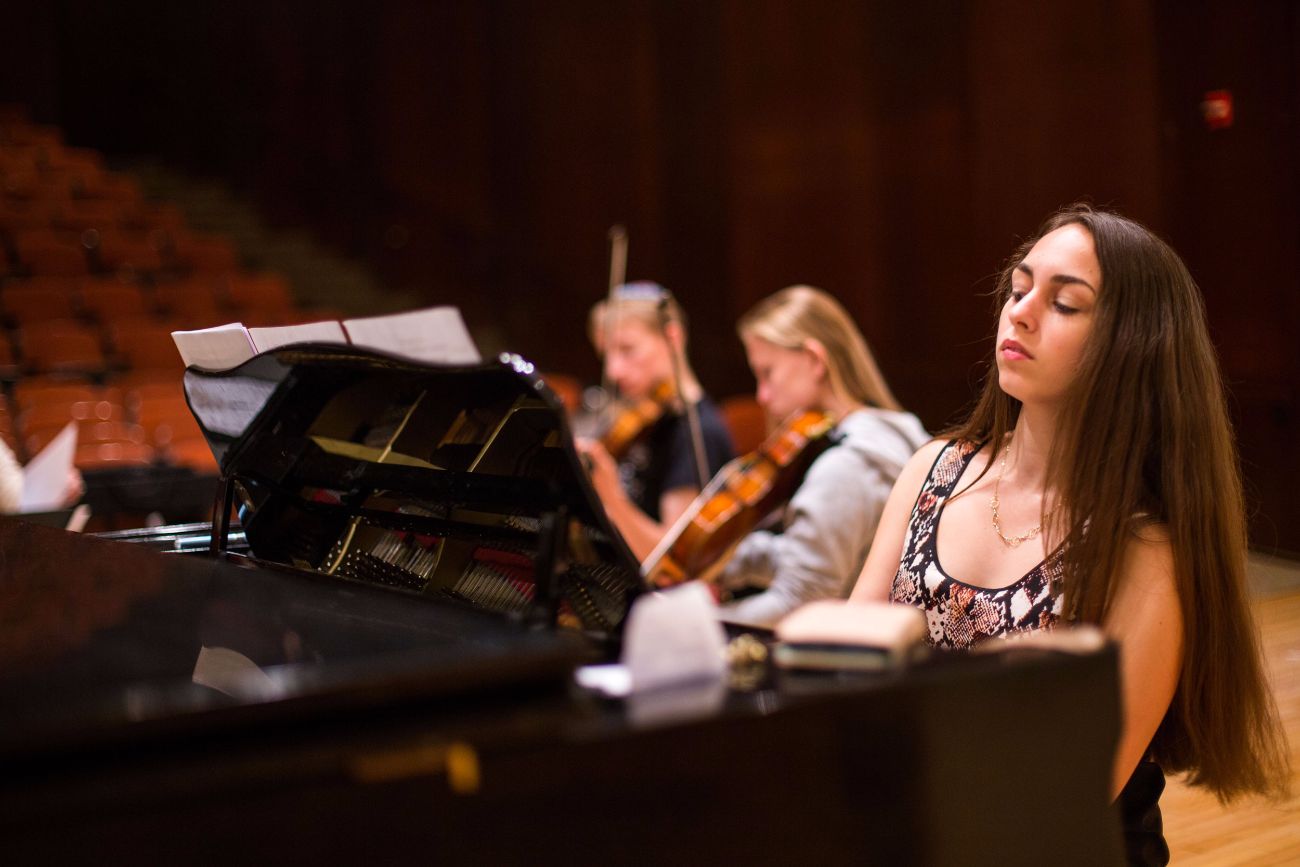
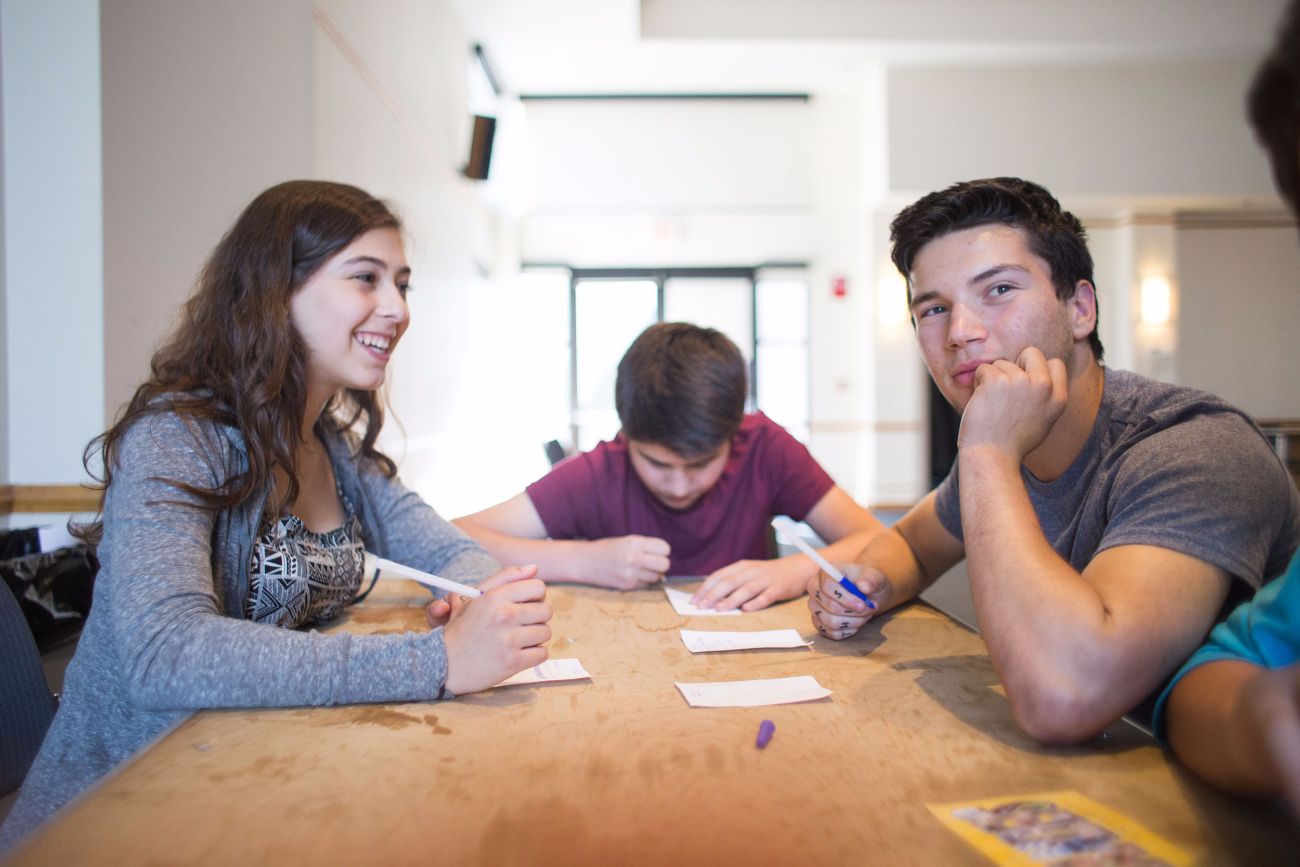
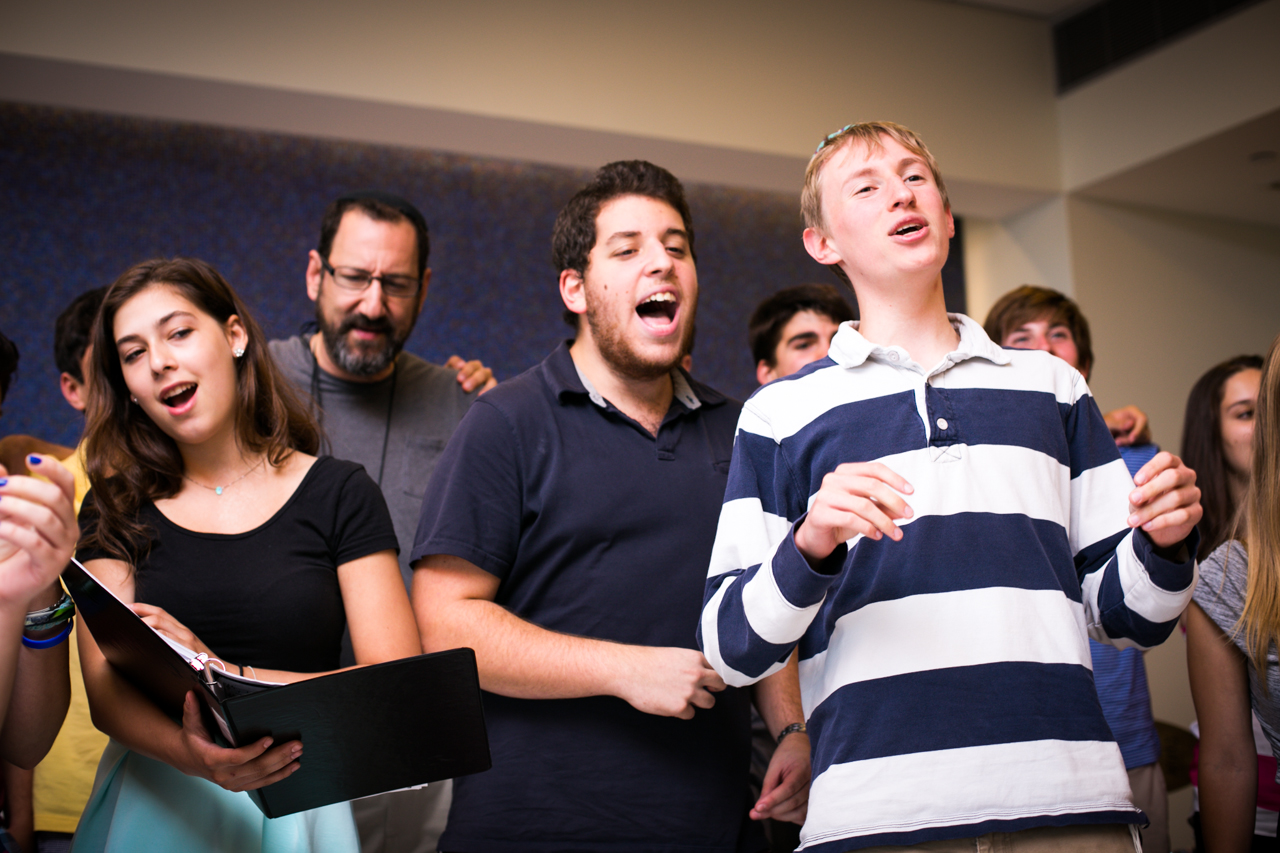
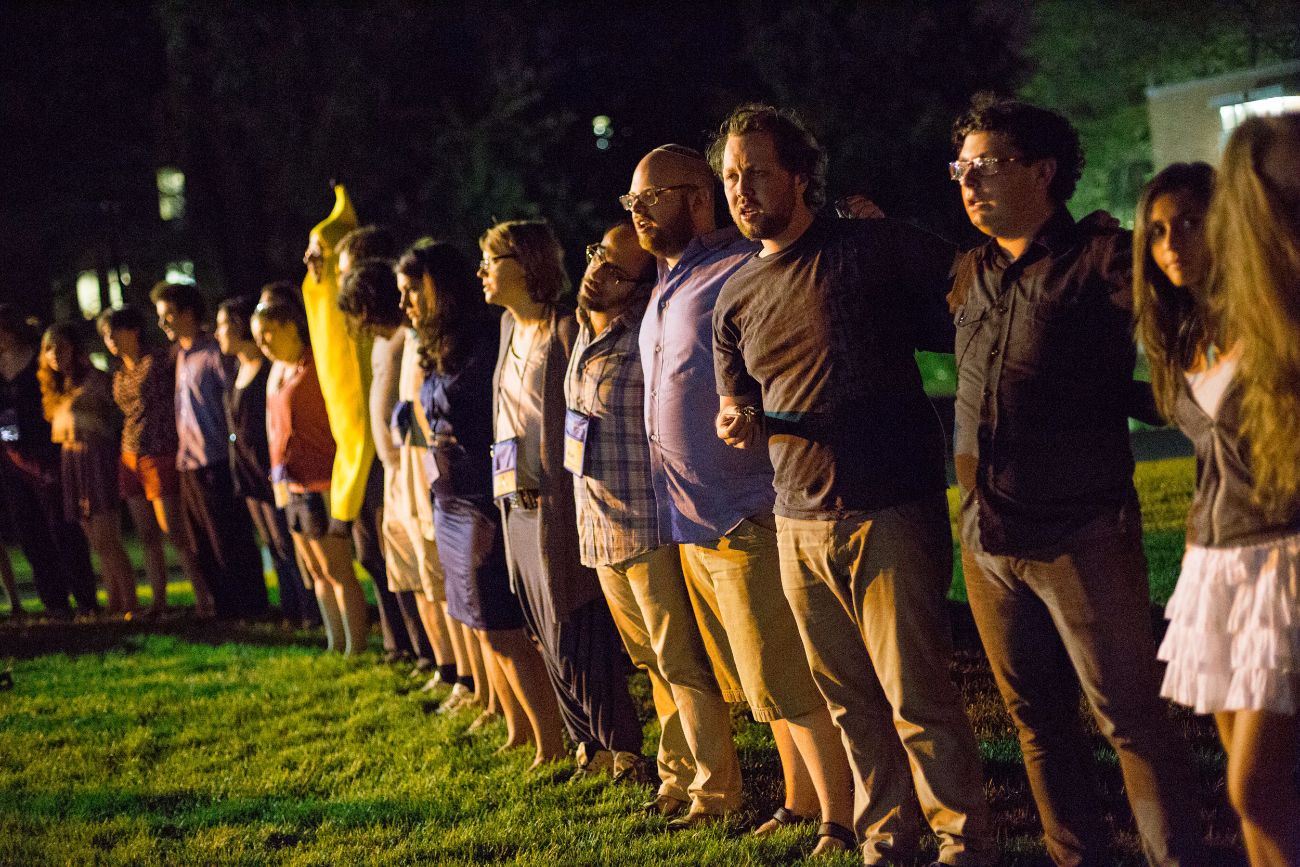

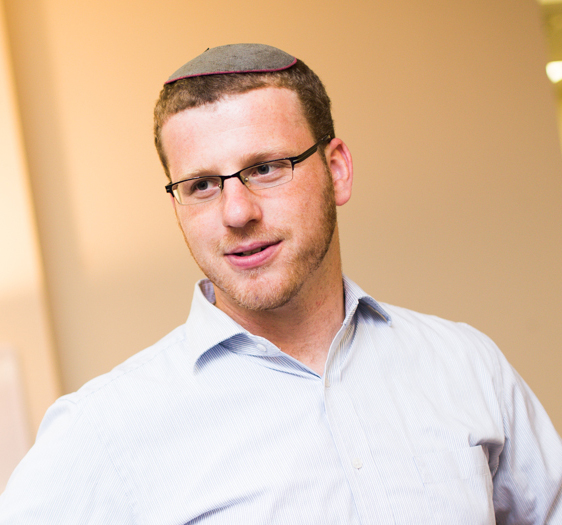
Each summer, BIMA brings high school students from across the globe to the Brandeis University campus for a month to study dance, creative writing, music and theater. But BIMA is not regular old summer school. In fact, the Joseph theater project from last summer is just one example of the ways in which BIMA invites students to develop their artistic passions while simultaneously exploring their Jewish identity. Schwartz explains that in selecting participants for the program, he intentionally tries to create the most pluralistic community possible. “We have kids who identify as Jewish but do not practice any ritual at home, to kids whose first language is Yiddish. There’s a huge spectrum of observance and identity. They are coming to us from Long Island to Nashville to Kiev.”
Both the BIMA and Genesis programs are closely guided by principals of design thinking, which, as Schwartz explains, is a systematic approach to addressing challenges, to opening lines of dialogue within a community and to brainstorming the best ways to address communal needs. “While they’re taking these courses,” he adds, “the students also have to negotiate what it means to create a Jewish community here at BIMA and Genesis. They are not passive consumers, but rather, they use design thinking to consider how we approach sacred space.” For example, Schwartz explains, every Shabbat the community sits together and uses a design thinking process to decide what that particular Shabbat will look like. “Shabbat doesn’t happen to them, but rather, they design it, they craft it,” he says.
And students are supported in their design by a faculty comprised of experts in their respective fields. “We cast a wide net when looking for faculty,” Schwartz says. “We seek those with strong backgrounds in Judaism, in a textual or a cultural way, in addition to the emotional intelligence required to do good residential supervision, and the educational experience to teach intensive courses.” Schwartz speaks animatedly when describing the make-up of this summer’s BIMA faculty, which includes visual artist Batnadiv Hakarmi-Weinberg and Ellen Alt, writer Jon Papernick, collaborative theater maker Lynda Bachman, musicians Carroll Goldberg, Asia Meirovich, Jesse Regan Mann and Greg Wall and choreographer and dancer Mica Bernes.
Featured in this volume is a collection of essays by Liz Lerman, a Covenant Foundation grantee, titled Hiking the Horizonal. In her book, Lerman “reflects on her life-long exploration of dance as a vehicle for human insight and understanding of the world around us." Also featured is The Creative Habit: Learn It and Use It for Life, a book by choreographer, dancer and author Twyla Tharp, in which she offers exercises aimed at generating creativity and helping readers harness their best ideas.
Hiking the Horizontal: Field Notes from a Choreographer
By Liz Lerman

In this collection of essays, Liz Lerman, a Covenant Foundation grantee, “reflects on her life-long exploration of dance as a vehicle for human insight and understanding of the world around us. Described by the Washington Post as "the source of an epochal revolution in the scope and purposes of dance art," Lerman here combines broad outlooks on culture and society with practical applications and accessible stories. Her expansive scope encompasses the craft, structure, and inspiration that bring theatrical works to life as well as the applications of art in fields as diverse as faith, aging, particle physics, and human rights law. Offering readers a gentle manifesto describing methods that bring a horizontal focus to bear on a hierarchical world, this is the perfect book for anyone curious about the possible role for art in politics, science, community, motherhood, and the media.”
The Creative Habit: Learn It and Use It for Life
By Twyla Tharp

In this book, Tharp offers 32 exercises aimed at generating creativity and helping readers harness their best ideas. “In ‘Where's Your Pencil?’ Tharp reminds you to observe the world—and get it down on paper. In ‘Coins and Chaos,’ she gives you an easy way to restore order and peace. In "Do a Verb," she turns your mind and body into coworkers. In "Build a Bridge to the Next Day," she shows you how to clean the clutter from your mind overnight…Tharp leads readers through the painful first steps of scratching for ideas, finding the spine of your work, and getting out of ruts and into productive grooves….” (from Amazon.com)
Featured here is a short tribute to beloved musician, Jewish educator and Covenant Award winner, Debbie Friedman, Z"L, who inspired generations of Jews to express themselves in song and reclaim their spirituality. Also featured is Jon Adam Ross, a playwright, performer and artist who created a stage piece commissioned by The Covenant Foundation, titled "Upon Reflection" in which he explores what happens when we harness the Jewish wisdom all around us, and use it to create a piece of art. In "Stories from a Disappointing Nephew: A Work-in-Progress," Aaron Wolfe, a writer, musician and storyteller, performs the tale of his Great Aunt Ila, who fought in the Krakow Ghetto Uprising, baked the best mocha torte, and taught him not to give up on his dreams.
Shababa!
Shababa is a “welcoming community for everyone, nurtures family bonds and bridges
connections to Jewish life and values.” Led by Karina Zilberman, Director of Jewish Family Life and Culture and recipient of the 2012 Covenant Award, Shababa inspires children and adults alike to engage with their Judaism in a joyful, musical way.
Before Jewish parenting blogs, mohels with websites or online guides to picking the perfect Hebrew baby name, Lisa Farber Miller, a nonprofit consultant from Denver, Co., had what seemed at the time like a radical idea: A glossy newsletter for expectant and new parents, about how to incorporate Judaism into their family lives.
This newsletter would include recipes, activity ideas, glossaries of Hebrew terms and thoughtful commentary on holidays and traditions. One regular feature would explicitly, and warmly, address interfaith families.

“Some people felt like if I even included something like that, I had to come out with a strong statement about the fact that intermarriage was a negative thing,” Farber Miller recalled. “I felt like that wasn’t the kind of inclusive message we needed to be sending.”
In 1994, Farber Miller -- who was knee-deep in a major consulting project helping Denver’s Jewish Community Center reinvent itself -- received a grant from the Covenant Foundation to create the newsletter, Apples & Honey. It was the beginning of a mission that came to define her career: Finding creative ways to bring in Jews on the periphery by filling their needs in an appealing, non-judgmental way, at junctures in their lives when the desire for connection and meaning is most pronounced.
“We’re the 16th largest Jewish community in the country, and anytime you have a market where 65 percent of your customers aren’t using you, you’ve got to think differently,” she said. “People are not going to necessarily come to us anymore. We need to go to them and prove our value and our worth and the beauty that Judaism can bring to their lives.”
For the past two decades, Farber Miller has done just that, as the Senior Program Officer for Jewish Life at Rose Community Foundation, which is dedicated to improving the quality of life in Greater Denver (other program areas are the Aging, Health, Education and Child and Family Development). Farber Miller shaped the foundation’s approach to Jewish grant-making, to focus on welcoming, innovation and a perennial quest for new ways to “connect Jews to Jewish life and to each other.” During 18 years on the job, she has stewarded more than $53 million in grants.
When it comes to bringing in Jews on the margins, Denver presents an interesting conundrum or, as Farber Miller would say, opportunity. She calls it the “native/non-native issue.”
A 2007 demographic study found that a third of Jews ages 25-39 had been in the Denver-Boulder area for less than five years. In many of those homes, one partner is not Jewish.
Though technically not a native, having moved to Denver when she was 18 months old (“It doesn’t count,” she explained), Farber Miller, 60, is the ultimate insider: She met her husband, a fifth-generation Denverite who is now president and chief executive of the Denver Foundation, in the seventh grade, and two of their three grandchildren are seventh-generation Denverites. Still, she has remained keenly attuned to the perspective of the new and disconnected.
“Those people have left their families of origin and are here without the support of family, and maybe can’t afford to belong to a synagogue or maybe don’t see a synagogue as a place where they want to be,” she said. “That’s a tough place to be.”
Many of the projects that Farber Miller has championed target parents with small children. She cites not only the yearning for community that new parenthood often brings, but research on the importance of early cognitive development.
“Even values are formed by the age of five,” she said. “I’m hoping that early childhood and early family engagement will be the next wave in the Jewish world, and people will get on the boat with us.”
To this end, in 2009, Farber Miller helped create MazelTot.org, a website for local parents of young children that quickly became a popular destination -- and a crucial marketing tool for Jewish institutions. MazelTot.org features a calendar listing programs and events for young kids (family getaway at the 400-acre JCC Ranch Camp, anyone?) and offers generous discounts on everything from preschool tuition to ceremonies officiated by a rabbi “or ritual leader.” Beyond surfing for information in isolation, parents are invited to contact one of a dozen “parent connectors,” whose pictures and home neighborhoods are posted online.
“We often get calls from families who are relocating to Denver before they’ve even moved,” Farber Miller said. And while it can be maddening to try to find a human being behind many websites, MazelTot.org has a full-time staffer with a listed number. “He talks to parents all day long,” she said.
MazelTot.org has repeatedly been cited in the Slingshot Guide as one of the nation’s most innovative Jewish nonprofit projects. A recent evaluator determined that the website was “truly moving the needle on Jewish engagement” and urged other communities to “learn from this model and replicate locally.”
Also in the early childhood space, Ms. Farber Miller has spearheaded an effort called BUILDing Jewish ECE, to improve Jewish preschools (or Early Childhood Education centers), help them draw a wider audience, and integrate preschool families into synagogues and community centers so they aren’t lost to the community when their children go off to kindergarten.
And then after kindergarten? Another demographic group Farber Miller is determined to reach: teenagers. In particular, she has come to see philanthropy as a powerful way to excite and inspire young Jews.
“The teen years are when young people are creating their identity and asking themselves, ‘Who do I want to be when I grow up?’ and ‘What’s the good I want to do in the world?’” she said. “Hopefully we will be by their side, to inspire and inform the good that they want to do.”
Of all the programs Farber Miller has created, one of her favorite is Rose Youth Foundation, in which teenage “board members” learn about Jewish values related to giving and tikkun olam. Then, as a group, they determine grant priorities and conduct extensive research to select worthy grantees. Through RYF, Jewish teens have given away more than $700,000 in 14 years.
Jono Bentley, a member of the Stanford class of 2015, had little interest in the organized Jewish community when, in high school, a friend from his jazz band mentioned RYF.
“The opportunity to give $60,000 a year as teens is totally unique and was more intriguing to me than a traditional youth group, or what I knew of them,” said Bentley, who joined RYF and, during his senior year, served as co-chair. “It was very much the catalyst that reengaged me in the Jewish community.”
Bentley is still in touch with Farber Miller. “She is always having coffee with RYF alumni when they’re back in Denver on college breaks,” he said. “She’s very dedicated to keeping a strong connection.”
At a time when many Jewish institutions find it challenging at best to reach those on the periphery, what is Farber Miller’s secret to success?
Listen, then do.
“The most important thing is to listen first, and to understand people, and to not make assumptions about people,” she said. “Learn from the people you’re trying to connect with. Really understand where the gaps are.”
When Farber Miller organized and funded focus groups of teenagers recently, she found that the very experience of being listened to had a palpable effect. “The teens loved it,” she said. “A couple of parents called up and said, ‘What were you doing with my teen in this focus group? They came back and said this was one of the most powerful Jewish experiences they’ve ever had!’”
In her ongoing search for new ways to reach Jews on the margins, Farber Miller is both philosophical and practical.
“It’s learning how to answer the phone, and actually answering the phone, and promptly returning people’s phone calls,” she said. “It’s also being sensitive to the diversity of the human experience.”
Featured in this volume are four books, which each address the idea of Portals to Jewish Life and Learning though a variety of methods. In Relational Judaism: Using the Power of Relationships to Transform the Jewish Community, Dr. Ron Wolfson, presents his idea for revamping the old models of Jewish institutions and focusing instead on building community. In Wise Aging: Living With Joy, Resilience and Spirit, Rabbi Rachel Cowan and Dr. Linda Thal explore a range of issues that concern an aging population, including: relationships with adult children and spouses; body image; romance and sexuality; living with loss; and, cultivating wellbeing. In Seder Talk, Erica Brown offers both a commentary on the traditional haggadah text as well as conversation starters for the Passover dinner table, and in The Green Bubbie, Ruth Pinkenson Feldman offers tools and tips for an “energy-efficient” model of grandparenting.
Wise Aging: Living With Joy, Resilience and Spirit
By Rabbi Rachel Cowan and Dr. Linda Thal

“Grounded in mindfulness and spiritual practices such as meditation, journaling, movement, and blessings from Judaism and other faith traditions, Wise Aging offers social, emotional and spiritual insights to help individuals meet the challenges of second adulthood with a sustaining spirit.
In addition to its use as a foundational text for the Wise Aging program, Wise Aging can be read as a standalone book, and serve as an excellent resource for book groups, and other places where ongoing learning, reflection on experience, spiritual practice, and pursuit of wisdom define the agenda.
Wise Aging provides the road-map for the journey we are all on, and that is especially relevant for baby boomers: achieving a fulfilling older age. No subject is off limits. Rabbi Cowan and Dr. Thal explore a wide range of issues including: relationships with adult children and spouses; body image; romance and sexuality; living with loss; and, cultivating wellbeing.” (Institute for Jewish Spirituality-Wise Aging Newsletter June 3, 2015)
More to Consider
- Aging Wisely, Together (The Forward)
- Rabbi Rachel Cowan, biography
- Linda Rabinowich Thal, Covenant Award Recipient, 1994
Relational Judaism: Using the Power of Relationships to Transform the Jewish Community
By Dr. Ron Wolfson

“With this simple, but profound idea, noted educator and community revitalization pioneer Dr. Ron Wolfson presents practical strategies and case studies to transform the old model of Jewish institutions into relational communities. He sets out twelve principles of relational engagement to guide Jewish lay leaders, professionals and community members in transforming institutions into inspiring communities whose value-proposition is to engage people and connect them to Judaism and community in meaningful and lasting ways.” (Amazon.com)
More to Consider
- American Jewish University Faculty Page
- The Key to Building Community is Social Interactions, Not Social Networks (Jewish Journal)
- Conversation with Dr. Ron Wolfson (Connecticut Jewish Ledger)
The Green Bubbie: Nurturing the Future
By Ruth Pinkenson Feldman

“Bubbie is the Yiddish word for grandmother, but a Green Bubbie is an energy-efficient model of grandparenting. Whether or not you have your own children and grandchildren, you too can be a Green Bubbie—the secret is to know how to nurture those who are growing right in front of you! And if you’re lucky enough to meet a Green Bubbie, she will become the “accidental relative you meet on the road to finding yourself.”
Whether you’re a Green Bubbie or one of her “sprouts,” you can become part of the very special world of organic, intergenerational relationships.”
More to Consider
- Ruth Pinkenson Feldman, Covenant Award Recipient, 2004
- The Greening of Bubbie (Rare Finds, The Covenant Foundation)
- The Green Bubbie website
Seder Talk: The Conversational Haggada

“For award-winning author and educator Dr. Erica Brown, one should approach the Passover Seder with imagination as well as intellect. The Seder's grab-bag of esoteric rabbinic texts, prayers, symbolic foods, and strange farm-animal songs opens the door for commentary and conversation, inviting us to make the exodus story truly our own. SEDER TALK: THE CONVERSATIONAL HAGGADA features two books in one: an erudite, sensitive commentary on the Haggada text with conversation trigger points, and eight short essays for each day of the holiday. In her signature educational style, Dr. Brown includes art and poetry to engage the reader in the sensory emotions of Seder night in addition to thought-provoking questions and life-homework exercises for greater mindfulness, intention, and inner freedom. SEDER TALK introduces ideas from the Vilna Gaon, Stephen King, Rav Kook, the Hassidic Sfat Emet , the Harvard Business Review, and more, creating a springboard for fascinating conversation for all ages.” (Amazon.com)

“The future of Jewish teen engagement can in fact be found in 3D printers, and in text-people, and in service, and outdoor education, and in anything that brings teens into contact with authentic learning experiences and passionate, caring, knowledgeable educators.”
—Charlie Schwartz, Senior Jewish Educator, Director, BIMA & Genesis, Brandeis High School Programs
If you’ve ever stepped foot inside an early childhood Jewish education center in the late morning on a weekday, you may have asked yourself if you chose the wrong career path. There’s the delicious smell of baking challah wafting through the air, the gently raucous sounds of small voices singing and playing echoing in the hallways. There are colorful displays of children’s artwork on the walls, and a walk down any corridor usually reveals classrooms stuffed with books and art materials and happy faces.
Most early childhood Jewish spaces are joyful, warm and uplifting. These are places one doesn’t readily want to leave.
But here’s a sobering statistic: In the next 3-5 years, JCC Association of North America predicts that 50% of its’ early childhood education staff will retire. Right now, there are 8-10 positions in JCC early childhood centers nationwide that are left unfilled, and it’s not because these aren’t great jobs. But somehow, young and energetic childhood educators aren’t gravitating toward this field.
So what’s happening?
“We haven’t done enough recruitment, for one,” explained Cantor Mark Horowitz, Vice President of JCCA and Director of the Sheva Center for Innovation in Early Childhood Jewish Education & Engagement. “We need better recruitment efforts on college campuses and in graduate school.”
What’s more, Horowitz explains, young Jewish educators don’t necessarily see Jewish early childhood education as a long-term career path. Perhaps it’s because the pay is notoriously low. Or perhaps it’s because many early childhood Jewish education schools don’t offer full-time positions.
Horowitz is frank about the historical moves that set our community up for the ECE staff shortage we see now. “Many of us we were tapped to be leaders and directors because we were decent practitioners, but we didn’t understand leadership, or change, or what it means to be a leader in a Jewish institution,” he offered. “As such, we accepted roles we weren’t equipped for.”
It seems that the tide may be turning though, and not just in the Jewish space. Just recently, the Harvard Graduate School of Education announced the Saul Zaentz Early Childhood Initiative, the first of its kind. Among many other programs, the initiative will include an Academy for professional learning.
Horowitz and his colleagues are on-trend. They know that Jewish families with young children continue to need excellent schools for their youngest children and JCCA is responding to that need in the most robust way it knows how. “We now understand that we need leadership training,” Horowitz continues. And as the recipients of a recent Signature Grant from The Covenant Foundation to fund a Directors’ Fellowship, JCCA staff is working toward the fruition of that ideal.
The grant will help develop the high quality personnel needed for excellence in the field of early childhood Jewish education. “We spent so much time throwing people into the job who weren’t equipped to handle it,” Horowitz said. “And that didn’t serve us well in the past. Now, we want to train new early childhood directors so that they’re prepared to be leaders.”
Beyond leadership, there are other core changes afoot in the early childhood space that Horowitz passionately describes. For one, JCCA is beginning to “embrace the Jewish piece of our work as a foundational piece instead of worrying whether we’re doing too much or too little Jewish.”
“Judaism is a religion that you live every day, not just one that you access when it comes time for a holiday,” Horowitz explained. “And for that reason, it’s a religion that fits early childhood education so well. We can use day-to-day experiences and challenges to celebrate Jewish life; Judaism informs how we greet people, how we solve conflicts, how we are hospitable to others, and on and on. I think that over the last 20 years or so, a big change in early childhood Jewish education in the JCC world is that we have begun to truly embrace Judaism as foundational for our curriculum.”
Another big change: taking note of and beginning to apply gleanings from the scientific research being done on the national national ECE scene. For years now, we’ve all been reading about the findings about how children learn (think: Play!) and how young brains work. Staying abreast of the research helps Horowitz and his colleagues develop curriculum according to what children need, from a root biological and scientific perspective.
“Up until now,” Horowitz explained, “our approach has been didactic. We’ve taught children what we think they need to know. But over the last 10 years, because of all of the research that shows otherwise, we are beginning to think about what is meaningful and interesting to children, and then together we construct knowledge.”
To that end, key JCCA ECE programs like Discover CATCH (Coordinated Approach to Child Health) bring the science into focus, in a Jewish setting, and also meet the needs of young families who are looking not only for direction while raising Jewish kids, but looking for parenting support as well. Developed at the University of Texas, Discover CATCH is a response to the national epidemic of childhood obesity. At JCCA, under the leadership of Steven Becker, the Vice President of Health and Wellness Services, a Jewish lens approach that considers the imperative of shmirat haguf offers parents tips on helping their toddlers make healthy choices, from what to order when eating out (there are “whoa” foods and “go” foods) to helping foster a love of physical activity. Currently, there are 75 JCCs across the country implementing the Discover CATCH program.
Horowitz knows that to best serve Jewish families with young children, flexibility is key, which is why teaching toddlers how to eat healthy at restaurants is so useful to the busy modern family of today. Another such offering at a number of JCCs invites parents in to share cocktails while they make school lunches for their kids. “They come in, they have a glass of wine, and they put together 5 lunches for the week,” Horowitz explained. “They’re socializing but they’re also building community while being productive and crossing off a pressing household chore.”
“Families are struggling to just keep up, financially and emotionally,” Horowitz continued. “We need to meet them where they’re at. We need to give them tips on parenting, we need to invite them into the community in ways that work for them.”
The Discover CATCH program is just one example of how Horowitz and his colleagues at JCCA understand seamless Judaism, the idea that there is no demarcation between the Judaism that happens in the synagogue or school and what happens beyond. It’s a common theme amongst the foremost practitioners, advocates, administrators and thought leaders in early childhood Jewish education today.
And Horowitz would love to see even more collaboration amongst that cohort. “It would be great if, rather than functioning in our individual silos, as we’ve done in the past, we worked together more closely,” he said. He went on to explain that in some important ways, this collaboration has already begun, as JCCA has partnered with the URJ, and together with Cathy Rolland, the URJ Director of Engaging Families with Young Children, a number of cooperative projects have started.
“That’s just the beginning,” Horowitz assured, going on to explain how he’d love to see cross-pollination amongst early childhood educators in the Jewish community, like other Jewish educators benefit from, in fields like camping and day school education.
“As early childhood Jewish educators, we have access to the proverbial gateway to Jewish life. It’s at our fingertips,” he added, emphatically. “We can help set families on a course for the rest of their lives. We should be doing that in the best way we know how. This is not a competition. This needs to be a collaboration.”
Imagine a classroom where a cluster of three-year-olds mix colorful liquids at a potion station, while others play with robotic modules or experiment with construction materials at the invention table. A shelf of journey binders lines the wall, with photos of each child, samples of their classroom creations and teachers’ written observations about their growth and learning, for parents to peruse as they wish. There is no waiting for recess to get fresh air, as the classroom extends into the outdoors, with opportunities to garden, paint or play musical instruments outside throughout the day.

After dismissal, the teachers don’t pack their bags and head out. Instead, they sit together for an hour, reflecting on the day and what they might do differently tomorrow.
This is the sort of classroom that Diana Ganger dreams about, and is trying to make a reality within the Jewish community’s constellation of early childhood centers based in synagogues, Jewish Community Centers and day schools. As a school leader (director of the Moriah Early Childhood Center in Deerfield, Illinois), program director (at the influential though short-lived Jewish Early Childhood Education Initiative, or JECEI) and, now, independent consultant to communities and educators across the country, Ganger, a 2008 Covenant Award Recipient, has devoted her career to shifting the thinking around how the Jewish community welcomes families with young children.
While many institutions are inclined to treat early learning programs as a cash cow, generating funding to cover other expenses, Ganger sees them as a cornerstone of Jewish life, worthy of continual investment and deep consideration in their own right.
“This is not just about early childhood,” Ganger said. “This is the entry for families as they build their Jewish identity. It’s the first Jewish experience for many parents, after maybe having traumatic experiences growing up.”
By breathing new life into early childhood education and creating schools “that really embrace the whole family,” she said, “we can change how Judaism is lived in this country.”
Ganger traces her approach to her training as a social worker and her upbringing in Buenos Aires, Argentina, famous for its outsized population of psychologists and recognition, as a culture, that everyone could use a good therapist.

“You need to have a certain understanding of yourself before you can go out there and connect with others,” she said.
Ganger’s perspective was further shaped by her own two children’s earliest classroom experiences, first in St. Louis, Missouri, then in Chicago, where she still lives.
At one preschool, parents could peer into their children’s classroom through a one-way mirror -- an incredible way, she marveled, to bring parents into the fold without disrupting their kids’ classroom experience.
At another school, she requested to meet with the principal after seeing something that concerned her. She was told she’d need to wait a month -- a red flag, signaling the school wasn’t interested in what parents had to say.
Ganger loved the warm, nurturing feel of a third school. But she sensed that the teachers were burned out, and learned that they weren’t getting the training or development that all teachers need. “A culture of listening was not in place,” she added.
And so, when Ganger was offered a job as a teacher and assistant director at Moriah, she pounced. She stayed for two decades, including 18 years as director.
“The conversation at that time was only about children,” she said. “There wasn’t an understanding of the fact that children are embedded in families. To me, the family became the client. It was very important to begin to create and empower families to be a big part of the system.”
Ganger also sought to “transform the role of teacher,” from top-down instructor to facilitator of children’s innate interests and curiosities. “We need to change the way we listen, the way we connect, the way we observe,” she said.
In 1991, Ganger read a Newsweek article about Italy’s innovative Reggio Emilia schools, where classwork is organized around themes and projects, and where highly attuned teachers and parent volunteers recognize and nurture children’s differences. “A school needs to be a place for all children," as the schools’ longtime director put it, "not based on the idea that they're all the same, but that they're all different."
For Ganger, something clicked. “I thought, ‘This is it,’” she said. “This is my language.”
Ganger began thinking about ways to meld the Reggio Emilia approach with Jewish concepts. She developed a set of “lenses” through which early childhood centers might consider every aspect of their work: Masa (journey), representing reflection, return and renewal; B’rit (Covenant), representing belonging and commitment;
Tzelem Elohim (Divine Image), representing dignity and potential; K’dusha (Holiness), representing intentionality and presence; Hit’orerut (Awakening), representing amazement and gratitude; D’rash (Interpretation), representing inquiry, dialogue, and transmission; and Tikkun Olam (Repair of the World), representing responsibility.
The lenses are a way to achieve what Ganger calls “seamless Judaism,” saying, “Judaism needs to be lived. It’s not about, ‘now we’re doing something Jewish, now we’re not.’”
Similarly, Ganger warns against regimented block scheduling. If a music teacher comes into a classroom and some children are so immersed in their activities that they don’t want to switch gears, she believes they shouldn’t have to. Or what about carving off a couple of hours on Fridays for teachers to transform their classrooms into immersive experiences devoted to cooking, or science, or theater -- and giving children the freedom to choose where they go?
“It’s empowering children to know how to make a choice and giving them time to linger in an experience that they find interesting, and it’s allowing the teachers to use their strengths to offer things that excite them,” Ganger said. “One of the big ideas about Shabbat is that it’s a day when you linger, a different day. This goes perfectly with that.”
“Children need time to process, to problem solve, to create, to imagine, and it takes an unrushed environment to be able to get there,” she said.
Beyond the challenges of creating such an environment, schools must bring on board a generation of parents riddled with anxiety about their children’s place in a fiercely competitive world.
“We need to take the parents away from the whole concept of academics to the concept of intellectual development, and that school is for life, school is not for the next grade,” Ganger said. “There’s an anxiety to put children in all kinds of learning opportunities that in the end do exactly the opposite. They need time to create, they need time to be, they need time to explore. Parents want to do what they think is best, and in the end they’re stealing childhood away from their children.”
In recent years, Ganger has seen Jewish early childhood centers across the country struggle to meet parents’ childcare needs by offering extended hours or taking younger and younger children.
“I’ve seen this happening everywhere,” she said. “Parents need it. Is it a good thing or a bad thing? That’s a good question. It’s a great thing when it’s done right.”
Doing it right, of course, is even trickier when the day is longer and resources are stretched to accommodate the unceasing demands of infants. And then there’s the issue that, Ganger said, causes her “huge anxiety”: teacher pay, which may drive potential superstars away from the field.
“We need to wake up,” she said.
Still, if she were given a single question to understand a school, it would not be about teacher’s paychecks, but about the time they spend in meetings with colleagues, supervisors and coaches, reflecting upon and honing their craft.
“Most schools do not have the money or the understanding that in order for teachers to be really present, they need to have time to move away from the work and reflect,” she said. “Look at Google. Twenty percent of Google employees’ time is spent sitting down and creating and playing with things and inventing and dreaming.”
These days, Ganger spends much of her time coaching school directors, mentoring emerging leaders in the field and building a national network of excellent coaches in partnership with the Paradigm Project, whose mission is “to multiply, nurture and network the seeds of excellence in Jewish early childhood education.”
“I believe in mentoring the future of this field,” she said. “That will be the group that takes it further.”
In her coaching and consulting work, Ganger makes clear that she doesn’t have all of the answers. Which is precisely the point.
“I’m hoping that schools will understand themselves as places for experimentation and learning, that people will try things and take risks,” she said. “I’m hoping that they will embrace not knowing, and not having to know everything.”
It’s called the Hub, and true to its name, it’s become a virtual meeting point for Jewish Early Childhood educators looking to share ideas, camaraderie, and support.
Here on its user-generated, members-only Facebook page is everything from how to design a sensory table for two-year olds learning about Havdalah, to a discussion about creating a collaborative school culture that values Jewish Early Childhood Education (JECE).
The Hub is just one interactive manifestation of The Paradigm Project, an ambitious initiative that is engaging, equipping and empowering Jewish Early Childhood educators on the one hand, and by virtue of its existence, elevating the field on the other. On both counts, it is filling a need that is increasingly urgent.
“Children’s development in the early years is rapid and dramatic,” said Anna Hartman, Director of The Paradigm Project and one of its founders. “Just as they are growing during this period, so too are their families. And if families are exposed to a quality program, it opens their eyes to the possibilities of Jewish engagement and identity, especially if they have a neutral view of Jewish community and practice to begin with.
“If we can introduce, inspire or excite them through Judaism and meaningful education at that early point, then they have potential to be part of Jewish life very long term and it can transform the whole community.”
Often overlooked within education, viewed by some as organized babysitting, Early Childhood Education is beginning to garner the attention it deserves. Its value and priority on the secular side gets mentioned in State of the Union addresses, is being discussed in the presidential campaign, and municipalities are establishing guaranteed pre-K programs for families.
Advancing the Jewish take on all of this, The Paradigm Project was established just four years ago. It is the initiative of a small group of visionary and young Jewish Early Childhood Educators who recognized the importance of their work to children, families and community, but who felt generally constrained, even frustrated, by lack of Jewish communal support or attention to the field.
The founding group members were all alumni of the Jewish Early Childhood Education Initiative Fellowship – supported by The Covenant Foundation – and emerged from it dedicated to creating a movement that would earn recognition for - and bolster - JECE.
What emerged is a robust and growing group of JECE educators leveraging the power of social media, specialized communities of practice, expert coaching and in-person conferences to redefine and refuel the field for the 21st century.
It is a group married to the notion of egalitarian, grassroots energy pushing ideas, forward-thinking pedagogies, and impact - the antithesis of a top-down hierarchy that founders believe would have squashed an emerging field, rather than nourishing it.
“In the absence of something, you create something,”said Ellen Dietrick, Director of Early Childhood Learning at Temple Beth Shalom in Needham, MA, and one of The Paradigm Project’s founders.
“As Jewish Early Childhood Education Initiative Fellows, we had an experience that was transformational for us. We wanted to give that to other educators. No other platform existed for us. We created our own with our own stamp, approach and energy.”
That 21st century entrepreneurial spirit is driving this group to disrupt more traditional approaches to building and sustaining JECE and give it its place on the Jewish communal table.
By plugging powerfully into the connectivity of social media, for example, teachers who may be the sole advocates for JECE in their schools - isolated organizationally and even geographically - find common purpose. Sharing in and contributing to such channels as The Hub, and even Pinterest, JECE teachers are creating home and community.
Take Amy Meltzer, for example. The 2015 Covenant Award recipient, who teaches kindergarten at Lander-Grinspoon Academy in Northampton, MA, is the only JECE teacher at her school and only two other JECE classrooms are within about a 60-mile radius. Active participation in The Paradigm Project has shattered a sense that she is going it alone, she said.
“I’ve been figuring things out all by myself,” she said, “so just being part of Facebook conversations alone and engaging in topics there is huge for me. It gives me exposures that are not available to me as a teacher in a small community. My practice is exponentially better when I can reflect in conversation with others.”
This very real and tangible sense of connection – this culture of sharing and support – that is facilitated by The Paradigm Project is proof positive that this sector of Jewish education is hungry, the Project’s founders said
In fact, teachers connected to the initiative are dubbed as “Paradigm Shifters,” emboldened through connection to stamp legitimacy, stature, and pride on the field.
“As we share our work and learn from each other, we are becoming advocates for the dignity and importance of our work,” said Hartman, a recipient of The Covenant Foundation’s Pomegranate Prize for leadership and potential as a young Jewish educator. “The image of high-quality JECE is taking hold and spreading.”
The Paradigm Project convened its second, multi-day national conference for JECE teachers earlier this year near Washington, DC. The conference attracted 160 participants representing 84 schools from throughout 20 states.
The multiplying effect is huge. Knowledge, insights and approaches discussed and shared there continue to reach untold numbers of educators as participants, once home, spread the wealth with colleagues and inject their institutions with new focus and attention to JECE.
Jenna Kalkman-Turner, Director of Early Childhood Education at the Harry and Rose Samson Family Jewish Community Center near Milwaukee, said the influence of The Paradigm Project had infused nearly 75 educators there from the trickle-down effect of her active participation.
“We see lots of change at the JCC because of it,” she said. “Lay and executive leadership are giving us more of a platform, our educators are not seeing themselves so much in a vacuum, and lots of conversations are being started and continued here.”
With two major grants from The Covenant Foundation to support its establishment and work, and support from other Jewish organizations, as well, founders believe that the impact The Paradigm Project is having on JECE practices is getting noticed and being given weight.
“Our orientation is toward change,” Hartman said.“We are impatient in our desire to take agency, ownership and control and move forward. This is what propels us as a network. There is an opportunity to elevate this field and do even more incredible work and so we want to just do it and get it done.”
Avi Rubel is the Co-CEO of Honeymoon Israel, an initiative that takes groups of newly married couples on heavily-subsidized nine-day tours of Israel. Open to participants between the ages of 25-40, and specifically geared toward those who are “confronting the deep questions about their futures and their families’ Jewish futures,” HMI participants tend to be largely interfaith. But regardless of their religious background, a common denominator amongst HMI participants is their desire to deepen their connection to Judaism, through community.
We spoke with Avi Rubel about how Honeymoon Israel responds to and functions to support couples at the very tender stage in which they begin to consider starting a family.
Covenant Foundation: Lets begin by discussing the obvious links. How does Honeymoon Israel intersect with Jewish Early Childhood issues?
Avi Rubel: In some ways, the name of our organization isn’t entirely accurate. Most of the couples that come on the trip aren’t necessarily in the honeymoon phase, but rather, they are right in that spot where they’re thinking about having their first child, and they’ve started thinking about the kind of family they want to create. What kind of values will they instill?
We’re learning that being in this phase is a real motivation for those couples that are applying to HMI. And this makes sense. For one thing, Birthright has created an image in people’s minds that immersive experiences can be very powerful, so couples are turned on by this idea and people in general seem to intuitively understand the power of these experiences. Second, people in early to mid 30’s (33 is our average participant age) are in a hard spot. It’s not easy to make new friends at that stage.
When we interview couples who have applied for the trip, we repeatedly hear the mantra “Wow, if we could meet some couples in the same place as us, it would be a game changer.” We’re tapping into a real need for this population.
CFN: So how does HMI support couples at this stage of life?
AR: For us, our whole purpose—our mission—is to give a couple—through this shared experience of visiting Israel—a community of other couples who are navigating the exact same issues: starting families, finding community support back at home. When you’re in your early 30’s and having your first child, it’s not easy to figure out how to be social, and find community support.
When couples return from this trip, we try to put them in the driver’s seat to build micro-communities at home. Some will get integrated into the larger Jewish community, but most are not necessarily open to that. We do provide some hands-on support through HMI representatives in their home cities, but we don’t plan programming. We find that the HMI returnees are getting together in groups and coming up on their own terms with the ways they’d like to be involved, together. They might decide they want a parenting group, where they can meet and talk about raising kids, or a book club, or a group to learn more about Judaism. We’re working hard at developing resources they can access financially and otherwise, so that we can meet them halfway in their efforts.
CFN: What happens on an HMI trip that helps to foster the closeness you see amongst these couples?
AR: Out trips are not “workshoppy.” Couples get to know each other organically. But we do run a few reflection sessions on the trip where couples can share and be very intimate about the things they’re experiencing as couples, what they deal with back home, and those conversations end up leading couples to feel connected to each other in ways that are hard to achieve in a large city, surrounded by the distractions and demands of work and extended family. Our goals are simple: to help they feel connected to each other and a sense of welcome to Jewish community.
CFN: How are participants selected? What’s the general demographic of the group? And what are you seeing, when you informally study the demographics of those who are applying?
AR: We’ve got about an average of 4 couples applying for every spot. We pick the one couple for each spot that is least engaged in Jewish life. About 70% of our couples are interfaith. About 30% have a partner who is a recent convert to Judaism or a partner who is struggling, not yet clear on how they relate to being Jewish.
We really want to contribute to the Jewish community’s understanding of who the young couples in our community are. Based on Pew Report data, couples that we’re bringing on HMI represent the majority of Jewish couples. We want to be partners in educating the Jewish community, partnering with the community and meeting couples halfway. This doesn’t mean just inviting these couples into structures—like synagogues and JCC’s—that already exist, but understanding that these are people who are actively choosing a different path. They know those structures exist and yet they’re not partaking.
We’re also finding that the paradigm has shifted. In the past, the Jewish community was focused on investing in college-aged Jewish young adults. Then many years would pass, and once those college kids had their own children, they would begin to show up again in Jewish spaces. But now, the window of time is longer between college and child-bearing. We’re beginning to understand the importance of investing in young adults before they arrive at the preschool stage. We’re too early in our research to make an definitive statements but we hope to see, in years to come, that those who chose to participate in HMI are more likely to send their kids to Jewish preschool, Jewish summer camps, or Jewish Day School, based on these experiences.
CFN: What are HMI alumni saying about the impact of the trip on their lives?
AR: Why don’t we hear straight from the participants? Here are some thoughts from one of our San Francisco-area couples, who went on the trip in December 2015:
Talia Gracer and Todd Ryan:
“We applied for Honeymoon Israel because it seemed like an incredible opportunity for us to see and experience Israel together as a couple. I had been previously, and this trip would offer Todd the chance to experience Israel for the first time.
The experience we had on the trip solidified our commitment to teaching our son JB (almost 2 years old now) about the Jewish traditions, incorporating the language and teachings into our daily and weekly routines and it emphasized how important it is for us to integrate into our local Jewish community, enroll him in Jewish preschool, and make sure he understands that he is Jewish.
The community we found through Honeymoon Israel has expanded our opportunities to participate in Jewish life.”