Beit HaYotzer/the Creativity Braintrust had not originally planned to host a public event this spring. “But we felt compelled to create some kind of vehicle to help people process their experiences of this time,” said Dr. Miriam Heller Stern, National Director of the School of Education and Associate Professor at Hebrew Union College-Jewish Institute of Religion (HUC-JIR).
“The Omer is a time of loss but also of rebuilding and renewing,” she said. And as it happened, this April and May, the counting collided with the COVID-19 emergency.
In the age of COVID-19, the themes of vulnerability, wandering, humility, and redemption took on new meaning, as did the need for creative thinking in the face of what the Creativity Braintrust described as an “uncharted wilderness ahead.” The digital learning series “Reclaiming Time, Self and Voice: Counting the Omer with the Creativity Braintrust,” made possible by support from The Covenant Foundation, offered a public vehicle for reflection, conversation, imaginative work, and creative response.
The program’s live Zoom sessions (which are now available as recordings) were led by Dr. Stern and the Creativity Braintrust cohort of artist-scholars—Rabbi Dr. Ariel Burger, Aaron Henne, Alicia Jo Rabins, and Jon Adam Ross. They invited a public audience to draw connections between Jewish ritual and culture, art-making, and personal experience, and to partake in the artistic practices of the Creativity Braintrust members themselves. The series featured reflections on the meaning of time; storytelling and poetry-reading; musical performance; a writing workshop designed for the online audience; and a chance to “put it together”—or to capture and interweave the insights that had emerged in each session.
“It has been especially meaningful to share some of our conversations and points of learning with the public,” said Aaron Henne, “so that some immediate impact, not just for ourselves but for a larger community of learners, can be felt.”
As an academic institution with a Jewish mission, HUC-JIR’s School of Education is committed to its students’ intellectual, spiritual, and emotional development. Through what Dr. Stern calls “integrating the intellectual work with the affective work”—and empowering students to cultivate and exercise their creativity—the School of Education equips future educators to put their hearts and minds in dialogue. This dialogue will help them engage with Torah and apply its wisdom; bring Jewish perspectives to urgent questions of social justice in our time; and deepen their own capacities for empathy.
The central work of Beit HaYotzer/the Creativity Braintrust is to “catalyze” creative thinking, and a major component of the program gives HUC-JIR School of Education graduate students the opportunity to learn from the artists, who serve as guest teachers in a variety of classes. By productively disrupting the academic environment, the artists in turn offer new approaches and modes of thinking and expression to the graduate students who will become leaders across myriad Jewish educational sectors and settings.
Creative practice can also broaden strategies and vocabularies for contemplating and expressing complexity. “The role of an educator is to constantly unveil nuance,” said Dr. Stern. “It’s to challenge learners to see things from multiple perspectives so that they gain deeper understanding. We’re asking educators to develop capacities for thinking in new ways, and to challenge the people who’ll learn from them to do the same.”
Creativity Braintrust-led workshops have helped future educators to discover the creative impulses that they already feel and fulfill every day. Sessions are fueled by the artist-scholars’ own creative processes and projects. Sometimes they even feature interdisciplinary, classroom-ready resources, such as Alicia Jo Rabins’ Girls in Trouble Curriculum.
“My work as a writer, musician, performer, and independent teacher of Torah is often carried out alone,” Alicia Jo Rabins said. “To be in community with other artists who are deeply engaged with Jewish texts and traditions is a profound support. Each time we meet—virtually, for now—I feel my practice expand and my sense of connectedness increase.”
The importance of that connectedness is the foundation of another major focus of the program: to nourish and sustain the creative work of the participating artists themselves. Monthly group meetings, facilitated by Dr. Stern, are meant to foster trust and support among the Creativity Braintrust group; encourage artistic risk-taking; and carve out space for creative exchange, feedback, and constructive critique.
Aaron Henne confirmed that learning from his fellow artist-scholars, with Dr. Stern’s leadership, is of enormous benefit. “This interaction has allowed me to grow my practice, and opened me up to the possibilities for engaging with people in this challenging moment in new ways,” he said.
Our challenging moment demands that we truly listen to one another; develop new strategies for moving through the world; and have the fortitude and willingness to hold different values in tension. It asks for our resilience and our care. The learning and growth of the Creativity Braintrust—and the value of their leadership through art-making—is in many ways rooted in the needs of the present. But its emphasis on creative thinking also resonates with Jewish history, and with the imperative to build the future.
“Jewish creative thinking has been the key to diasporic survival and thriving,” said Dr. Stern. “In every era, you can point to examples—in Jewish homes, on a Jewish communal level—of Jewish creative thinking sustaining Jewish life in new ways. That practice of creative thinking has to be learned. We should be teaching it in every Jewish educational context.”
By Miriam R. Haier, for The Covenant Foundation
Miriam is the Director of Content and Strategy at Pure+Applied, a multidisciplinary design studio in New York City.
More to Consider
- Jewish Sensibilities for Crossing New Waters
- Jewish Creative Sensibilities: Framing a New Aspiration for Jewish Education
- HUC-JIR’s School of Education Receives Grant from The Covenant Foundation
- An Interview with Rabbi Ariel Burger
- Connection Beyond Distance: A Visualization for Humans in Quarantine
- Under lockdown, Portland writer pivots to pandemic poetry — from her bathtub
- Theatre Dybbuk Brings New Life to Ancient Plays
- Jon Adam Ross - Midrash, Empathy, and Viagra: A Recipe for Israel Education
Every night, instead of tidying up or cleaning the kitchen and then rushing into the bedtime routine for her ten-year-old daughter, Jennifer Loeb sits down for ten to fifteen minutes to do something she truly enjoys. Sometimes it’s calling a friend. Other nights, she sits and meditates while her daughter reads a book in the next room. Sometimes mother and daughter watch a TV show together. “I’m taking time for myself, and that’s something important I’m teaching [my daughter],” Loeb explained.
This new routine, which Loeb said has been life-changing, was inspired by her participation in the Orot: Center for New Jewish Learning program called The Peaceful Parent Project. Launched last year with the support of a Covenant Foundation Ignition Grant, The Peaceful Parent Project is a six-week live immersive group experience that integrates Jewish texts, mindfulness practices, and other sources of wisdom, to nourish and support parents emotionally, psychologically, and spiritually, so that they can in turn better nurture their children. Orot’s cofounders, Rebecca Minkus-Lieberman and Covenant Award recipient Dr. Jane Shapiro, have always been responsive to the “deep human needs” of their learners, helping them to find refuge, comfort, and coping strategies for difficult times amongst the treasure troves of Jewish wisdom. As a parent (Minkus-Lieberman) and both a parent and a bubbe (Shapiro) themselves, they know first-hand the daily challenges parents face.
“We believe that if parents have the space, tools, and opportunity to nourish themselves and care for themselves, that it will naturally ripple out and affect the interactions with their kids,” said Minkus-Lieberman. “[The experience] touches people’s heads, hearts, bodies, spirits—the whole of a person,” she added.
Over the course of six 1.5-hour sessions, parents explore various themes, including shema (listening deeply to yourself and your children), ahava (choosing the path of love), shavat va’yinafash (finding rest amidst the chaos), re’iyah (seeing your children for who they really are), anava (cultivating humility and embracing vulnerability), and hitchadshut (seeing each day as a parent with fresh eyes and new heart, and bringing holiness to the mundane). Minkus-Lieberman, who teaches the course, draws from Jewish teachings (including mussar and Hasidic texts), mindfulness, meditation, philosophy, and contemporary poetry and other modern sources. She begins each session with a breathing exercise and meditation, allowing time for parents to settle their thoughts and engage in personal reflection. After covering the day’s texts and theme, each session ends with suggested practices, both something that parents can try out for themselves and something they can try out with their children.
The most recent cohort of parents began the course in-person back in March. Then the Covid-19 pandemic arrived. But parents didn’t want to stop. They were facing compressed time with kids, a lack of structure from school, emotional uncertainty, isolation, and a lack of support structures. “They needed to feel grounded,” Minkus-Lieberman said.
Fortuitously, she and Shapiro had just finished testing out an online iteration of The Peaceful Parent Project right before the pandemic hit. The online version had been successful, so they quickly transitioned the current parent cohort to all-virtual sessions.
Talya Gepner, parent to a two-year-old and a nine-year-old, was trying to figure out how to take care of herself, engage in her career, and support her children while they were out of school. Inspired by the cohort’s discussion of the “Shabbat mind”—a mindset of finding moments of pause and connection with yourself and your children—she instituted a new weekly family practice at Friday night dinner. Rather than asking for the week’s positive highlights, she creates space for her children to express a full range of emotions while they reflect on both the good and challenging aspects of the week.
“It gives parents a chance to be more authentic, too, and to validate for kids that we don’t have all the answers, we’re not perfect, and we’re learning, too,” said Gepner.
The Peaceful Parent Project theme that stuck most with Jennifer Loeb was shema—listening. Her ten-year-old daughter was going through a rough time during the pandemic, because she couldn’t see her friends. Loeb did her best to empathize but was struggling with how to support her daughter. In the shema session, she learned how to “be in the problem” with her daughter, rather than trying to fix it. “I held her hand and I looked her in the eye, and I said ‘I know it’s so, so hard,’” Loeb explained. “It made her cry more, but it felt like a shared emotion instead of me watching her go through something.”
The shema session also helped Carolyn Reinglass, a full-time parent to five children ranging in age from eight to 19, who faced the enormous challenge of accommodating remote learning for all of them while also dealing with stress from the fact that her husband works in a major care center for Covid patients. Reinglass was particularly moved by the Sefat Emet’s (Rabbi Yehudah Leib Alter of Ger, 1847-1905) commentary on Parshat Vaera, in which he says that “true listening means being open, receptive, and fully present to all things.”
“I learned to pay attention more to my parenting and to increase the space between my children’s actions and my responses to their actions. I am also more intentional about meeting each child as an individual person and listening more to his or her needs, versus imposing a system that I think should work for all of them,” Reinglass said. This space and intentionality has also enabled Reinglass to reframe the current situation, and she now thinks of her family’s time together this summer as an opportunity to slow down and embrace the smaller moments, such as when her children initiate art projects, bake, plant, or play outside in the sprinklers.
Jennifer Loeb was also inspired by a text from neurologist, psychologist, and Holocaust survivor Victor Frankl, which speaks to the power of taking a breath and pausing before responding to stimuli. Loeb called this piece of learning “pivotal” and has adopted the practice of pausing, frequently taking a moment to decide which version of herself will respond to her children.
The practice of pausing and taking a breath was also instrumental for Naomi Shapiro, who found that her patience was wearing thin and her anxiety was increasing while she was home with her two children, ages five and eight, and also working remotely full-time. “Taking a breath and then responding—I have done that too many times to count! That’s been a very useful tool,” she shared.
With no end to the pandemic in sight, and uncertainty surrounding school reopenings and the entire academic year, the need for parents to have this safe space—a “micro-spiritual community” as Shapiro calls it—for learning and support will likely only deepen. As such, she anticipates a flood of interest come September. And, now that The Peaceful Parent Project has gone entirely online for the foreseeable future, the program is no longer limited to participants in the local Chicago community. Indeed, after opening up the program nationally and doing several info sessions on Facebook Live, Minkus-Lieberman heard from parents all over the country (and even one from Brazil!) who are interested in joining a cohort.
“These are parents who have no community right now and are desperate to be with other Jewish parents,” said Minkus-Lieberman. “It’s a gift to be able to offer this right now.”
By Yonah Kirschner, for The Covenant Foundation
More to Consider
- 2017 Covenant Award Recipient - Jane Sherwin Shapiro
- 7 Mindful Parenting Lessons for the Pandemic (Mindful.org, June 2020)
- A Mindfulness Practice for Stressed-Out Parents (Mindful.org, June 2019)
- How Mindful Parenting Differs From Just Being Mindful (Mindful.org, June 2016)
- Jane Shapiro - The Torah of Bubbiehood (ELI Talks)
- What’s Jewish about mindfulness? (JUF News, April 2020)
- When Yoga meets Judaism (JUF News, June 2019)
On the edge of Bernal Hill, an outcropping of nature adjacent to San Francisco’s bustling Mission District, an experiment in Jewish prayer was about to start. Rabbi Jessica Kate Meyer, the chazan at The Kitchen, stood in front of a microphone wrapped in a sweater and scarf against the typical bluster of a summer afternoon. A dozen feet away on a folding chair was legendary Bay Area guitarist John Schott, part of a small group of professional musicians who help lead Shabbat services for the nine-year-old congregation. Sitting in between them was congregant Aaron Danzig, his guitar and oud at the ready, and in whose backyard this new approach to Kabbalat Shabbat was taking place.
At 6 p.m., around 150 people—Kitchen congregants and friends from around the Bay Area and across the country—joined by Zoom. It was the day after Tu B’Av, the holiday in which tradition encouraged young people to go out dancing in the fields. In that context Rabbi Meyer evoked the presence of the Baal Shem Tov, who drew inspiration from the energy and sounds of nature.
As the music began, Meyer gave permission to everyone watching to “find your voice” before beginning Shiru L’Adonai: Sing to G-d a new song.
Almost a decade into a new kind of Jewish congregation, The Kitchen is making a bold push to place music and song even more strongly at the center of their program. This move—supported by a 2019 Covenant Foundation Signature Grant for their Community in Song program—reflects a deepening sense among Jewish leaders and educators that music is a key tool for building community, connection, and Jewish literacy.
The Kitchen is not alone in emphasizing the power of music and song for creating community. The congregation is part of a seven-member collection of innovative congregations called the Jewish Emergent Network, which collectively aims to deepen community in large part through song. This collaboration is clear in the level of sharing and influence among the congregations. Indeed, Meyer was formerly the musical director at Romemu in New York City, as well as an active musical presence at IKAR in Los Angeles—both members of the network.
The Kitchen’s approach to music and prayer experience continues a generation (or two) of innovations that began with the chavurah movement of the 1970s, in which smaller Jewish congregations—intentional, anti-institutional, and mostly lay-led—put a premium on personal experience over formal tradition.
“One of our core pillars is that religion has to be experiential. This is especially true on the West Coast, where many people are two to three generations removed from sustained religious practice,” explained founding Rabbi Noa Kushner.
Congregants, rabbis, and educators at The Kitchen all emphasized the anti-hierarchical approach to prayer (there is no bima; everyone sits in a circle), and the fact that every voice counts—literally and figuratively.
The Community In Song program is spearheaded by Meyer, who came to The Kitchen from Romemu in 2019 in part to help bring the congregation to the next level musically. A rabbi as well as a chazan, Meyer embodies the value of music as both a means to deeper Jewish engagement, and as an end in and of itself.
On the one hand, she explained, giving oneself over to the spiritual experience of music can be a goal of Jewish practice. In the case of the Hasidim, for instance, “The niggun (wordless song) is the highest expression.” One sings the prayers in order to get to the musical spirit beyond and behind the words. In addition, Meyer added, “music literally moves us into a different space. In Hebrew and Arabic, the word for musical scale is makam, similar to the word makom, or holy space. Being inside the music is being inside a holy place.”
On the other hand, music has long functioned as an important tool to bring people further into prayer, study, and knowledge.
“When we learn Gemarah [Talmud], we chant,” she explained. “There are scales for learning this, which makes it easier and more memorable. It’s the same reason that we chant the Torah portion.”
The Community in Song program is designed to reach all age levels, and offer more performances, additional teaching opportunities, and home support for individuals and families wanting to bring music more fully into their home practice. While some key elements of this project will be delayed due to Covid, others appear to be more necessary than ever.
“For families with young children, as well as many others, music and musical prayer are a natural connecting point,” said Kushner. “Pre-Covid, we had been working to give families access to Jewish music at home, at their own tables. In the last few months, instead of being left high and dry, families are getting the learning opportunities they need at home.”
Congregant Melanie Ranen, a parent of two children ages 4 and 7, feels that the musical outreach The Kitchen has been doing is a lifeline during the pandemic. “Without the music for our kids, the Jewish experience would be a skeleton. The meat would be gone from the experience if we didn’t have service on the iPad in our home, and have our family listen and participate and be connected.”
Aaron Danzig, who works in tech by day and is part of the core “davening team” on Shabbat and holidays, emphasized the “ensemble” dimension of The Kitchen, in which every voice has a place.
“At The Kitchen I found a liturgical voice I never knew I had. And I found it as part of a group producing a bigger sound than I could make by myself,” Danzig explained.
A classical trained violinist, Danzig is also the son of a rabbi. What drew him to The Kitchen was the combination of musical quality and participation, and intellectual and ritual seriousness. It’s the same combination that drew Rabbi Meyer to The Kitchen, and who sees in Jewish music a key to Jewish continuity and innovation.
“With music we can go deeper into liturgy, and into Torah,” she said. “It’s one of the strongest tools of transportation into Jewish practice and learning. We grow through song. And in times like these, it’s where we find sanctuary.”
By Dan Schifrin, for The Covenant Foundation
A former columnist for both New York Jewish Week and the j: Jewish Newsweekly of Northern California, Dan Schifrin has taught creative writing at UC Berkeley, San Francisco State, and Stanford University Continuing Studies, and served as writer-in-residence at the Contemporary Jewish Museum. He recently founded StoryForward, which offers creative writing courses to Jewish teens, intergenerational Jewish book club support, and public conversations connecting art, literature, and community. He is the author, among other things, of the play “Sweet and Sour;” the one-man show “String Theory”; and a forthcoming memoir about fatherhood and science fiction. As part of a LABA Fellowship at the JCC of the East Bay, Dan is writing a play about medieval Jewish Spain and its influence on twenty-first-century America.
More to Consider
- The Kitchen lands three-year grant to expand musical outreach
- The Kitchen: A new take on Jewish practice
- Return Again: Rabbi Jessica Kate Meyer
In recent months, the country has erupted with marches, rallies, and social media outcry around the brutal murders of George Floyd, Ahmaud Arbery, Breonna Taylor, and many other innocent Black men, women, and children. Following the uproar, like so many other faith communities, the Jewish community committed anew to making antiracism a priority. But Jewish allies needed guidance—in the form of diversity training—to learn how to actively engage in conversations about race, ethnicity, and identity, and so much more.
Enter Be’chol Lashon, an organization that has been engaged in racial justice work within the Jewish community for two decades. Committed to tackling difficult conversations about race and justice both within and outside of the Jewish community, Be’chol Lashon’s platform has understandably been elevated in recent months.
Following the death of George Floyd, the organization released a statement acknowledging both the pain of America’s broader Black community as well as the specific pain of Black Jews. The Be’chol Lashon team was particularly concerned about making sure that Black people within the Jewish community were seen and heard and supported.
“We have to make it clear and make it a priority to celebrate all of the identities that exist within the Jewish community as well as recognize when parts of our community are in pain,” said Lindsey Newman, the Director of Community Engagement for the organization and herself a Jew of color.
“When parts of our community need love and support—and in this moment, Black people and Black Jews need both—we see that as very central to our mission,” Newman said. “The Black community is not separate from the Jewish community, but rather, it is intertwined through the intersections of all Black, Jewish identities.”
As Jewish teens of color, we can speak to issues of identity. Throughout our lives, mainstream Jewish spaces often made us feel like exceptions to an “all Jews are white” rule instead of including us in the definition of who is a Jew and what that person looks like. Jewish American spaces must be inclusive of Jews of color. This means abolishing phrases like “well you’re Jewish, you’re not really Asian,” a sentiment that so often follows a racist comment.
Both Newman and Rabbi Ruth Abusch-Magder, the Educator Director and Rabbi-in-Residence at Be’chol Lashon, speak frequently about how essential it is that the Jewish community celebrate and recognize diversity not only because it is the right thing to do, but because it is integral to the Jewish people and our survival.
We have heard phrases like “so...were you adopted?” too many times. We have been quizzed by our doubting peers to “name one Jewish holiday.” We are consistently asked to prove our Judaism—as if our color disproves it.
With this lack of awareness in mind, Be’chol Lashon created a program called “Passport to Peoplehood,” a curriculum-based initiative that aims to further their mission to celebrate Jewish diversity in all Jewish spaces, by helping Jewish organizations understand, include, and celebrate diversity through the lens of different races, cultures, and ethnicities. The organization received a Covenant Foundation Signature Grant to fund the program in 2018.
“We need to approach this kind of learning as a long-term problem, not as a ‘one and done,’” said Abusch-Magder. “Racism will not change by hosting one program. It requires a shifting of culture and society.”
Part of that shifting requires that, as a community, we accept that the task of transformation is not up to Jews of color alone. This can be difficult to contemplate but, as Newman attests, “Often there's a learning curve of being comfortable with discomfort.”
For those of us who care deeply about our Jewishness, it is confusing and frustrating to frequently feel excluded and apart from our Jewish communities. These are places where we should always feel comfortable and supported and whole. Being Jewish is only one slice of our identities, and it is important that the Jewish community celebrates the many other identities that make us the people we are today.
We cannot exclude the marginalized groups that are not reflected in our mirrors. We must include everyone, regardless of race, religion, ethnicity, gender, or sexual orientation. We need to fight for each other because in our nuanced world, we know that every identity has a place in the global Jewish community. Supporting Jews means supporting all of us.
By Naomi Kitchen and Makeda Zabot-Hall, for The Covenant Foundation
Naomi Kitchen is a high school senior from Pittsburgh, Pennsylvania. Two years ago, she attended Alexander Muss High School in Israel for two months. She attended Jewish day school until eighth grade and then attended an intercity public high school. A hockey player and participant in many school organizations, she also attends Hebrew and Judaism classes each week. She is passionate about her local community, traveling and exploring different cultures, Israel, and fighting human and sex trafficking.
Makeda Zabot-Hall is a freshman at Brandeis University. In past summers, she traveled to Israel and Jamaica where she had the opportunity to experience both sides of her roots. These experiences helped her understand more about her family and background, and connected her more with Judaism and her Jamaican roots. In her free time, she enjoys spending time with my family, traveling, and writing poetry and nonfiction.
More to Consider
- 4 Lessons on Anti-Racism from Brené Brown and Ibram X. Kendi
- A Call for Action: Jewish Day Schools address Racism by being Multi-Cultural
- Black Jewish Educator Advocates for More Inclusive Classrooms
- US Jewish recognition of Jews of color took decades of sweat, blood and tears
- Using Mindfulness to Break Racial Bias
- What Anti-racist Teachers Do Differently
Other pieces by and about Naomi
- Raised to Be Independent, Bold, Strong, Wild and Free
- The Cruel Case Of Katie Hill
- Thoughts And Information On Title IV
- Big Tech
- ‘Our Boys’ Review
Other pieces by and about Makeda
Last March, Darian Dauchan, an actor, musician, and writer, clasped his hands and looked out at the audience at JCC Harlem. “We want to start our show by apologizing,” he said from the stage. “We are not going to solve racism tonight.”
The audience laughed because Dauchan was funny—and because hearing the word “racism,” they needed an outlet.
“Very sorry,” echoed actor, playwright, and teaching artist, Jon Adam Ross. “And we’re not going to solve antisemitism.”
“But what we are trying to do,” Dauchan said, “—we want to push the needle on this conversation about tribes.”
The theme of tribalism had powered the In[HEIR]itance Project’s open playmaking process at JCC Harlem for more than six weeks in a project made possible by UJA-Federation of New York. Through intensive study and dialogue, artistic experimentation, and open rehearsals (with any and all feedback welcome), the community reached toward a new understanding of the “conversations that were, and were not, happening around tribalism, displacement, and gentrification” in their neighborhood.
That night—the evening of March 10th—The In[HEIR]itance Project and the JCC Harlem community had gathered for what would turn out to be JCC Harlem’s final program before it temporarily closed due to the escalating COVID-19 emergency. Many in attendance would remember it as their last evening out, in a crowd, for a long while. They spent it reconsidering the histories we shoulder and the legacies we carry—our inheritances, and how they continue to act on us, through us, and for and against us.
With nods to Black and Jewish artistic legacies, the play took the form of a variety show—Showtime at the Apollo meets American Jewish vaudeville—to create space for a plethora of voices, perspectives, and artistic modes. The variety show format also allowed actors to tear down the theater’s “fourth wall” and acknowledge the fellow community members that comprised their audience.
“With open playmaking, the process is the product,” said Jon Adam Ross, who is also the Managing Director and a Founding Artist of the In[HEIR]itance Project. “Each moment of engagement with the community has value. Each moment is an opportunity to welcome people in.”
Through music, dance, drama, and comedy, playmakers and performers found ways of exploring questions that had resonated throughout the process: What tribe or tribes do I belong to? How do I claim my membership—with language, a theme song, a flag, a style of dress? Beyond what I choose for myself, what tribal associations do other people assign to me? How does this impact my ability to join different communities?
For the communities with which the In[HEIR]itance Project has partnered—from those in New York to Kansas City to Seattle—the most crucial conversations have often required talking about race. “We are in service of the needs of the communities we work with—we listen to the communities,” Ross emphasizes. “Race is key in those stories.”
In a 2016 project in Charleston, for example, listening to the community resulted in a strong focus on race, social justice, and criminal justice reform. As part of a larger project to explore and express contemporary problems through the prism of Old Testament paradigms, the Charleston playmaking process saw the creation of The Rebecca Play.
Participants experimented with the idea of thinking of the City of Charleston as a mother—like Rebecca—who sometimes “played favorites” between her sons. To explore the shifting rights and responsibilities of Jacob and Esau—and to challenge the social positions and expectations of Charleston’s white and Black residents—the play consisted of scenes run twice, with casting “flipped” the second time. In the exchange of roles, the racial presentations of the actors (who presented as white, and who presented as Black) were meant to awaken the audience members to their own assumptions and to multiple dimensions of the story. The project was made possible with support from The Covenant Foundation.
“Great art poses questions, presents contradictions, pulls back the curtain—without necessarily trying to answer any of it,” Ross says. “It’s hard for people who need certainty, who don’t want to look in the mirror, who are comfortable with stasis and what’s familiar. It’s hard for many white people in America. But art lowers barriers to action.”
In its playmaking process, the In[HEIR]itance Project introduces an “inherited, sacred text” to respond to, take inspiration from, and sometimes debate with. For the project at JCC Harlem, it was Dr. Martin Luther King, Jr.’s words on “Beloved Community,” which ask us to envision the community we can build through the transformative practice of love for human beings.
For more than half a century, Dr. King’s concept of Beloved Community has inspired activists the world over, and perhaps none more than the late Representative John Lewis. “Consider [these] two words,” Representative Lewis wrote in his 1998 book Walking With the Wind: A Memoir of the Movement (co-authored by Michael D’orso). “‘Beloved’—not hateful, not violent, not uncaring, not unkind. And ‘Community’—not separated, not polarized, not adversarial.” When Dr. King spoke of Beloved Community, Representative Lewis heard the ideal that would motivate his life’s work.
For Jon Adam Ross, studying Dr. King’s text activated an aspect of Jewish practice from which he often takes inspiration—the obligation to form a minyan. “To accomplish certain tasks, you need a minyan, a quorum of community members. You can’t do it by yourself. These tasks include exploring inherited texts. To have true access, you need a quorum.”
In the In[HEIR]itance Project’s work, this translates into the imperative to gather community members, build on alliances and partnerships that may or may not have already existed, and ensure authentic representation. “It’s a radical attempt to realize the potential of Jewish values—to leverage them for the greater good,” says Ross.
The next In[HEIR]itance Project endeavor will be its first-ever online creative process—necessitated, in more ways that one, by the COVID-19 crisis. For many of us, the world feels irreparably changed, time seems to bend and shift, and justice remains parked elsewhere. Cycles, the Virtual In[HEIR]itance Project, will become a “collaborative reflection of the world changing around us.” At its core, it is about time and the need to envision futures beyond “the broken systems of our present.”
“Artists are not first responders to the health crisis of a pandemic, but we are responders who work on the front lines of many societal crises,” Ross says. “Once we survive and come out on the other side of any crisis, we have to figure out how to live in a new way. And artists are the imaginers, dreaming what's possible.”
By Miriam R. Haier, for The Covenant Foundation
Miriam is the Director of Content and Strategy at Pure+Applied, a multidisciplinary design studio in New York City.
More to Consider
- Restorative Justice + Action at JCC Harlem
- John Lewis urges: Back ‘the beloved community’ (2017 interview)
- Facing History and Ourselves: Race and US History
- Sacred Text As A Stage For Community Building
Does where you pray affect how you pray?
This is a question that Oren Kaunfer, the madrich ruchani (spiritual educator) at JCDS: Boston’s Jewish Community Day School, has been considering for quite a while. It’s part of his larger goal of engaging students in t’fillah, and, as he explains it, the older the students are, the more central this challenge becomes.
“Lower school students tend to be naturally engaged in prayer through music and an innate young person’s wonder,” Kaunfer said. “They also lack the self-consciousness that starts to appear in later tween or teen life.”
Once kids reach middle school, melodies for certain prayers may feel old, or perhaps the awkwardness that’s part of reaching adolescence inhibits the kind of soulful singing these students once enjoyed.
“We’re always trying to think of different avenues into t’fillah, methods that are both creative and experimental,” Kaunfer added.
With a background in producing animation for television, Kaunfer brings a tech element to his work at the school. Several years ago, he experimented with projecting different images onto the ceiling of the school synagogue, “planetarium style,” he said. Kaunfer calls these special additions “t’fillah power ups,” because they enhance the everyday prayer ritual.
“I’m always looking for ways to embrace tech in the service of t’fillah, because tech is the native language of our students,” he said.
But perhaps nothing to date has embraced technology more than Kaunfer’s latest endeavor: using virtual reality to help kids deepen their prayer experience.
In the virtual reality (“VR”) world, a key term is “presence,” which refers to how a person using VR may genuinely feel as if they are inhabiting the environment they see through their goggles. In some cases, they may even physically react to VR stimuli, by registering an increased heart rate when looking out from the top of a virtual skyscraper, for example.
In the world of t’fillah, presence is a key term, too. Together with kavanah, or intention, it’s a recipe for meaningful prayer experience.
One day not that long ago, Kaunfer and his colleague Jared Matas, who was then the STEAM director at JCDS, had a mutual brainstorm. What would happen if they employed VR during t’fillah?
“Oren and I wondered if using VR could allow kids to feel like they’re not in their school building while they pray, but rather, in the mountains, or in Israel, or at the ocean,” explained Matas.
Luckily, VR goggles, which used to be cost prohibitive, have recently become much more affordable. So with this unique idea in mind, they bought a few sets of goggles and started testing the equipment.
“For our first tests, we took a 360 camera and drove out to two of our students’ most beloved summer camp sites and got video footage of iconic camp locations,” Kaunfer said. (A 360 camera has a 360-degree field of view and captures everything around the sphere.)
“Imagine students putting on the goggles in May, when they haven’t been to their camp for almost a year, and all of a sudden they are transported to their favorite spot, lakeside at camp...it’s pretty awe inspiring,” he said.
Kaunfer explained that emotional connection to a specific place is one of the “x factors” essential for spiritual encounters. He referenced the work of Rabbi Michael Shire, who studies spirituality and children; Shire teaches that spiritual encounter is paramount in nurturing religious development in children.
“Whenever I speak to anyone about their most spiritual moment, a moment when they felt a connection to God, or to something bigger than themselves, I often hear that such a moment occurred in a natural setting,” Kaunfer said.
Shira Deener, Head of School at JCDS, echoed the idea. “Prayer, in its very nature, is particularly personal,” Deener said. “And the setting in which we pray can have a powerful impact on one's experience.”
Kaunfer received a Covenant Foundation Ignition Grant in January of 2020, to support this experimental t’fillah pilot program at JCDS.
The program began with informal tests of the technology with students. Kaunfer explained that it was important to make sure the VR use was regulated, and that there was a system for how it would work. They wanted to keep the experiences short and well-framed, too.
Eighth grade students tried out the technology first, with the option of exploring a 15-minute “VR mincha.” First, they had a quick tutorial on how to use the goggles, and then put on a headset which allowed them to choose from 18 different natural locations. Once they had settled on their virtual location, Kaunfer instructed the students to “be in that location” as they began chanting the ashrei prayer.
“Ashrei opens with the words ‘ashrei yoshvei beitecha,’ ‘happy are those who sit in the house of God,’” Kaunfer said. “And as they chanted those words, the students were literally immersed in god’s creations, regardless of which natural landscape they chose to explore.” Kaunfer then gave students a few minutes to just ‘be,’ while he played guitar.
“Right when we finished the ashrei, one of our students spontaneously broke into the shehechiyanu prayer,” Kaunfer shared. “It was an awesome moment and showed just how immediate and powerful the connection was for the students.”
With the seventh grade, Kaunfer tested out the technology during a morning service, using psalm 148 of the psukei dezimra in the same way.
“Psalm 148 is an anchor text of the morning service,” Kaunfer said. “It’s all about the natural world, the sky, the seas, the mountains, the trees… so when the students put on the goggles, the kavanah of the prayer was magnified, quite literally.”
The goal of experimenting with VR during t’fillah is not to entice the students to put on the goggles every time they pray, but rather, it’s the opposite: when they find themselves in a beautiful natural setting, perhaps they might think to themselves, “this is a prayerful space.”
“The idea is to keep the VR experience short but impactful,” Kaunfer said.
Of course, once the Covid-19 pandemic forced school to shut down last spring, Kaunfer (along with educators everywhere) had to quickly rethink plans for the project.
Initially, he wasn’t sure how the project could continue, given that the headsets were stuck inside the school and the kids were stuck inside their houses. But pretty quickly, he realized that by sanitizing the goggles and offering contactless drop offs at his students’ homes, he could continue the experiment, albeit in a newly remote—and ultimately super meta—way.
Once everyone was in quarantine, he drew on some of the skills he knew his students already had, to further their VR t’fillah exploration.
“We had started incorporating coding into our t’fillah electives a few years ago,” Kaunfer explained. In “Coding T’fillah" the students learn real coding in the service of making web-based applications to improve or enhance the t’fillah experience for their peers.
“One of the most interesting coding apps we have allows the user to enter in data about feelings,” Kaunfer continued. “You can tell the program ‘I feel X, and I want to feel Y.’” The app then recommends a few prayers to help the user address their mood.
It just so happens that there’s a VR app for that, too. Liminal asks the user how they’re feeling, and then the user chooses a VR experience. After that, the user assesses their mood again, generally finding that it has improved. Kaunfer was excited to let students explore this and debriefed it with a t’fillah connection.
“There’s been a lot of research done on how physical and mental experiences can change your emotions,” Kaunfer explained. “And that’s one of the goals of t’fillah, too. You begin your prayers with a certain kavanah, perhaps you’re feeling lost and want to feel comforted, or perhaps you are low energy and want to feel more energized. Prayer can do that for you.”
Kaunfer also employed VR to mitigate student disappointment when the annual 7th grade Teva camping trip was cancelled.
“We really wanted to give them something special for those three days when they would have been on the trip,” he said. “And it dawned on me that we could do a virtual trip into nature. Jared and I built a three-day arc of programming that included some actual time outdoors, more experiments in VR t’fillah, and then in Zoom chavruta, the students building their own virtual worlds as reflections of the morning prayers. The culmination of the ‘trip’ was when we travelled from virtual world to world, literally traveling through shacharit in VR.”
Kaunfer is hoping that at some point this fall he can reconvene in person with his students to continue their prayer journeys. In particular, he’s looking forward to having more time to reflect on the VR t’fillah experiences that the students have had thus far, though there was some processing happening even before school shut down.
“What we did learn so far is that the kids really appreciated the solitary experience of using the goggles during prayer. In fact, many of them wrote about how much they enjoyed being alone, and I think that’s a really valuable aspect of t’fillah that’s also really hard to teach.”
Kaunfer added that in one particularly moving 360-degree video from the International Space Station that his students viewed, an astronaut shares, “I thought to myself, this is something human eyes are not supposed to see. This must be the view from heaven.”
“He is practically invoking the words of siddur,” Kaunfer exclaimed. “It is incredible to be able to give this immersive experience to students and even more powerful to directly connect it to t’fillah.”
By Adina Kay-Gross, for The Covenant Foundation
More to Consider
- JCDS Students Experience a “Coding Tfillah” (video)
- Experience on Demand by Jeremy Bailenson
- Virtual Human Interaction Lab at Stanford
- Taking a Week to Solve Real World Problems (By Jared Matas for eJewish Philanthropy)
- Are Your Students Partners in Creation? (By Jared Matas for eJewish Philanthropy)
- VR Isn’t a Novelty: Here’s How to Integrate it Into the Curriculum
If you could make a film describing the current moment, what kind of film would you make? Would it be dark and upsetting? Light and full of nature themes? Would family loom large? Would screens abound?
This was the challenge posed to 10th and 12th grade students at The High School of Art and Design in New York City. Hanan Harchol, an artist, animator and filmmaker who teaches students at HSAD has been instructing his students remotely since the Covid-19 quarantine began, and has maintained a nearly 100 percent attendance rate.
“We conduct Google Meets every weekday for 50 minutes in which we watch, discuss, and analyze professional and student films,” Harchol said. “All students participate in the discussion and write their feedback on a shared Google doc. Each student must submit a pitch, preproduction package, rough draft and final draft. Every student has accountability and the class is fast-paced and engaging.”
Below is a sampling of the student films. They were all produced individually during the mandated quarantine period (as opposed to in groups as usual). The films range from public service announcements that address the pandemic to short experimental films that address student feelings during the quarantine period.
At jGirls Magazine, an online community and publication in which all content is created by and for Jewish girls ages 13-19, our teen editors have stepped up during these strange times. These editors come from all over the country (you can get to know the writing of two jGirls editors—Molly Voit and Emmanuelle Sippy—in this very issue). jGirls writers and editors are used to meeting on Zoom, where we hold all our editorial and leadership training, and where they gather weekly to curate teen-created writing and art. It is also in this virtual space that they have developed close and meaningful relationships with each other.
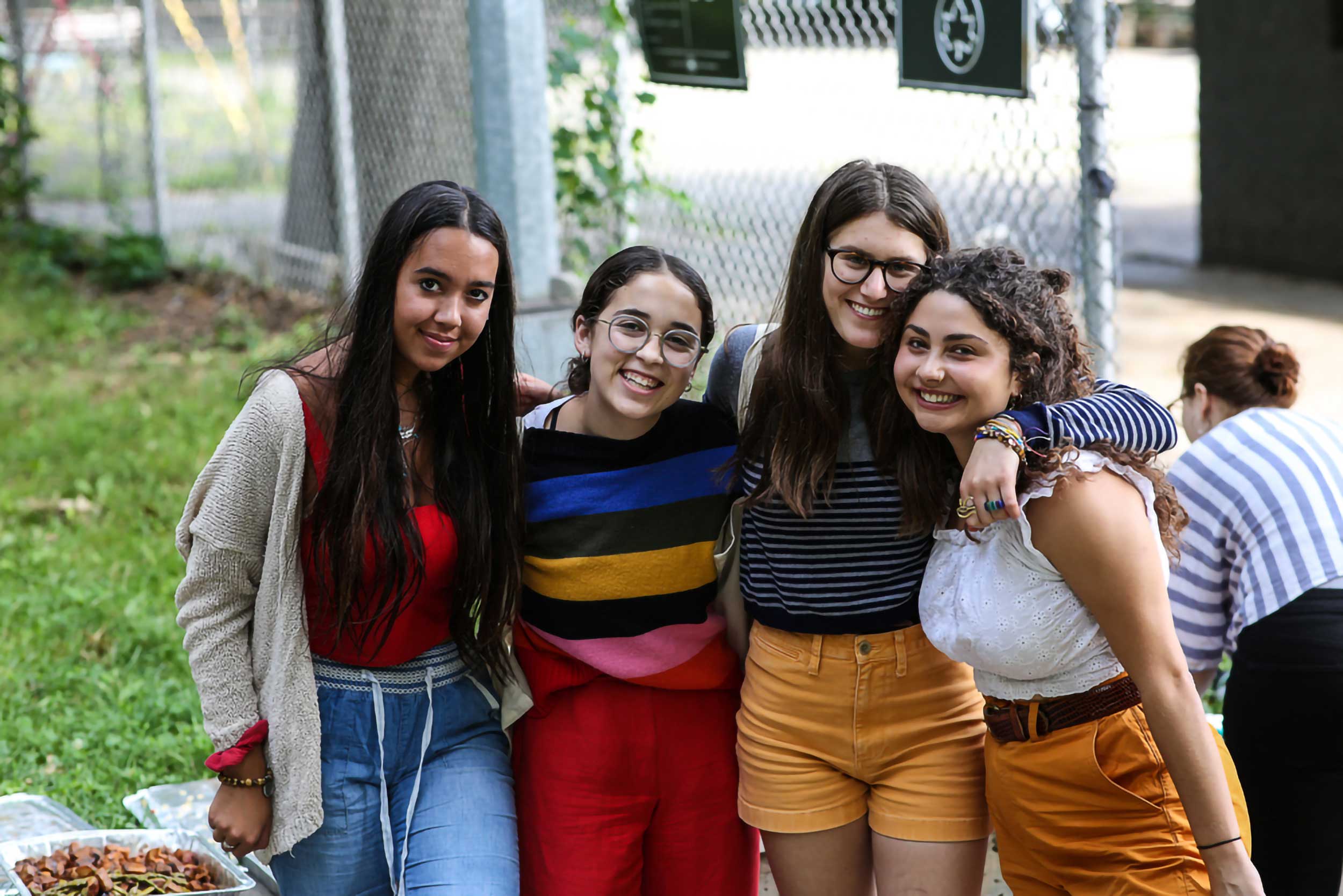
Our teens tell us that the fact that we can continue our regular programming during social isolation has given them a semblance of normalcy and continuity. They wanted to extend that feeling to our wider community. Over the past two months, they’ve brainstormed ways to help others create meaningful relationships online—and have built a creative and social outlet for the magazine’s readers and contributors, as well as for others just getting to know us. These teen-led initiatives have included a creative sprint and a discussion on racism and sexism in high school sports. We have yoga coming up and are planning an introductory workshop on feminism, as well as more sessions throughout the summer.
To learn more about upcoming teen-led programming and other ways to get involved, please visit www.jgirlsmagazine.org, where you can sign up for our newsletter and join us on social media.
—By Elizabeth Mandel, Founder and Executive Director, jGirls, for the Covenant Foundation
More to Consider
Debra Sagan Massey, Senior Educator at Jewish LearningWorks in San Francisco, has for the last year been holding regular pop-up meetings for Jewish educators working with teens. As a result of the pandemic crisis, these meetings have recently gone virtual, but have, as a result, become fertile ground for sharing best practices – or in some cases, new practices – with colleagues.
While there is clearly no pedagogical silver bullet for this sudden and extraordinary educational disruption, Massey has been impressed with both the number and quality of innovations spurred by Covid-19.
“Some of my colleagues are pivoting to focus on strengthening the core of their teen populations,” explained Massey, who helps runs the Bay Area programming for the nation-wide Jewish Teen Education and Engagement Funder Collaborative. “Others are looking to work individually on mindfulness and wellness. In all of this, we are looking down the road to the mental health issues we will increasingly need to address in order to support teens to thrive.” This summer, Jewish LearningWorks will be providing virtual Youth Mental Health First Aid training for anyone who works with, or supports teens.
At a moment when our ritual calendar – following the Israelites as they wander in the desert – eerily parallels our current directionless moment, educators are acutely aware of the pedagogical opportunities, as well as the risks, to the entire structure of organized Jewish education. At the same time, beneath all this confusion flows a strong undercurrent of hope. A sense that Jewish culture is made for disruption, and has the capacity to survive and thrive. Among the teens themselves,
there appears to be a palpable sense of loss, but also an appreciation for how the community is pivoting to provide for them.
Mozi Turbow, a 14-year-old in Berkeley, recently heard that Camp Tawonga in the Sierra mountains will cancel its flagship summer program. “We’re all really sad about it, as this is supposed to be our last year as campers,” she explained about the Jewish overnight program, which has been operating since 1925. But after watching a Facetime Live town hall, during which the camp leadership explained their Plan B (and C), she felt some hope that some essential part of the camp experience will continue this year, one way or the other.
Max Bamberger, a 17-year-old at San Francisco’s Jewish Community High School of the Bay, was similarly grateful for his school’s creativity and commitment to student learning. Bamberger is also a 2019-2020 Bronfman Fellow, and had expected to study in Israel this summer with his cohort from around the country, a centerpiece of the program. The Bronfman program will hopefully bring those students to Israel next summer. For now, Bamberger and his friends are talking regularly on a Bronfman WhatsApp group, which has given him “further clarity” about the values of community and conversation that are central to the experience.
Like many Jewish teens, Bamberger said he was experiencing a deeper appreciation for the simple yet profound rituals of Jewish communal life.
“The other night I went for a walk to my shul [Congregation Beth Israel in Berkeley]. It’s freaky that services have been cancelled for the first time in decades, or maybe longer. But I saw from outside that the Ner Tamid was glowing above the Aron Kodesh. This gave me some hope. This too shall pass.”
The following are highlights of Bay Area teen programs, a sampling of programs and approaches for an unprecedented season that already feels like 40 years.
God was in this place...
Place-based Jewish institutions like camps and nature programs have had to shift radically this year. While most summer camps are cancelled, and just beginning to figure out how to salvage something from the season, many programs are finding a way to access their core competencies in unexpected ways. Wilderness Torah, which connects Jewish rituals with earth-based experiential learning, has leaned into two aspects of its pedagogy for teens – meditation and self-reliance. For its B’naiture program (focusing on nature-based Bnai Mitzvah ceremonies), staff have found ways to support an awareness of both self and nature at home.
“In some ways, the condition of pandemic revealed what is most helpful and valuable about our program, which is expanding awareness and tuning in to the mystery and beauty of earth under your feet,” explained Youth Programs Director Daniel Schoen. Instead of Wilderness Torah’s typical wilderness-based experience, middle school students are mapping the spiritual ecology of their own neighborhoods. And instead of experiencing meditation out in the woods – modeled in part on Hasidic Rebbe Nachman of Bratslav’s practice of Hitbodedut, or “self-seclusion” – teens discover as if for the first time the spiritual potential in their own yards.
One True Thing
In some cases the pivot is less about content then process and delivery. For Devra Aarons, Executive Director of Contra Costa Midrasha, continuing the two-hour-long weekly sessions virtually has been challenging. “Everyone is Zoomed out,” she explained. Instead, she decided to go deep rather than broad, picking the most essential 45 minutes out of a longer lesson plan to deliver. The result? More teens are connecting than before.
Rabbi Akiva Naiman, NCSY’s East Bay Director, has also shifted the delivery system. The “one true thing” for him is literal – the answer to his daily Israel trivia contest on WhatsApp.
“Every day I ask a question about Israel, something [the students] they aren’t likely to know. For instance, about how Israel engineered the cherry tomato. Or how Israeli bank notes include braille,” he explained. The Orthodox-affiliated teens have the chance to earn money if they get the answer right. Plus, the more friends they invite to participate, the more the pot grows. “We went from 30 to 400 in just a few weeks. And now they have the option of giving the money they win to Tzedakkah.”
With this strategy, Rabbi Naiman dips into teens’ need to connect often, as well as the competitiveness that is part and parcel of the social media universe. But instead of going for “likes,” they are trying to demonstrate the most complete knowledge about Israel.
“These trivia contests might seem trivial,” he joked. “But every day they are all talking about something new that connects them to each other and to Israel.”
Expand the Bubble
In some cases, Jewish organizations have doubled down on opportunities for teens to connect and learn outside their core circle.
At the Contemporary Jewish Museum in San Francisco, which has a diverse, robust and innovative teen program, the inability of teens to physically meet with mentoring artists, give tours, and learn from each other has been frustrating. Like nature-based organizations, the connection to physical spaces – in this case museums, galleries and workshops – is central.
“We’ve been especially concerned about the loss of professional opportunities for teens,” said Fraidy Aber, the museum’s longtime education director. Her response? “Let the teens’ natural facility in virtual spaces lead the way.” Instead of giving up on bringing teens to meet artists, teens have curated tours of artist galleries, then shared those tours with others teens, who share them again. The result is an expansion of teens’ outreach into the art world.
“In a way this is an extension of the digital work we have already been doing, like with our audio project What We Hold, in which teens talk with older adults around the country,” said Aber. Moving forward, the museum anticipates that their move to a hybrid model of digital and real-life engagement will accelerate, creating even further opportunities for teens to connect with artists and peers outside the normal circles.
At the Jewish Community High School of the Bay, Evan Wolkenstein had also expanded his students’ bubbles by doubling down on technology. As the school’s Director of Experiential Education, he was “a little less panicky than others about what was happening, since I run my class like a digital learning lab.” Sensing that school might not return to normal for a long time, he reached out to a colleague at the San Francisco Islamic School, expanding a collaboration that would likely only happen online.
“The physical distance between our schools had prevented our classes meeting in person and sharing our views on our respective religions at the next level,” Wolkenstein said about the video pen-pal project his class on comparative religion has been doing for five years. “But now is the perfect time to double down on this. If we had tried to wait and do this in person, we might not have ever brought ourselves to share in this way.”
Step Up, Step Back
At the K-8 Brandeis School of San Francisco, opportunities for teens and faculty converged in one insight – let students help lead the way.
“For Phase One [of the epidemic], our focus was on taking a dynamic, challenging academic program and porting it online,” said Head of School Dr. Dan Glass. “Like a lot of Jewish day schools, we were relatively well positioned, especially in middle school. It was fairly seamless.”
Phase Two, during which it seemed like the fully digital reality would be longer-lasting, was more complicated. How, for instance, “would the school affirm the creative capacity and leadership capacity of its students on a delivery system designed to present material, not cultivate relationships?”
“The answer was to give the students more of a voice,” said Dr. Glass. “We piloted with our middle school students the major survey of distance learning before it went out to the families, in order to gain their input.” By stepping back enough, the faculty gave students the opportunity to step up and model the kinds of relational learning they had been practicing for years.
Many congregational educators have also discovered that asking teens to help them figure out the collective next steps has been successful.
In the Bnai Mitzvah classes at Berkeley’s Congregation Netivot Shalom, Youth and Family Educator Director Elisheva Hurvich has noted a lack of engagement on Zoom for many teens. “Some of our students have found the isolation depressing. Kids are suffering. And parents are not sure what to do,” she said. “To help, I called some of our teen madrichim, asking them to reach out to our younger students, to connect and check in. There is more power in teens reaching out to the middle schoolers than in me, an adult, reaching out.”
Grief and Celebration
Among the most important services teen-facing Jewish organizations can offer is space for students to feel, and express those feelings in community.
“One of the first thing our teens did during this crisis was create a care circle,” said Samara Leader, Program Coordinator for the Diller Teen Fellows in San Francisco. “The idea behind this was that everyone has the capacity to give care, and everyone has a need to receive care. It was understood that how we connect and care for each other was bigger than one specific program goal.”
The opportunities that grew out of this insight led to an increased focus on viritual social action, in conjunction with Diller teen cohorts in Israel and around the world.
Leader added that she felt compelled to model certain values during this time, especially those of transparency and openness. “At a recent event, I started by saying, ‘this has been a really long week for me. Anyone else’?” But at a following event, a global celebration for Yom Ha’atzmaut, she wanted to create an environment in which “teens could feel like teens. There could be a feeling of celebration and escape. Creating this opportunity for them to feel ‘normal’ was really important.”
By Dan Schifrin, for The Covenant Foundation. A Berkeley-based writer and professor of creative writing, Dan is the founder of StoryForward, which brings people together through Jewish frameworks of reading, writing, and sharing stories.
To launch a wide-ranging conversation about feminism and activism, the teens at this year’s Kol Koleinu retreat were asked to think about their personal, emotional experiences and priorities.
In response to the prompt, “What upsets you most right now about how sexism affects your life and the lives of people you love,” participants wrote their answers on Post-it notes that were then affixed to the wall and shared with the group. Several of the notes were about gender stereotypes and the double bind; others addressed body image; some took on issues related to sports. Even as clusters of Post-its revealed persistent themes, each person had the space to think about what was most significant to her.
“We want the teens to explore topics and change-making strategies that are authentic to them, while also taking risks,” says Jennifer Anolik, Moving Traditions’ Curriculum Manager, who runs Kol Koleinu. “Risk-taking is important to feminism, and to creating change.”
This year, with the onset of the COVID-19 pandemic, resilience and adaptability have also become major themes. The November retreat was the first time that many of the 2019-2020 Kol Koleinu fellowship participants were able to meet in-person, but COVID-19 has made a second in-person meeting impossible. The program’s regular online meetings, and its vibrant online community, have taken on new significance. Kol Koleinu participants are now striving to support each other and reimagine new ways to complete their fellowship projects. As an unexpected crisis has intruded on their plans, they are gaining insight into the usefulness of being able to revise their expectations, pivot, and find alternative ways to meaningfully advance their change-making work.
Even before social distancing became a priority, Kol Koleinu operated primarily online so that it could connect teens across the country, and reach a range of Jewish communities. There are 14 students in the current cohort. The program is offered by Moving Traditions, in collaboration with NFTY and USY.
“Moving Traditions added Kol Koleinu to its offerings two years ago, initially with the support of a grant from Hadassah. We discovered a related project that was underway through NFTY in New York, spearheaded by a former Rosh Hodesh program participant, and soon joined forces," says Rabbi Tamara Cohen, Moving Traditions’ VP and Chief of Program Strategy. “We aspired to offer something to older teens—particularly those who had participated in Rosh Hodesh and were looking to build on their experiences, but also others who ready to take a next step in their leadership, activism, and ability to make feminist change as Jewish teens.”
With the leadership of Anolik and Rabbi Cohen, Kol Koleinu is one of Moving Traditions’ many educational offerings driven by its mission to “embolden teens by fostering self-discovery, challenging sexism, and inspiring a commitment to Jewish life and learning.” Though all of the teens in this year’s cohort identify as women, in the past there was a male participant and a few participants who identified as genderqueer. Indeed, the fellowship’s name itself—which means “All of Our Voices”—is meant to “. . . signal a feminism that is gender inclusive and a vision of a community that truly elevates and celebrates all voices. In many Jewish communities in the past, and in some still today, the voices of women and sexual and gender minorities have been quieted, silenced, and/or sexualized. This program envisions a community where all voices are heard and taken seriously.”
Kol Koleinu seeks to help participants create change in diverse Jewish communities across the country—their Jewish communities. It also responds to very real concerns expressed by Jewish teens today.
Jennifer Anolik points to the Jewish Education Project’s GenZ Now: Jewish Teens Research Study. In a survey of Jewish teens who were asked about “which problems the teens they know need help with,” 68% of female respondents said “self-esteem issues” and 55% said “challenging sexism.” In helping young people to develop leadership qualities and empowering them to become agents of change, Kol Koleinu is responding to needs expressed by Jewish young women themselves.
Anolik and the fellowship participants meet regularly online to explore topics including theories of activism as well as the stories of famous—and not-so-famous—Jewish activists. Through these examples, the teens see that they, too, may be able to enact change. As their ideas develop, Anolik explains, it is critical to ensure that young people feel supported in their change-making.
“There’s this idea of the feminist activist who is always on her own, working solo,” Anolik says. “We try to break down that stereotype.”
The fellowship offers opportunities for the teens to build community and learn from one another. Each participant chooses and works to become an expert on a topic that relates to feminism (such as reproductive justice, racial justice, gender and Judaism, and intersectional identities). They then share their new expertise with the rest of the group and, through teaching, have an enormously beneficial learning experience. In this model, Anolik provides structure and guidance while encouraging the teens to “take up a lot of space” in the meetings.
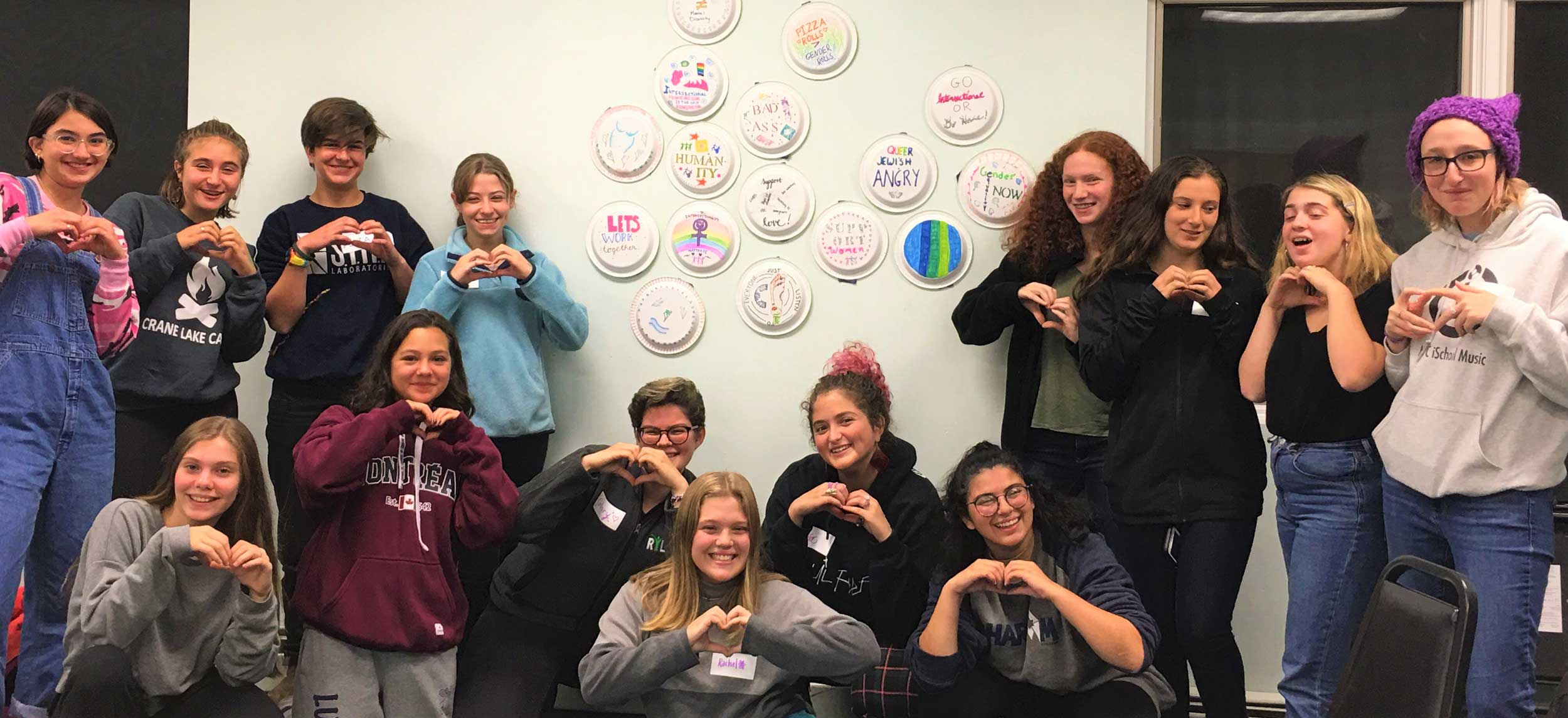
The final core component of the fellowship is completing an activist project. Participants must first propose their project ideas (working individually or in small groups). Based on their proposals, they are then matched up with mentors—adults who have worked as activists or advocates in relevant areas. The teens are encouraged to check in on a semi-regular basis and learn from their mentors’ experience. The goal is to ensure that young people are not only empowered, but also prepared.
Sometimes “learning from the experience of others” is the change-making project. This year, one of the Kol Koleinu participants is creating a podcast featuring conversations with women in STEM (or science, technology, engineering, and math). The podcast’s creator decided to find out what it is actually like to work in those fields as a Jewish woman. What are the possibilities and challenges, and how might a young woman prepare to face them? Do Jewish women who work in STEM experience sexism? If so, what do they do?
Other Kol Koleinu teens are creating workshops to educate their peers on topics ranging from voting to sex education. One participant planned to do a project that would rally her synagogue community around the importance of sustainability. Unfortunately, the in-person version of the project has been delayed due to COVID-19.
“Activism takes time. Change takes time,” Anolik reminds this year’s Kol Koleinu participants. “Some projects can be done in a few months; some take years.” As the end of the term approaches, Moving Traditions is honoring the already impressive work of the teens, and encouraging them to persevere. In many ways, their work has only just begun.
By Miriam R. Haier, for The Covenant Foundation