When Moving Traditions released “Family Education @ B-Mitzvah: A Moving Traditions White Paper” last month, most synagogues across the country were just slowly beginning to welcome learners back into their halls. After more than a year of online Jewish supplementary learning (or in some cases, after more than a year of none at all), religious school directors, rabbis, cantors, after school program leaders, teachers, and, of course, families, rejoiced.
What’s more, this fall, b’nai mitzvah “season” began again, in earnest. While many families are still choosing to keep their celebrations virtual or their in-person gatherings small, others have held in-person celebrations while instituting mask mandates, mandatory vaccination proof and negative Covid-19 test results. Some b’nai mitzvah learning is still on Zoom. Some is back in person, in the rabbi or cantor’s office at the synagogue. But one way or another, communities are resuming as much “normal” Jewish life as possible.
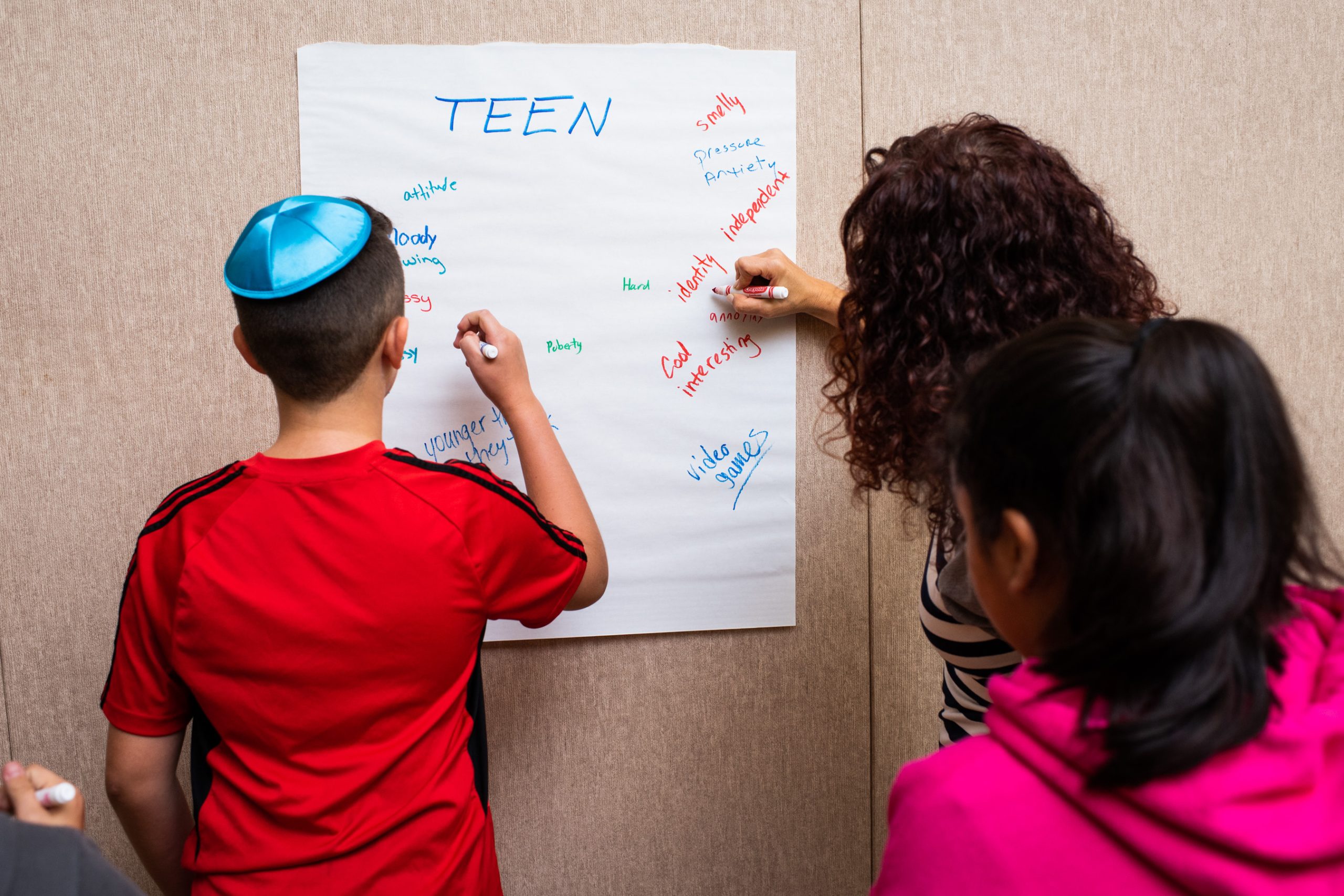
But amidst this good news is a pressing reality: Jewish families need support, now more than ever. The preteen years are stressful—for parents and kids alike—under the best of circumstances. But add to the mix a global pandemic, isolation, new peer pressures related to technology and social media, confusion and uncertainty about sexuality and gender identity, and it becomes abundantly clear that the community must respond to the needs of Jewish families and kids, and time is of the essence.
“To strengthen Jewish families and Jewish life, family education in the preteen years needs to become as normalized as family education for preschoolers,” said Deborah S. Meyer, Founder and CEO of Moving Traditions.
Enter “Family Education @ B-Mitzvah,” a white paper (available for download here) that shares research culled from the Moving Traditions B-Mitzvah Family Education program, which is currently implemented in more than 100 synagogues and Jewish institutions, as well learnings from their June 2021 convening of scholars, Jewish educators, activists and funders.
The paper is a call to action to the Jewish community, to take heed of social-emotional learning and the timeless wisdom of Jewish tradition, and apply those assets to the needs of all stakeholders involved in this liminal moment in Jewish life—parents, children, families. (The research focuses on 6th and 7th grades, in particular, as those are the years immediately before and after B’nai Mitzvah, but is undoubtedly applicable beyond those years).
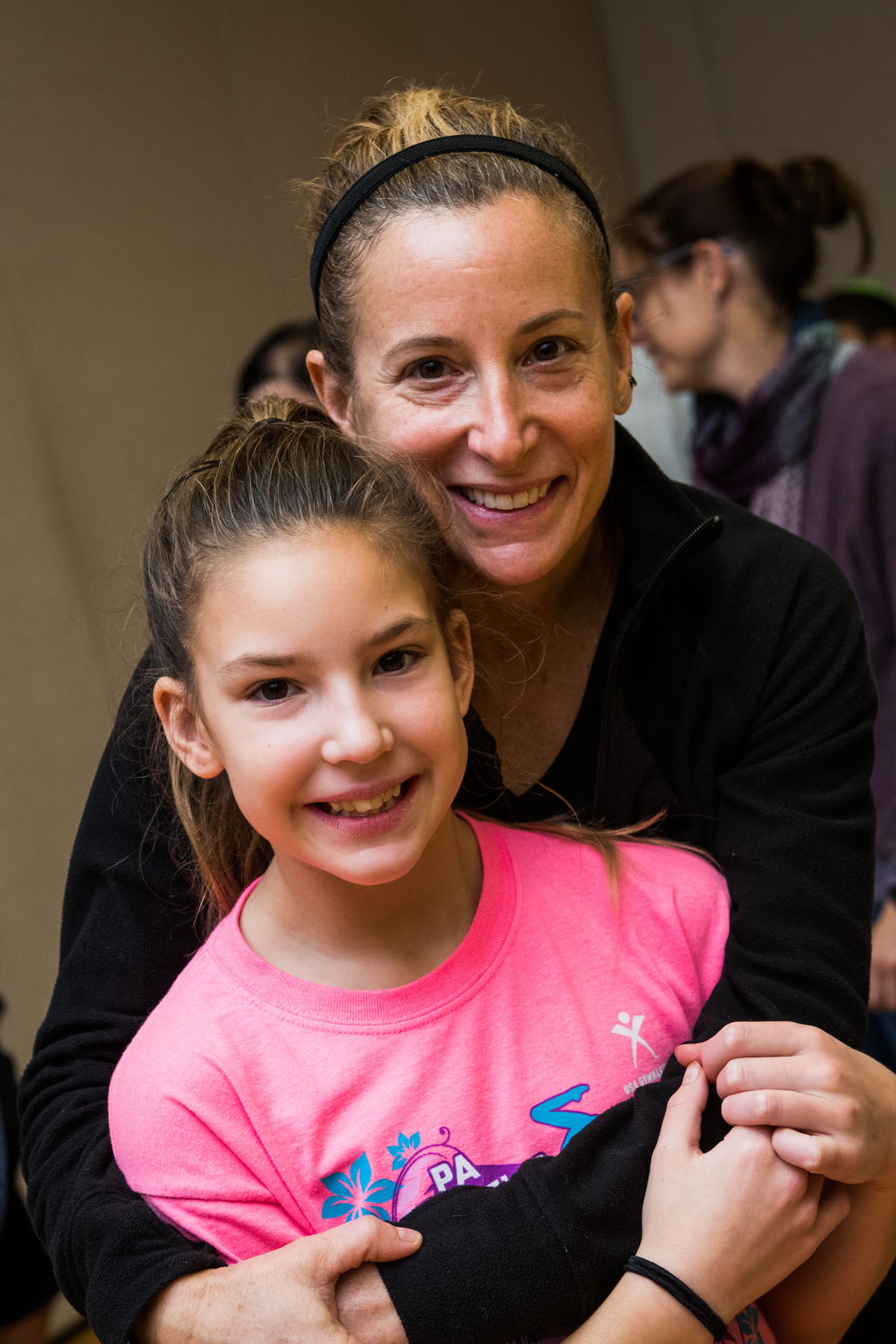
“Creating opportunities to be in conversation with parents and kids is essential, and that’s our message,” said Rabbi Daniel Brenner, Chief of Education at Moving Traditions. “Our hope is that this research will underscore again, the necessity of family education,” he said.
“When you give people content that is relevant to their lives, they will connect with synagogue and Judaism in a deeper and more engaged way,” Brenner said.
Brenner cites learnings from the recent Pew Forum study on Jewish Americans in 2020, which reflects the growing diversity of the Jewish community, both racially and politically, as having informed the work of the paper, as well as the reality that identity is a more complex and fraught concept for preteens and teens than ever before.
As their literature asserts, Moving Traditions “was created with the understanding that Jewish people and practice will thrive as Judaism continues to evolve—as it always has—to meet the challenges facing Jewish people.”
Whether it’s Rosh Hodesh, the nationally renowned program for girls, the Shevet program for teen boys, the Tzelem program for Trans, Nonbinary, Gender Diverse, and LGBTQ+ teens, or the B-Mitzvah Program, Moving Traditions is working to lift up and support Jewish preteens, teens, and their parents. And it is incumbent upon all of us, to join in. Our kids are counting on us.
By Adina Kay-Gross, for The Covenant Foundation
More to Consider:
- We Can--and we should--support Jewish preteens and parents now (eJewish Philanthropy.com, October 13, 2021)
- Teens Are in Crisis. So Are Their Parents (New York Times, May 2021)
- As My Son Came of Age, He Taught Me: Embrace What Is Possible (WBUR, April, 2021)
- Moving Traditions' New Bnai Mitzvah Program for Families (Sight Line Volume 25, September 2019)
- Meaning Making for Teens, An Interview with Deborah Meyer (Sight Line Volume 5, June 2015)
Jackie Rassner was taking a walk recently with her daughter when she bumped into one of her colleagues who also has a daughter. The two children attended the same Jewish afterschool program but, due to the pandemic, had only met in the program’s virtual iteration, on Zoom. Despite never having met in person, once they recognized each other as classmates, they ran off immediately and played together for a full hour in the park.
How did these peers have such an instant connection? It’s all thanks to the intensive community building in Mishkan Chicago’s Mensch Academy.
A few years after founding Mishkan Chicago as a radically inclusive spiritual community in 2011, Pomegranate Prize recipient Rabbi Lizzi Heydemann sought to establish Mensch Academy as an educational community grounded in the same values as Mishkan Chicago: welcoming, accessible, and open to each person’s journey to make Judaism their own. After receiving funding to establish the program, Rabbi Heydemann hired Ilana Gleicher-Bloom as the founding Vision Director of Mensch Academy. Before officially opening Mensch, Gleicher-Bloom spent a year on research and development, including visiting 10 different religious schools, reading numerous books, studying trends in education, listening to podcasts, and meeting for coffee with 50 parents who had attended Mishkan Chicago.
Gleicher-Bloom emerged from that year with a dual focus for Mensch: cultivating joyful learning and fostering a deep sense of belonging.
“We want [kids] to feel loved and safe enough to take risks, and kids can’t feel loved and safe enough if adults don’t feel that way too,” said Gleicher-Bloom, who is also a Pomegranate Prize recipient and now serves as a consultant to Mensch.
So from the very beginning of Mensch Academy, teachers (who are actually referred to as facilitators at Mensch, because they are facilitating the learning) have been welcomed into the community as a cohort of learners themselves. Facilitators arrive on site a few hours before every session and spend time engaging in professional development and preparing their lessons for the day. By paying the facilitators for this time, Mensch Academy sends the powerful message that although these individuals may be part-time employees, they are treated with the utmost respect as educators, and are given the time and safe space they need to excel in their profession.
Giving facilitators a sense of belonging includes acknowledging that teachers are full humans, coming to the experience with their own perspectives and interests, Aviva Stein, Mensch’s new director, shared. So, “everything we teach to the students, we learn as a cohort of facilitators first,” she said.
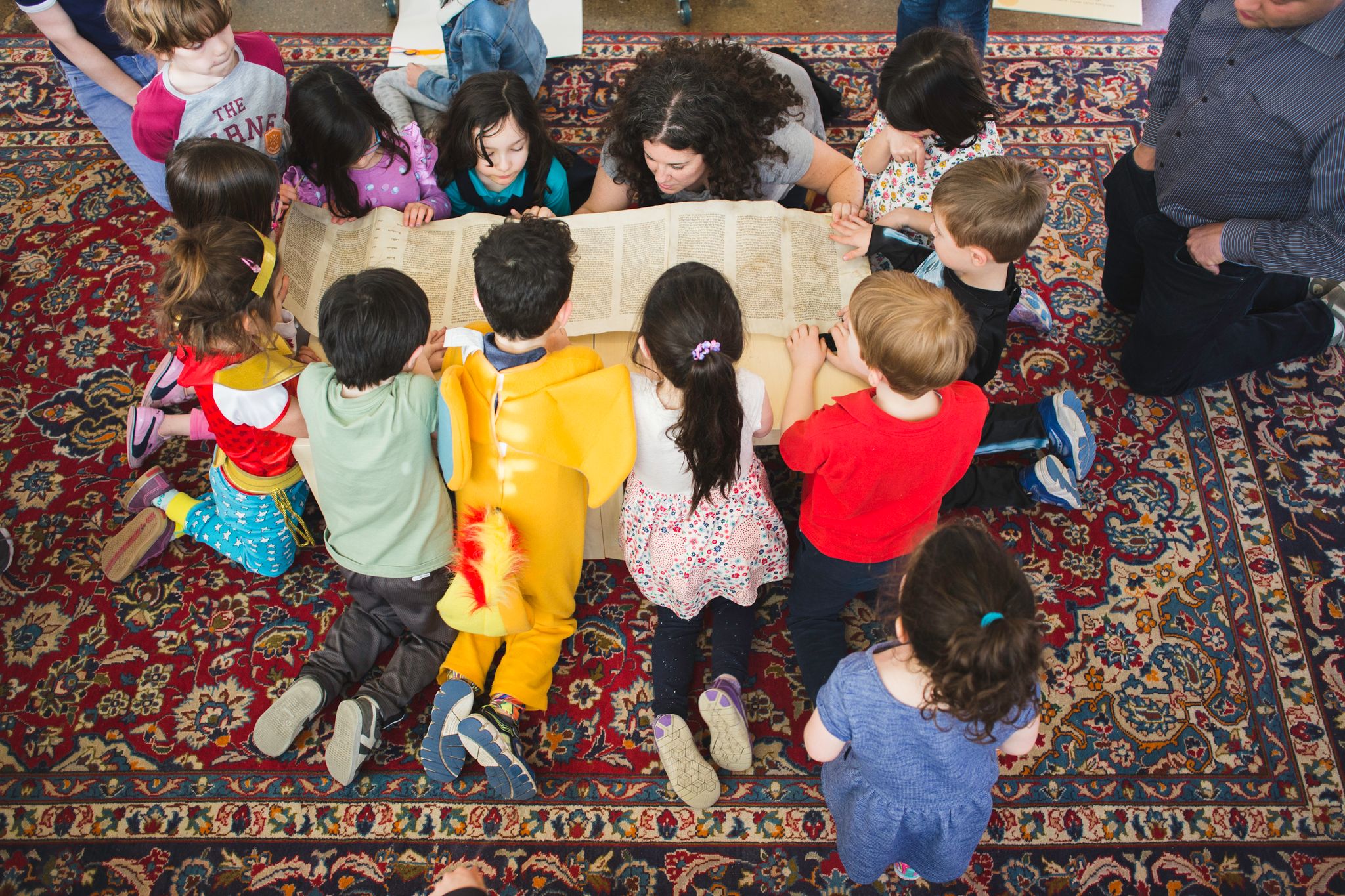
Staff development time also enables the facilitators to hone the specialized skills they need for a Mensch classroom, which typically has very little frontal teaching or learning. Students are usually working in various locations around the room, and two facilitators circulate, asking open-ended questions and taking careful notes about each child. These notes help facilitators get to know their students and build relationships so the students feel seen, heard, safe, secure, and confident.
“Part of speaking to kids is showing that we care about what they say and what they are doing,” Gleicher-Bloom shared. “The second level is learning how they’re learning. How are they interpreting the text? Then you can reflect it back to them.”
Mensch Academy classes meet once a week, and they always begin with tefillah with all the grades together. Next, the children split up into mixed-age groups (Kindergarten & Grade 1, Grade 2 & Grade 3, and so on) and engage in Jewish text learning. Last, the students choose how they are going to experience the text. Sometimes that might be through painting, building, or play, and other times it might be through a more prolonged experience over multiple sessions.
For instance, after studying verses on the ger (stranger), facilitators had a conversation with students about who gerim are today and how best to help them. Students determined that gerim today are refugees. There happened to be a refugee family in the area that wanted to know about free family-friendly places to visit in Chicago, so Mensch students came up with ideas for places to go and halal restaurants nearby. They were able to give the family a whole book to help them find places to go (which was translated by the family’s daughter).
At the beginning of the unit, students had been tempted to donate items to refugee families, but they learned that what they think refugees need might not be what they actually do need, explained Gleicher-Bloom.
Lessons like this one are important to Jackie Rassner, whose daughter attended Mensch Academy for 1st grade and is now in 2nd grade at Mensch. She wants to make sure her children’s Jewish education includes social justice, and “the understanding that being an adult in the Jewish community involves justice work.”
Hannah Bloom-Hirschberg, whose children are now in Kindergarten and 3rd grade, chose Mensch Academy for the learner-centered approach that prepares young people to engage with the world in a Jewish way. Even more important to her, though, was developing relationships.
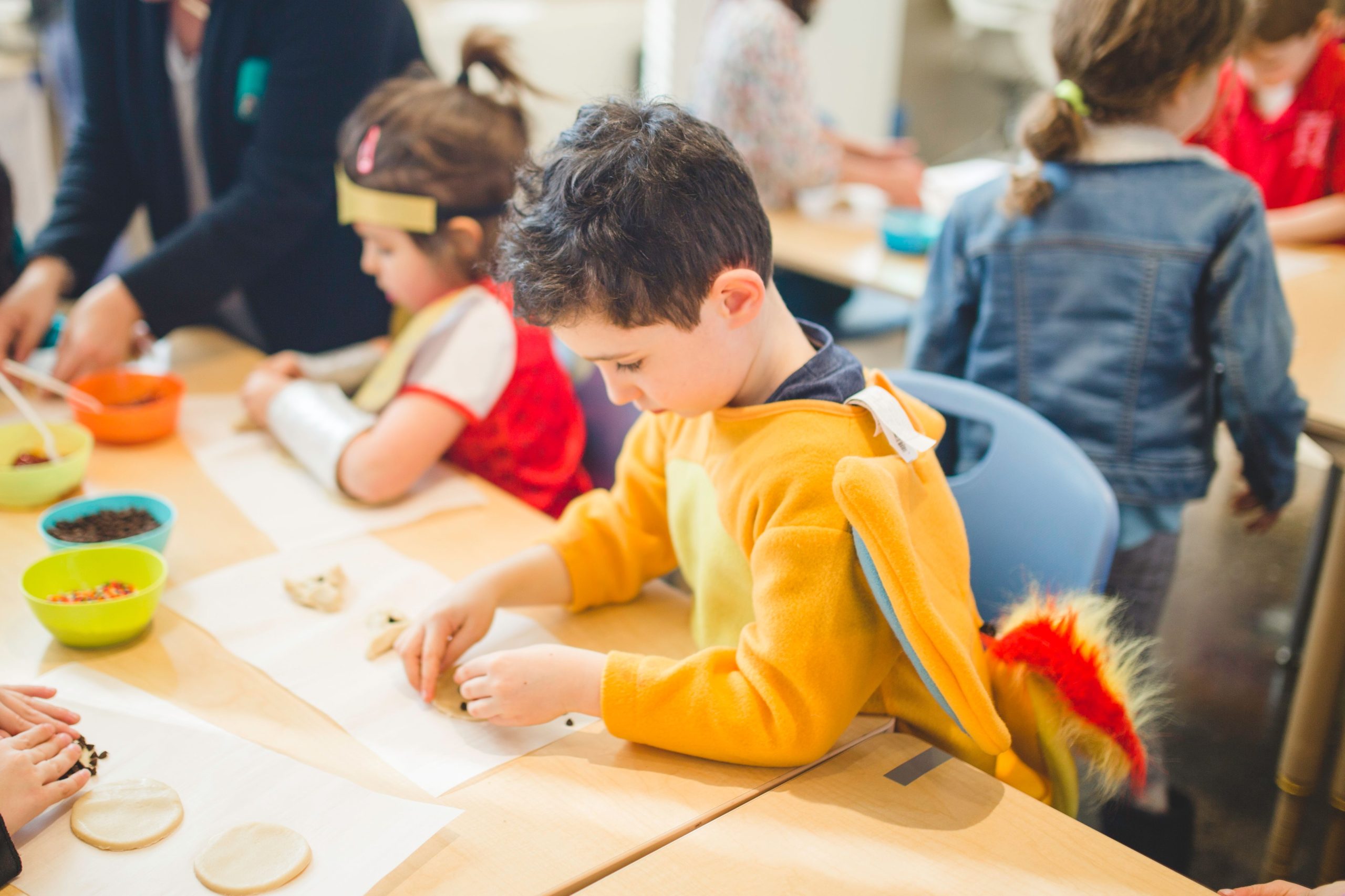
“For us, the highest priority is that [the kids] feel a part of the Jewish community, and the way Mensch is structured really encourages them to build community with each other,” she said.
Pre-Covid, that sense of community was widely evident when Mensch held Sunday showcases at the end of each unit of study. Children would welcome their families and share their learning in an interactive exhibition-type format that included artwork, puzzles, conversation starters, a bracha book, and other activities such as a gratitude station.
“It was a really lovely way to spend time with your community, and to also have an opportunity to be learning with other people,” Bloom-Hirschberg shared. “Learning in community changes the dynamic and deepens the relationships we get to build as parents and families, both within our family and with other families.”
With relationship and community building so integral to Mensch Academy, when COVID-19 hit in March 2020, Gleicher-Bloom initially felt she had to cancel the program. How could Mensch Academy be translated onto Zoom, an all-frontal learning virtual space? But after some encouragement from parents on her advisory board, she agreed to try. Mensch moved to Zoom and actually grew, with 17 new students signing up. Gleicher-Bloom credits the resounding success of the program’s virtual iteration with the continued dedication among her and the facilitators to creating and maintaining a sense of human connection.
“The kids felt heard by the adults on Zoom,” she said. “They had one-on-one check in calls with their facilitators. They knew they could talk to us and we would listen to them talk about things that are important to them. As a staff, we talked about how everyone is struggling, so relationships come first.”
To gives kids the feeling that virtual Mensch Academy was still their community and “their place,” facilitators allowed them to keep their screens off, write silly jokes in the chat feature, change their Zoom names, and use funny filters and virtual backgrounds. Students even got to choose elective classes, such as Judaism & Herbalism and Jewish Myths & Monsters, which were created by facilitators based on their own passions and interests.
“We’ve always been on our toes and ready to pivot,” Stein explained. “And constantly adapting to the situation at hand is a very Jewish tradition. It’s what our people have done for a very long time—embracing that unpredictability and leaving us open to lots of new possibilities. New problems present new solutions that we can succeed in.”
By Yonah Kirschner, for The Covenant Foundation
More to Consider
- 3 Ways to Build Relationships in Person or Virtually (Edutopia, August 2020)
- How to Build a Strong Virtual Classroom Community (Edutopia, March 2021)
- Mensch Academy videos here and here
- Taking the Ideas of Our Learners Seriously by Ilana Gleicher-Bloom (Gleanings)
- Mishkan Chicago puts an interactive spin on High Holiday rituals(The Chicago Reader, Sept. 2020)
The Hannaton Educational Center and Leadership Institute is a site of Jewish learning in the Galilee region of Israel. Located on Kibbutz Hannaton, the Institute offers long and short term educational programs focusing on identity issues, pluralistic thought text study and leadership training for youth, educators, and community leaders from Israel and the Diaspora.
About to embark on a new journey, the Hannaton Educational Center is broadening its original vision and looking to change the nature of discourse about Judaism in Israel. Educators at Hannaton strive to teach the leaders of tomorrow to accept, incorporate and promote progressive, humanitarian Jewish values in Israeli society, and to reach out to like-minded individuals across the world to join them in their work - to make sure the future of Israel is one which saves a place for Jews of every movement, every stripe, and every affiliation.
Watch and learn more about Hannaton, here:
While they live in cities that are more than 1200 miles apart, Susan Berson and her 7-year-old granddaughter Ellie have been studying the weekly Torah portion together, over Zoom, for the past year. Last year, they joined with other pairs of Berkeley-based grandchildren and their grandparents all over the United States and Israel, in a program organized and led by Edah, an innovative full-service Jewish afterschool program in Berkeley.
With Edah educators guiding them in group study before shifting to individual family breakout rooms, the generations engage in lively conversations – unprecedented for many – making connections between the text and their daily lives. Berson recalls that when they spoke about the story in Genesis of Abraham rushing out to greet the angels visiting him with warm hospitality, she told her granddaughter how much she appreciates it when Ellie runs out to greet her and her husband when they visit.
“The most important thing about the program,” Berson says, “is that the grandchildren get the idea that the Jewish story is important in their family, and that they can relate Jewish learning to their lives.”
Edah is a program of Studio 70, a non-profit Jewish educational center, which has received grants from The Covenant Foundation. Yafit Shikri-Megidish, executive director of Studio 70, explains that during the pandemic in the summer of 2020, Edah staff were thinking anew about online programming. They initiated a 6-week program bringing together their students and their grandparents for a weekly shared hour of Torah learning, with two different groups, based on age. For Shriki-Megidish, this was an opportunity for expanded learning and also for the grandparents to get to know the Edah community.
An Edah educator led a discussion of the week’s Torah portion, perhaps including puppets or videos for the younger children, and then gave a discussion prompt to the group, inspiring thoughts of family stories or their daily experience. For 20 minutes, the family pairs conversed, catching up on their lives and interests as well as addressing the prompt. Afterwards, the larger group came back together and shared what they had discussed. Usually, the event ended with singing.
After the six weeks, both the group of grandparents and group of grandchildren asked to continue. Edah then organized a year of joint learning for them. The grandparents were also invited to join in online celebrations, including a celebration of Edah’s tenth anniversary.
“It was magical,” Shriki-Megidish says. “I think it created a shared experience they didn’t have before. Now they can build on it and continue the conversation.”
Edah then expanded their offerings to include similar sessions for young teens (ages 11 to 13, including some Edah alumni) and their grandparents. In one session, the grandparents were asked to show something in their home that related to their Jewish identity, and to share the story behind the object – sometimes these were items seen frequently, but the stories had been previously unknown to the young people. One grandmother showed a wall hanging with a blessing she received from her mother, a Holocaust survivor, who received it from her father.
“The program has helped grandparents get into deeper conversations with their kids, beyond asking how was their day,” Shriki-Megidish says. She also emphasizes that the elder generation had an unusual window into the kids’ lives, seeing how they interacted with friends and teachers and learning about their interests in social justice and current events.
For Yom HaShoah, Holocaust Remembrance Day, Edah educators invited all the children and grandparents involved in the program to join in a conversation with two Holocaust survivors. Participants had a chance to ask questions, and, afterwards, they divided into their family breakout rooms to talk about what they had heard.
“This gave the grandparents another opportunity to be involved in their grandchildren’s education and to bring their insight, wisdom, and what is important to them about being Jewish to the conversation,” Shikri-Megidish says.
About 40 families participated in the program at Edah, and Shriki-Megidish also initiated a group in Los Angeles, partnering with the Ikar community, as well as a program in Hebrew for students whose grandparents are in Israel, following the same format.
Shriki-Megidish, who worked as director of education at Edah before being named executive director, has a broad and varied background in education. Born in Jerusalem, she has worked in both formal and informal settings, with students of all ages and backgrounds; she served as principal of a middle school in Israel, worked with youth at risk, and has taught teachers.
At Edah, there is an emphasis on students developing Hebrew language skills as well as positive feelings about themselves and a sense of belonging to the Jewish people. Their groundbreaking programs combine recreation, enrichment, and education, and foster a deep sense of community among students and parents.
Shriki-Megidish’s mother participated in the intergenerational Torah learning, zooming in from Israel to meet with Shriki-Megidish’s daughter. “Every time the session ended, my mother would text that it was a joy, so precious to her. She got to know my daughter – her granddaughter – so much better.”
When the Edah facilitator recently visited Israel, all the participating Israeli grandparents wanted to meet him. “The program was such a gift for them,” Shriki-Megidish adds.
Another benefit of the program, as Susan Berson points out, is that the grandparents got to know each other and learn from each other, as well as from the kids, week after week.
She also credits the teachers and their very positive approach. “They were so kind and respectful to the kids. Especially when we were joining together after the break-out rooms, when we shared what we discussed with the whole group. They really wanted to hear what the kids had to say. Sometimes it’s hard for kids to speak up in a group and they made it much easier.”
For those students who don’t have grandparents, or whose grandparents weren’t able to participate, the organizers paired them with family friends or Edah educators.
“We wanted to make sure that everyone was included,” Shriki-Megidish says.
While programming at Edah will be shifting back to in-person and hybrid participation, staff will be sending a weekly email to students, suggesting a task that they do with their grandparents, whether on Zoom or by phone. The students will then report back to teachers about how they did.
“This was something both sides were excited about. We want to hold that connection,” Megidish says. “It was such a joy.”
By Sandee Brawarsky, for The Covenant Foundation
More to Consider
- “This Isn’t Your Parents’ Hebrew School” (Jewish Boston, May 2016)
- “Multi-aged, Project-Based, Experiential Learning: Mayim” (The Jewish Education Project)
- Webinar in which Mayim is presented as part of a series on Thriving in Jewish Education
- Chapter on Mayim Tamid (Portraits of Jewish Learning)
- Edah A New Approach to Jewish Learning After School (Studio 70)
- These Jewish schools are getting it right (Brandeis Now, Sept. 2019)
In 2014, Harlene Appelman, the Executive Director of The Covenant Foundation, realized that there was more the Foundation could do to spotlight Covenant grantees and add value to the field of Jewish education. Two grant sustainability and impact studies that took stock of Covenant grants had been published as internal documents in 2006 and 2007, and Appelman wanted to make those studies –and the lessons they contained-- accessible to everyone.
“We wanted to create a platform where grants could be showcased in a way that would allow practitioners to understand how they fit into the broader scope of Jewish education,” Appelman said.
The idea of launching an online journal took hold. Appelman knew that by presenting the stories of Covenant grants in a visually appealing and interactive way, the Foundation could take an effective approach to thought leadership while also embedding the grants into the Jewish education ecosystem. To make the platform palatable, she added, it had to include great artwork and photography, interesting video clips and opportunities for reader engagement. And so, Sight Line was born.
Now, 25 issues later, the journal has evolved but its central purposes remains the same: to shine a light on excellent, innovative work and to be accessible to anyone working in Jewish education, from first year classroom teachers to organization executives.
Upon reflection, Appelman noted that Sight Line’s success has been due in part to its flexible format, which has allowed the Foundation to incorporate new and exciting ideas into each addition, like original artwork, interactive graphics, and a grants filter.
“In a way, Sight Line has become a window into the creativity that is flourishing in the field of Jewish education—across all sectors,” Appelman said. Indeed, over the past 24 issues, the journal has featured over 40 Covenant Award recipients and just as many grantees, with close to 30 articles on the topics of Arts in Jewish education, 28 on Social Justice, 22 on Early Childhood and a dozen on the topic of Inclusion. With multiple features on teens, technology and professional development too, the journal offers a cornucopia of topics in its archive, all available to readers in perpetuity.
Looking ahead, Appelman hopes to incorporate more interactive features into Sight Line, perhaps by using articles as a springboard for live panels, conversations or podcasts.
“Sight Line has been and should remain a catalyst for Jewish ideas,” she said.
In 2014, Sam Ball and his colleagues at Citizen Film received a Covenant Foundation Signature grant to implement new approaches to digital storytelling that would engage Jewish Studies scholars and the communities they serve. New Media in Jewish Studies, as the project was called, was intended to “creatively explore intersections of Jewish and American modernity.”
To begin, Citizen Film recruited a cohort of six Jewish Studies professors — and then expanded to 12 scholars and their graduate students — to create a media collective engaging Jewish Studies programs and audiences in innovative ways.
Citizen Film's documentary storytelling had already been pushing the boundaries of Jewish education. For instance, Ball's short films and media installations exploring Jewish culture had already appeared in exhibitions at the Jewish Museum in New York, the Contemporary Jewish Museum in San Francisco and in many other cultural centers. But engaging with universities opened new doors for Citizen Film and Jewish Studies scholars.
Deborah Dash Moore, the Frederick G.L. Huetwell Professor of History at the University of Michigan, who collaborated with Citizen Film on the project, notes that digital storytelling in the classroom is "a transformative experience for these students." Students’ knowledge of newer media-making techniques and platforms means that teaching and learning is intergenerational in both directions, a traditional Jewish idea.
"As a professor, whenever one can learn from one’s students, that's a very useful thing,” says Dr. Moore.
“This grant created many opportunities for uncommon connections," Ball said. For instance, "What We Carry with Us," Citizen Film’s project with University of California, Berkeley, Jewish Studies scholar Francesco Spagnolo, allowed students to contribute to a 2019 multimedia installation at the Magnes gallery in downtown Berkeley, exploring objects curated by Jewish and non-Jewish refugees.
This work has travelled extensively. On New York’s Times Square, after viewing outdoor video art exploring refugees’ “memory objects” on large outdoor billboards, passersby were invited into a modified shipping container where immersive short films and video chats with professor Spagnolo engaged them in reflection and chavruta, or one-on-one conversation.
During Passover of 2021 (with the further collaboration of the JCC of San Francisco and the National Endowment for the Arts), Ball and Spagnolo co-presented the exhibition as an online program of short films connecting Exodus with current displacement around the world. That reboot reached 35,000 unique viewers and catalyzed reflection about the intersection of Jewish education and social justice work.
Now, for Pride Month and World Refugee Day, Citizen Film and the Magnes are preparing to relaunch the project with support from the San Francisco Arts Commission and the San Francisco International LGBTQ+ Film Festival to focus Jewish and non-Jewish audiences on the experience of LGBTQ+ refugees.
"The film festival is typical of the partners we’ve onboarded thanks to our original Covenant grant,” said Ball. “We are interested in reaching out beyond Jewish venues, to fulfill Jewish Studies’ traditional mission as a bridge between Jewish scholarship and community, and between Jewish communities and allies. The festival also expands the audience for Jewish themed social justice work.”
Ball added that “Covenant’s ongoing thought partnership supports entrepreneurial bridge building that helps us engage many thousands of audience members in reflection and dialogue on an ongoing basis.”
By Dan Schifrin, for The Covenant Foundation
More to Consider
- Digital Storytelling: A Conversation with Sam Ball (December 2018)
- 12 Jewish Artist Educators You Should Know (October 2017)
- New Jewish Texts (December 2014)
Ten years ago, Gabrielle Kaplan-Mayer and her synagogue, Mishkan Shalom, received a Covenant Foundation Ignition grant to expand the Celebrations! program. Inspired by her personal experiences of raising a son with Autism, Celebrations! had been established one year earlier by Kaplan-Mayer and Rabbi Michelle Greenfield as a synagogue-based Jewish family education program for children who have cognitive, learning or developmental disorders, cerebral palsy and Down Syndrome.
By 2011, Celebrations! was ready to be iterated-- and the Ignition grant allowed Kaplan-Mayer to do just that. With funding, she was able to expand Celebrations! and create a curriculum to share with other communities.
“At the time, I remember being amazed that other synagogues were willing to invest in family inclusion,” Kaplan-Mayer said recently. “And I think there was a ripple effect; congregations began looking inward,” she said.
The initial Celebrations! group from 2010 still meets—now, as a part of Mitzvah Mensches, a social and social action program for young adults (between the ages of 18 – 30) with special needs.
“When our inaugural group aged out of the program,” Kaplan-Mayer explained, “there wasn’t a lot of community to be found for young adults with disabilities, in a Jewish context and space. It was important to us to create that for them.”
The Mitzvah Mensches offshoot program meets monthly on Saturday evenings for dinner, Havdalah and a mitzvah project. And even during the pandemic, they have continued to meet regularly online.
About an hour northeast of Philly, in Bucks County, PA, the Ohev Shalom congregation also has a dynamic and growing Celebrations! program that has been running since the curriculum was first produced a decade ago. When asked about their success and the longevity of the program overall, Kaplan-Mayer points to two key factors.
“I think the success of this program has been twofold,” she said. “One, the congregation –in both cases--had a readiness, and they learned along with us about inclusion and accessibility. There has to be a communal culture of inclusion and an understanding of why you’re doing this, for the program to succeed,” she added.
The second key factor is stakeholders, Kaplan-Mayer said. “You have to bring in lots of different stakeholders,” she said. “Children who are of b’nai mitzvah age, congregants who want to donate time and money, young families, and more.” Essentially, all cohorts of the congregation should be willing to engage with inclusion programs in one way or another.
Suzanne Gold, the Inclusion Facilitator at Ohev Shalom shared that their program is indeed growing. Even during the pandemic, two new families joined their Celebrations!! group. And this year, there are 12 families in the program.
According to Gold, most of the Celebrations!! families were unaffiliated before they joined the group but have subsequently become members of the synagogue. Now, the cohort meets once a month, even during the summer, and learns about the Jewish holidays and traditions through activities, games, songs, and crafts. Gold also runs a parent group for the caregivers of the children in the program.
“It has truly been a gift to share a love of Judaism with children and young adults at every developmental level,” she said. “We are opening doors, one family at a time.”
More to Consider
- How Jewish Professionals Can Support Families Raising Kids With Disabilities, During the Pandemic (eJewish Philanthropy, February 2021)
- Making Strides in Inclusion and Accessibility (The Jewish Week, February 2020)
- Giving Families and Children Access to Jewish Experiences, No Matter What (February 2018)
For more than a decade, the Jewish Court of All Time (JCAT) online trial-simulation program has empowered middle school students to engage with crucial questions of Jewish history from the diverse perspectives of historical and contemporary figures.
First funded by The Covenant Foundation in 2009, when RAVSAK, the former Jewish Community Day School Network, received a Covenant Foundation Signature grant, the program is currently run by Dr. Meredith Katz, Clinical Assistant Professor of the Wiliam Davidson Graduate School of Jewish Education at JTS. In its current iteration, JCAT engages 20 Jewish day schools, from Seattle to Jacksonville, to participate in two parallel trial simulations for 10 weeks in the fall semester. Approximately 450-500 students play 150-200 characters.
“Choice of character is very important to the students. JCAT gives them an opportunity to be someone who is different, to experiment, to say things they don’t normally get to say in school,” explained Katz.
“A strength, and potentially an inflection point, is the extent to which we’re able to make JCAT feel distinctive or not quite like school,” Dr. Jeff Stanzler said of the program’s long-term success. Stanzler is a JCAT Project Director and the Director of the Interactive Communications & Simulations group at the University of Michigan. The program activates the power of “bringing a playful spirit to learning,” he said.
One of the reasons this program has appealed to participating teachers for so many years is that JCAT can jumpstart difficult but necessary conversations in the classroom. The court cases are modern, relevant for our time, and often controversial. The diversity of characters reflects JCAT’s approach to Jewish history.
“Jewish history doesn’t happen in a vacuum,” Katz explained. “We’ve always influenced, and been influenced by, the people with whom we live.”
What might George Steinbrenner say about the ban on students wearing kippot and hijabs in French schools? How might Moses Maimonides and Barack Obama discuss Black-Jewish relations?
“No matter how diligent the student is, they can’t look up the answers,” Stanzler said. Instead, their work is “intellectual, expressive, and conjectural. Students have to think about not only what their character would say, but also how they would say it,” Stanzler added.
To encourage students to express themselves while using the online platform wisely, JCAT has worked with veteran educators to develop digital citizenship guidelines. During the simulated trials, students benefit from the input of graduate student mentors and, of course, the support and guidance of their classroom teachers, whose feedback helps to shape the program.
JCAT continues to evolve. It is midway through piloting a trial simulation specifically designed for congregational schools. The congregational school pilot was made possible by funding from the William Davidson Foundation in support of the William Davidson Graduate School at JTS. The Mandel Teacher Educator Institute has also partnered, building dynamic conversations and professional development opportunities around the pilot.
Thinking about JCAT’s future, Meredith Katz pointed to the potential of “merging the JCAT world with the real world.” In the JCAT world, Jewish students from around the U.S. are learning together about civic engagement. Perhaps someday the program could culminate with students meeting and working to create change in the real world. Together, they could discover new answers to a core question and challenge of JCAT: “What does it mean to learn from history?”
By Miriam Haier, for The Covenant Foundation
More to Consider
- The Jewish Court of All Time: Role Playing for Civic Engagement (eJewish Philanthropy, March 2020)
- Modeling and Learning Thriving Through Civic Engagement (Dr. Meredith Katz, JTSA)
- The Enchantment Factor: A Conversation on the Pedagogical Benefits of the JCAT Virtual Space (January 2019)
- Engage with a Text, Watch the World Unfold: RAVSAK's Case for Jewish Literacy (December 2018)
Over eight years ago, when Covenant Award recipient Beth Huppin was writing a grant proposal for what would become Project Kavod, she had no expectations about its longevity.
“I remember trying to answer questions about a timeline and thinking— ‘I have no idea!’ I needed to talk to people at the Agency, understand what they needed, see what they were open to, and develop relationships,” she said.
Intended to reinvigorate the Jewish purpose that underpins the work of the Jewish Family Service of Seattle, Huppin and Rabbi Will Berkovitz, the CEO of JFS Seattle, dreamed up an educational initiative that would provide JFS staff, board members, and volunteers with fresh opportunities to examine the Jewish roots of the organization’s work and help staff members increase and enhance their capacity to serve.
When the grant project first began, Huppin quickly found how deeply employees needed the grounding.
“Over the years, so many people have shared with me that before JFS, they hadn’t ever worked for an organization that truly articulated its values,” she said.
“Every organization occasionally gets lost in the administrative aspects of what they do,” Huppin continued. “By taking an hour on a regular basis to step outside of the day-to-day details of our work, and to ask ourselves, ‘why am I here?’—we can boost our morale, and add value to what we do,” she said.
By 2019, when Project Kavod was first featured in Sight Line, Jewish values were solidly embedded into all of JFS’s work, both internally and externally. In fact, that Sight Line article described a Chanukah event where volunteers made baskets of food to deliver to those in need. Huppin was there, and provided the Jewish context for participants. “Because it was Chanukah, I asked the volunteers to consider the light inside each of them. What does it mean to be a volunteer? What’s the Jewish value here?” she said.
It’s these kinds of thought provoking questions that have led to Project Kavod’s lasting success.
“Really, this isn’t about the information I might impart during a lesson,” Huppin said, “but rather, it’s about starting conversations, and listening to people.”
Today, Project Kavod’s reach extends beyond the Seattle JFS board, staff and volunteers and includes community outreach as well. What’s more, Project Kavod has become a unique model for other Jewish human services agencies looking to bring more Judaism to their work. In June of 2019, The Covenant Foundation hosted a consultation where Huppin shared best practices with other Agency professionals who are interested in bringing the Jewish back into the work of their JFS.
So what’s the secret of the success of this grant? Huppin points to a few key factors.
“Any successful project starts by building meaningful relationships,” she notes. “I got to know everyone in the building at JFS when I first arrived; I took a listening tour and learned about what mattered to people.”
Beyond the walls of JFS, Huppin points to the importance of relationships with a funder. “At The Covenant Foundation,” she said, “the ethos is to trust the educator, and that has made all the difference. When we needed one extra year of funding to help us establish trust and a reputation within the Agency, the Foundation was willing to take that chance on us. Now, there’s no question about the importance of Project Kavod and its place at JFS. This work will continue on.
By Adina Kay-Gross, for The Covenant Foundation
More to Consider
- Harchol, Huppin, Grishaver and Wise: Veteran Educators Offer New Ways to Teach Civil Discourse (February 2021)
- Embedding Jewish Education into Agency Wiring: JFS and Project Kavod (February 2019)
- Eternal Tables: The World to Come (Beth Huppin, ELI Talk)
- Stories That Matter: JFS Seattle Blog
More than a decade ago, Covenant Award recipient Jody Hirsh had a hunch. And a vision. He wanted to fill a need among Midwestern Jewish artists for community, engage them in Jewish study in a way that would penetrate their work, and in doing so, bring art and Jewish expression to the local Jewish communities in a reinvigorated style.
“Arts are the best education,” Hirsh said, in a recent phone conversation, during which he looked back at the impact of the Covenant grant he received in 2010 for the Jewish Artists Lab. “Arts can be a purveyor of Jewish culture, tradition and knowledge.”
He piloted the project first at The Harry and Rose Samson Family Jewish Community Center in Milwaukee, where he serves as the longtime Judaic Education Director, and then with partners at the Sabes JCC in Minneapolis and the Hillel at the University of Wisconsin at Madison. In 2014, Hirsh and his team received another Signature Grant to bring the project to Jewish communities in Chicago, Kansas City and Cleveland.
For each cohort, a group of Jewish artists was recruited, along with a professional Jewish educator and, in some instances, an art educator (in subsequent years participants stepped into the role of arts facilitator). While each group evolved its own style, the model was to meet regularly and study texts together – whether traditional Jewish texts or works of art, modern poetry or other eclectic materials sharing Jewish values on a theme – and then create art inspired by the sessions. Participants would also discuss their own art and exhibit the work together annually in a public space. The themes used over the years included text and subtext, inside and outside, wanderings, water and light.
“I know that artists living in the Midwest feel neglected – that the center of the art world is New York – and I wanted to help them to feel important and noticed. I wanted them to learn more about themselves as Jews,” Hirsh says. “And I think there’s a need for artists who are Jewish to get to know other Jewish artists. The process was electrifying.”
Hirsh and the other pioneering program directors – Robyn Awend, Director of Cultural Arts at the Minnesota JCC and Rabbi Andrea Steinberger of the Hillel at the University of Wisconsin at Madison – speak with enthusiasm and a strong sense that the project has flourished and gone better than they imagined.
“I am passionate about exploring ways that art and Judaism intersect and impact community,” Awend says.
An artist specializing in printmaking, Awend explains that in her city, the program has continued beyond their Covenant funding, with some of the artists involved all along, and new artists joining each year. In fact, Minneapolis is the only site where the program is still in full swing. This year, their theme was wholeness and brokenness, and they followed a new model: Each of the twenty Lab members selected a partner of a younger generation to work with outside of the Lab. The group met virtually throughout the year and will have a virtual show later this year.
Over these ten years, Awend explains, some of the artists have shown their work together in galleries, traveled together, formed deep friendships and acknowledged a lot of important moments together, both joyful and tragic.
“This program is such a special gem for the artists. Over this last year, people really needed this. Lab members already trust the process and each other,” she says. Participants share their thoughts and news of their artistic work on a blog.
In Madison, which does not have a JCC, Rabbi Andrea Steinberger had the challenge of bringing together students and older artists from the community to work together through Hillel. While the program is not running in a formal way, she says that many of the artists “have continued to be in community with each other.”
“The Art Lab was not really asking anyone to create Jewish art. It was an understanding that artists have a way of connecting with Jewish texts that is intense and beautiful, that learning with a supportive group can open up a piece of their identity,” she says.
“I think the artists who loved the Lab were thirsty for meaning in their lives,” she added.
Hirsh, who is also an award-winning playwright, says that many of the artists are still active on the Facebook page, Midwest Jewish Artists’ Lab Network. He is retiring this June, but he will continue to work on cultural projects for the JCC, and on his own projects, including theater.
“I’m very proud of this project,” Hirsh says. “It has brought out a new dimension of the artists’ Judaism, a new sense of participation in the Jewish community and Jewish culture, and has inspired them to think about how complex Jewish life is.”
By Sandee Brawarsky, for The Covenant Foundation