
Sasha Kopp Hass is a passionate Jewish educator dedicated to transforming Jewish communal life by supporting early childhood educators. As the senior director of education and engagement at ElevatEd, she strengthens the field of Jewish early childhood education nationally by empowering educators and mentors to create meaningful, play-based Jewish learning experiences. Sasha has served as a senior early childhood consultant at The Jewish Education Project and as the assistant director of the May Family Nursery School at Central Synagogue. Sasha frequently presents at national conferences and collaborates with educators to advance the field of Jewish early childhood education. Based in Cambridge, Massachusetts, she earned her bachelor’s degree in Sociology and Education Studies from Brandeis University and holds master’s degrees in Jewish Education and Nonprofit Management from Hebrew Union College-Jewish Institute of Religion.
The Covenant Foundation: Can you share a bit about what the last year has looked like for you, professionally?
Sasha Kopp Hass: Over the past year, I have continued to deepen my work partnering to support educators, leaders, and communities as the Senior Director of Education and Engagement for ElevatEd, a pilot initiative between JCC Association, URJ, and JFNA to help recruit and retain new educators in early childhood Jewish education. ElevatEd has expanded to serve 16 communities of all sizes around the country, and we are excited to be launching our work with smaller communities this year with the inclusion of Madison, Savannah, and Memphis. Over the past three years, we have built an alumni network of more than 500 educators, a growing force of trained, connected professionals shaping the future of early childhood Jewish education.
The Covenant Foundation: How would you define the core pillars of the updated ElevateED learning program?
SKH: Our year-long Emerging Educator Program supports 120 new teachers across 16 Pioneer Communities. The curriculum is built on four core content pillars:
- Teaching and Learning: Creating developmentally appropriate classroom experiences.
- Jewish Learning and Exploration: Making Jewish values and culture come alive naturally for young children.
- Child Development and Identity: Structuring spaces where diverse children and educators can thrive.
- Reflection: Helping educators build their unique professional identities.
The Covenant Foundation: What trends are you seeing amongst Jewish early childhood educators and how are you addressing them in your work?
SKH: In my work I primarily support the emerging educators and mentors in these schools, and the community coordinators who are partnering with schools and local partners. We have continually adapted our curriculum to reflect current trends, such as fewer Jewish teachers in the field and a large percentage of our new to the field educators not having a degree in education. I have helped lead the effort to craft a curriculum where educators are exposed to top notch curriculum providers from around the country, bringing expertise in both child development and Jewish learning.
Our data clearly shows that our program is having an impact, and we are excited to be offering our year of learning for the fourth time this year, with two distinct delivery methods: synchronously and asynchronously, to meet the needs of our educators.
The Covenant Foundation: What role does mentorship play in your work?
SKH: Mentorship remains a core component of what we do. Regardless of whether a teacher learns synchronously or asynchronously, they participate in 45 minutes of weekly mentorship. We also support 100 experienced mentors through our partnership with the Jewish New Teachers Project, ensuring veteran teachers build their own leadership pathways.
This past year I have also focused my writing on supporting educators who are learning how to bring Judaism to young children in developmentally appropriate ways, including pieces on teaching Israel and on making Jewish values visible and felt beyond Purim costumes.
The Covenant Foundation: Relatedly, how do you handle complex or sensitive topics like teaching about Israel to very young children?
SKH: We lean directly into the discomfort. We noticed many educators initially rated their comfort levels very low (like a 1 or 2 out of 10). Therefore, we shifted the paradigm by teaching about Israel as a living, breathing place rather than just representative of a holiday, etc. We focus on sensory, everyday entry points that children naturally connect to, like tasting and cooking local foods, moving and dancing to Israeli music, using Hebrew in the classroom, and through art projects. This removes the pressure educators may feel to “get it right” and focuses instead on humanity, curiosity, and connection.
The Covenant Foundation: What are you excited about for the coming academic year?
SKH: I am excited to continue to travel, connect, teach, and write to support ElevatEd and, of course, elevate the field of early childhood Jewish education.
The Covenant Foundation: How did receiving the Pomegranate Prize affect your professional path and goals?
SKH: The Pomegranate Prize gave me an incredible opportunity to invest in my own growth. I’ve used it in ways that have shaped both my work and my sense of local community in the Boston area.
The Covenant Foundation has enabled me to invest in myself as a leader. Last year, I had the opportunity to be coached by Rabbi Lisa Goldstein, and I deeply valued that time. This fall, I decided to continue coaching, this time reconnecting with a former mentor to focus on communication. Through my professional work with ElevatEd, I connect with a wide range of audiences: emerging educators, mentors, directors, national partners, and funders. My coach supports me with my public writing and with thinking about how to speak clearly and effectively to each of these audiences.
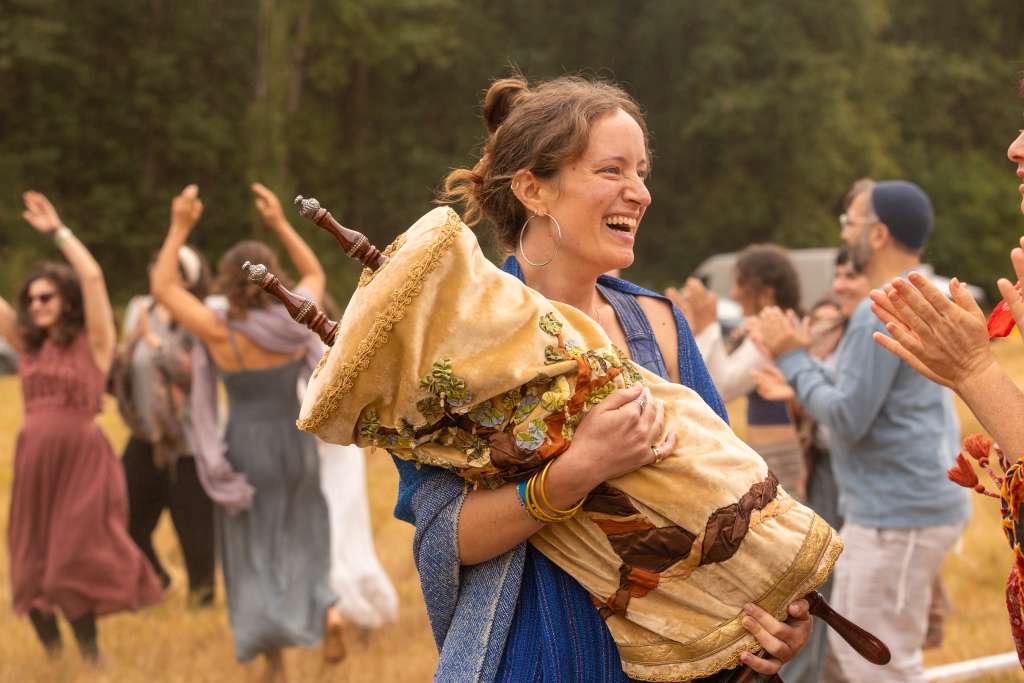
ElevatEd is a fully remote, national initiative. One of the most meaningful ways I’ve used the prize funding has been to root myself locally. This summer, I joined Trybal Gatherings’ Day Camp for local Jewish professionals, which helped me connect with my Boston network in new ways.
The Covenant Foundation: What are the best things that came out of the experience of being a part of this cohort?
SKH: The best thing that has come out of my relationship with the Covenant Foundation was the opportunity to travel to Berkeley, California, and spend three days with other Pomegranate Prize recipients at the Jewish Studio Project. I felt so cared for –being able to take this time to explore art, Judaism, and myself alongside other Jewish professionals. We were encouraged to disconnect and be present. We ate delicious food, laughed, went on walks in the sun, and I even experienced my first sound bath! I am so grateful that the Foundation gathered such a phenomenal group of people to create, learn, and grow together.
Now that I have attended multiple Covenant events, I feel more connected to the Covenant family, and I am grateful that I can continue building these relationships in the years to come.
Read more from Sasha:
Two Paths, One Program: Why ElevatEd’s Weekly Learning Just Got More Flexible | ElevatED