2021 Pomegranate Prize Recipient
Tiferet Berenbaum
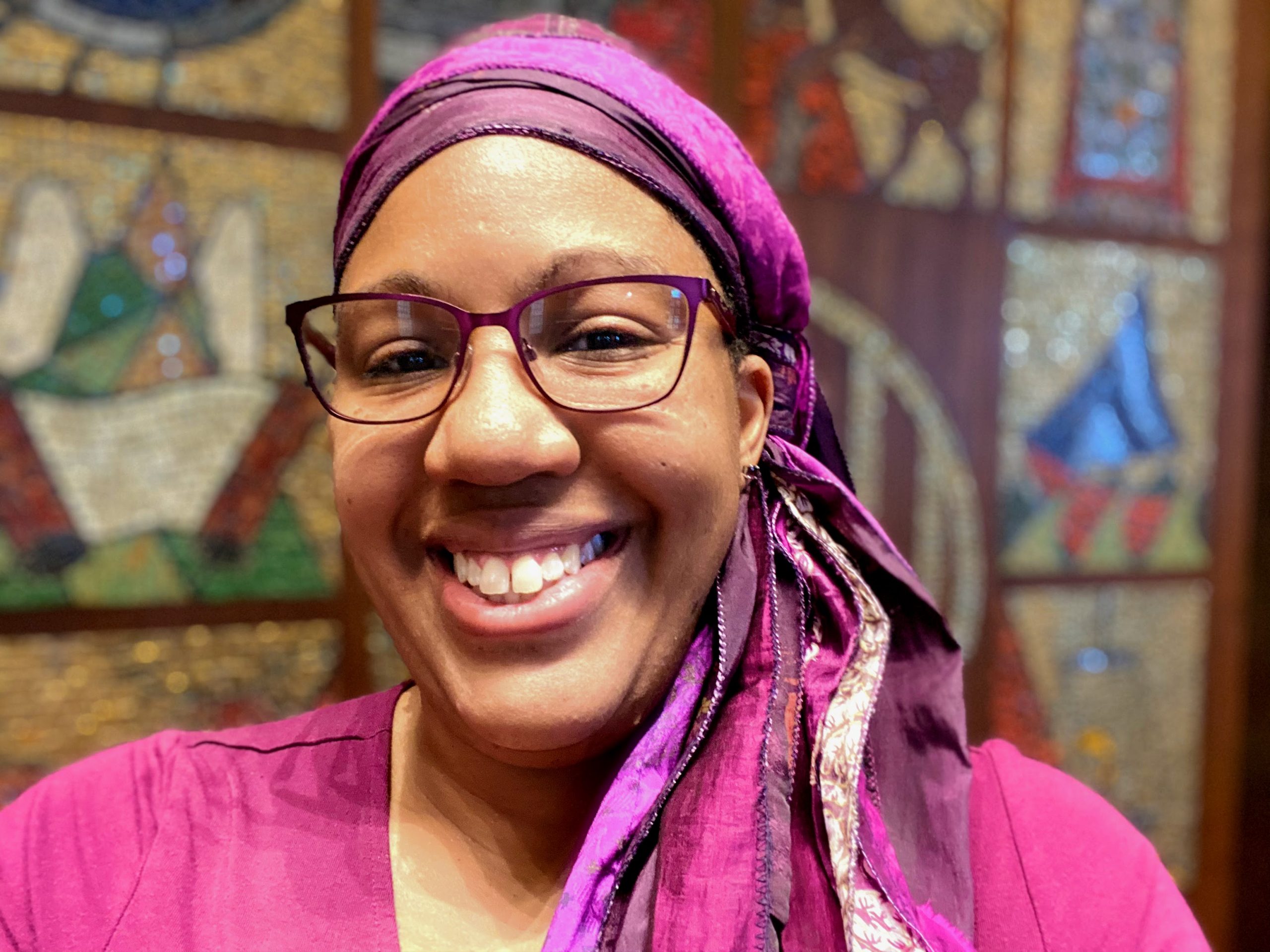
Rav Tiferet Berenbaum found the spark that would lead her to Judaism in the coat room of a classroom in a Catholic elementary school in Brookline, Massachusetts.
After many chapters in her life in Israel and across the United States, she is back in Brookline, flourishing as a Jewish educator. She serves as the Rabbi of Congregational Learning and Programming at Temple Beth Zion (TBZ), where she designs and leads programs for all ages.
Rav Tiferet is a person of deep passion for her work. Her conversation style is electric; each sentence overflows with enthusiasm.
“I just love doing Jewish education,” she says. “It’s not about me and what I know. That’s the least of it. It’s about having conversations, getting to know what others think, how they think. That deepens my own learning.”
She received her rabbinic ordination and an MA in Jewish Education from Hebrew College. About the learning there, she says, “I love Judaism so much. I loved the idea of doing Jewish study every day, all day, for a few years. It wasn’t without its challenges but I wish I could do it again. Life is like that: Now that I have a different perspective, having worked as a rabbi in the field, it would be fun to sit in the beit midrash and talk about Jewish texts again.”
Rav Tiferet says that she was always a spiritual person, “always seeking out a connection with a power greater than me.”
With candor, she speaks openly of converting to Judaism after growing up as a Southern Baptist. She begins with that moment in the coat room of her 6th grade classroom, when she found herself talking directly, actually praying, to God, in a personal and meaningful way, something she hadn’t done before.
“I spoke my own words to God and that was amazing. At church, the priest or pastor was leading and my job was to say Amen.”
“This taught me so many lessons. God is everywhere. God is infinitely accessible to me. I don’t need to wait. “
Then, at age 11, she began a plan of reading and study. After a Chabad rebbetzin in a supermarket handed her a pair of Shabbat candles, she began taking on the observance of Shabbat – she was drawn to the idea of having a break at the end of the week. Later on, in her second year at Tufts University, she began her adult learning about Judaism, finding a synagogue home and beginning the process of conversion. She learned with Rabbi Tamar Crystal who advised, that with her deep questions, she should go to rabbinical school, and that she should take her passion for Judaism into Jewish education. Looking back, she is very grateful for the advice.
For two years, Rav Tiferet taught Hebrew school at Kesher in Cambridge – that provided the foundation for her views of excellence in Jewish education. And after gaining some teaching experience, she began her rabbinic studies at Hebrew College. Upon ordination, she worked as a pulpit rabbi, leading congregations in Milwaukee, Wisconsin, and in Mt. Holly, New Jersey. In both settings, she had an educational role in addition to her rabbinic duties. The synagogue in Milwaukee didn’t have a religious school, so she started one.
“I loved having a pulpit,” she says, admitting to a “back pocket dream” of starting her own congregation, unless she finds one “willing to be shaped. I’m very excited about that, but not for a bit.”
How does she identify denominationally?
“I am just Jewish.”
In addition to her teaching, she also enjoys the pastoral aspects of serving as a rabbi.
“Every encounter I have is a pastoral encounter. When I’m leading services with young people, I have the opportunity to be creative. At our Shabbat minyan, called WonderMinyan, we have the opportunity to ask questions about everything.”
With her students at Beit Rabban, TBZ’s Afterschool Jewish Education Program, which she directs, she and her team of educators craft experiences that connect Jewish spirituality and social justice. She seeks to create environments where students can make discoveries for themselves.
“I’m not here to share an agenda,” she says. “Let’s talk. There’s no right or wrong. I’m seeking to break down binary thinking. We’re all here in a chain of tradition. That’s what I love about Talmud. It’s a conversation. My job is to open up the door to that conversation. It’s ours. That’s what Jewish education is all about – helping others find meaning in what is already theirs.”
She continues, “I need to be constantly learning. If I am authentic and curious with my own journey of learning, I can share that with my learners and my teachers.”
She used the funds from the Pomegranate Prize in two ways – to fulfill a lifelong dream to play guitar, and to pay part of her tuition toward a doctorate in educational leadership, which she is now pursuing at Lesley University. She is focused on examining the impact of the racialized Nazi caste system on Holocaust survivors and their descendants living in the U.S. today.
“As an educator, how do we use these lessons for the next generation. How do we preserve those legacies and mine them for how to respond to the present moment?”
As a Jew of color, she says she is always thinking about how racialization is different from ethnicity, about power dynamics and about “internal conflict between being racialized as white and identifying as Jewish.”
She’s interested in developing curricula, accessing her skills and interests. In addition to other things she says she’d love to do, she thinks about teaching at a college or university as an academic, “allowing me to be in conversation with learners.”
That said, she adds, “I’m very happy where I am.”
As for her guitar dreams, she is studying (virtually) with an internationally-recognized musician from Argentina, learning music theory as well as how to play the instrument. Initially, her hope was to play the guitar as an accompaniment to synagogue services but she is realizing that, “To be my most authentic self, I need to focus on connection – I can’t play and lead at the same time.” And there are several musicians who now play at TBZ services. But she keeps practicing and loves that.